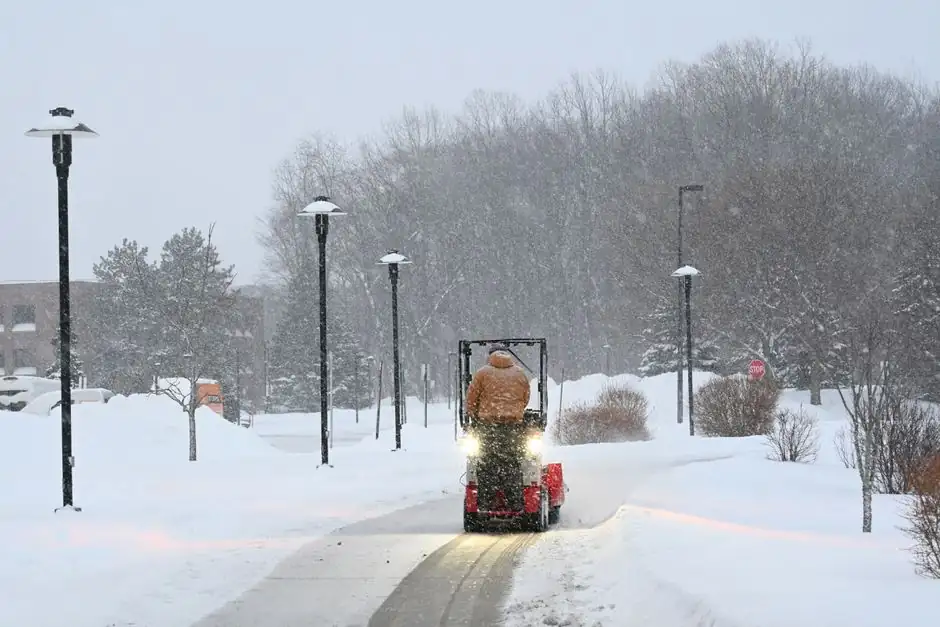
For winter operations, the dynamic compactor category overlaps ground-improvement crawler rigs (US$1,000,000–1,500,000 FOB) and 4–8 t hydraulic-impact rollers (US$120,000–350,000), with selection driven by mass × drop height × blows per minute and an ambient rating down to -40 °C [S5][S3].
Choosing the wrong class costs more than the list-price gap suggests: a crawler rig bought for what a mid-sized roller should cover ties up US$2 million plus a 60-day working-capital carry at 8% (roughly US$26,000) on every delayed month [S5]. Fleet managers specifying for airports, logistics yards, and city streets need a different selector than deep ground-improvement crews.
Snow-Removal Class vs. Ground-Improvement Class: Where the Lines Actually Sit
Snow-removal dynamic compactors are not the 5–40 t drop-weight crawler rigs used for mine backfill or waste densification. The winter-spec segment maps onto two narrower bands: a 1–3 t ride-on impact roller (100–200 kN centrifugal force) for taxiways, container terminals and main-line rail, and a 400–800 kg reversible plate or walk-behind roller (35–55 kN) for depot lanes, loading bays and pedestrian aprons [S5]. The heavy crawler class at US$1,000,000–1,500,000 FOB is engineered for soil densification, not for clearing snow, and its 10–30 m drop geometry is the wrong tool for surface work. For the broader mechanical-densification family, the dynamic compactor reference page lays out the same four-class split. Buyers reading the term for the first time should treat "dynamic compactor" as a process-engineering family name; the snow-removal application is a thin slice inside it. Where a yard needs both deep ground improvement and winter surface work, specifying two separate machines is cheaper than over-buying one hybrid.
Spec Levers That Decide a Snow-Compactor Buy
Three engineering quantities dominate the bill of materials and, by extension, the price: tamper mass, drop height or amplitude, and blows per minute. For walk-behind units the equivalent lever is eccentric weight and frequency, so a 500 kg reversible plate at 80 Hz is structurally a different casting and bearing package than a 200 kg unit at 100 Hz, and the BOM difference shows up as a 2–3× list-price gap [S5]. Hydraulic system pressure is the second cost driver: open-centre gear pumps at 16–21 MPa keep a US$3,000–6,000 plate compactor affordable, while load-sensing axial piston systems at 28–35 MPa, used on reversible plates and rollers for variable-frequency control, add roughly US$4,000–12,000 to the build [S5]. For Tier 4 final / Stage V diesel aftertreatment on rollers above 19 kW, expect a hard US$8,000–15,000 line item versus a Stage IIIA / Tier 3 package; that delta is one of the most visible gaps between Chinese OEM export rolls and EU-spec stock [S5]. The underlying physics of dynamic balancing machine design explains why eccentric-mass configurations scale with frequency squared, so a 10% rpm bump hits bearing life harder than the listed power does.
Cold-Weather Build Package: What the -40 °C Rating Actually Requires

A snow compactor that runs to -40 °C is not a stock machine with a sticker. The rated build typically includes arctic-grade hydraulic hoses, low-temperature seals (HNBR or FKM rather than NBR), block heaters on the diesel circuit, arctic lube in the final drives, and a battery and starting system sized for cold cranking. Transmission systems on professional-grade equipment focus specifically on low-temperature resistance and sealing performance to allow continuous operation in harsh cold environments, which both extends service life and reduces maintenance frequency [S2]. A rooftop-fleet specification shows what this means in practice: the heavy-duty Fleet Plow 440T is rated to -40 °C (-40 °F) operating temperature with 110V/20A single-phase power and 24" (60 cm) heavy wet snow depth throughput, against the medium-duty MD-12 which runs from a 12V deep-cycle battery delivering 89 cycles per charge at 0 °F (-18 °C) and clears only 12" (30 cm) of heavy wet snow [S3]. That delta is not a marketing claim, it is a metallurgical and electrical bill of materials. Buyers in continental interiors or high-altitude sites should treat the cold-start package as a separate line item; quoted list price often assumes Stage V stock hardware rather than the arctic-spec option.
Capacity Bands and Throughput: From 80 t/h Compact to 500 t/h MK6
Snow-specific compression units sit in a defined capacity band: the Compact Snowcuber (CSC) runs 80–200 t/h with a 900 mm impeller and 105 kW (143 hp) power requirement (PTO 90 kW), weighing 1,990 kg at full options and clearing up to 600 mm snow height [S1]. The MK6, sized for airports and heavy-duty operations, runs 350–500 t/h with a 1,300 mm impeller, 192 kW (260 hp) power requirement, 3,800 kg weight, and 1,300 mm max snow height [S1]. Both machines share the same patented compression logic, reducing snow volume by up to 50%, which directly cuts dump-truck movements and the CO₂ load that goes with them [S1]. Comparing across winter-spec equipment, the critical decision variables are throughput in t/h, max snow height, power requirement in kW, and total mass. The CSC and MK6 are the high-throughput end; skid-steer snow pushers and pusher boxes sit at the low-throughput, low-investment end and are sized by GPM hydraulic flow rather than by tonnage. Buyers should not confuse these families: a flow meter at 18–25 GPM on a skid steer is the right sizing metric for a snow pusher, not a t/h rating.
Selection Decision Tree: 4 Criteria, 3 Snow-Compactor Tiers

The cleanest way to pick is to score three options against four criteria. Tier 1: skid-steer snow pusher box (US$5,000–15,000 attachment, fits 18–25 GPM machines, very few moving parts, no hydraulic or electrical failure modes, can travel at the host machine's full ground speed) [S4]. Tier 2: 400–800 kg reversible plate or walk-behind roller (US$15,000–50,000, 35–55 kN centrifugal force, best fit for depot lanes and small airport aprons) [S5]. Tier 3: 1–3 t ride-on impact roller (US$80,000–220,000 Chinese OEM, US$140,000–350,000 tier-1 imports, 100–200 kN centrifugal force, fits taxiways and container terminals) [S5]. Against the four criteria, the pusher wins on capital cost and simplicity, the reversible plate wins on manoeuvrability and rental-fleet availability, the ride-on roller wins on throughput per operator-hour and on the depth of compacted-snow layer it can fracture, and only the compression unit (CSC / MK6) reduces haulage volume, which is a logistics question rather than a compaction question [S1][S4][S5]. For procurement teams also responsible for adjacent winter assets, the industrial valve reference is worth bookmarking, since hydraulic block selection on cold-rated machines determines whether a -40 °C spec is real or paper.
Standards and Compliance Anchors
The standards landscape for snow compactor procurement is thinner than for soil-density equipment, because winter-spec rollers rarely carry a formal ground-improvement certification. Buyers should still demand: engine emissions compliance to EPA Tier 4 final / EU Stage V for diesel units above 19 kW (a US$8,000–15,000 hard line item, not an option) [S5]; a documented ambient rating to at least -30 °C for temperate-zone fleets and -40 °C for continental or high-altitude sites, supported by specific component call-outs (HNBR/FKM seals, arctic hose, block heater, arctic lube, cold-cranking battery sizing) [S2][S3]; and for rooftop-fleet machines, a portable / fixed-base decision recorded with yard footprint and power-source data: the 440T needs 350 sq ft (32.4 sq m) of yard space plus on-site 110–120V/20A single phase, while the MD-12 needs 183 sq ft (16.7 sq m) and runs off an included 12V deep-cycle battery [S3]. Where a machine is specified for European chemical-plant or refinery zones, ATEX category 2 + Ethernet-APL dual-certified controls are increasingly the default on new builds, and the same logic is now filtering into mobile winter-service equipment via pressure transmitter and pressure sensor selections on arctic hydraulic circuits.
Lead Time, Working-Capital Carry, and Sourcing Window
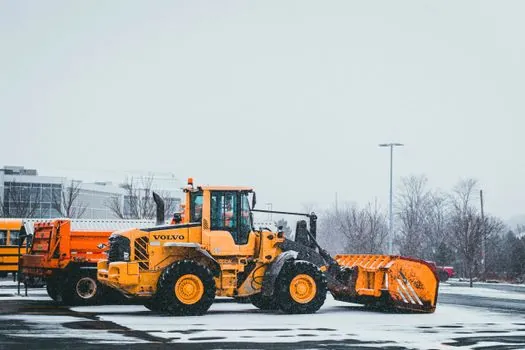
Configured roller lead time sits at 30–60 days depending on engine emission spec, drum width, and telematics package; a custom heavy crawler with a non-standard drop weight extends to 90–150 days including factory acceptance test [S5]. On a US$2 million crawler rig at 8% working-capital cost, a 60-day delay carries roughly US$26,000, which is the same order of magnitude as a full option package, so the lead-time line should be priced in at the RFQ stage rather than discovered at delivery [S5]. Tier-1 European brands (BOMAG, Ammann, Wacker Neuson) and Japanese majors (Sakai) carry a 30–80% premium over equivalent-mass Chinese OEM machines, reflecting dealer network, residual value, and the cost of Tier 4 / Stage V compliance documentation; within China, the premium brand split is XCMG, Liugong, Sany and Shantui at the top, Jida in the volume mid-band, and small forging-shop assemblers at the low end [S5]. The next trackable signals to watch are: (a) whether the Snowcuber MK6's 350–500 t/h throughput gets independently verified outside Interalpin 2025 demonstrations, and (b) whether EPA Tier 4 final / EU Stage V pricing stabilises after the 2026 mid-year emission-certificate reissue cycle.
This topic is covered further in Fire Extinguisher Selection for Oil and Gas Facilities.