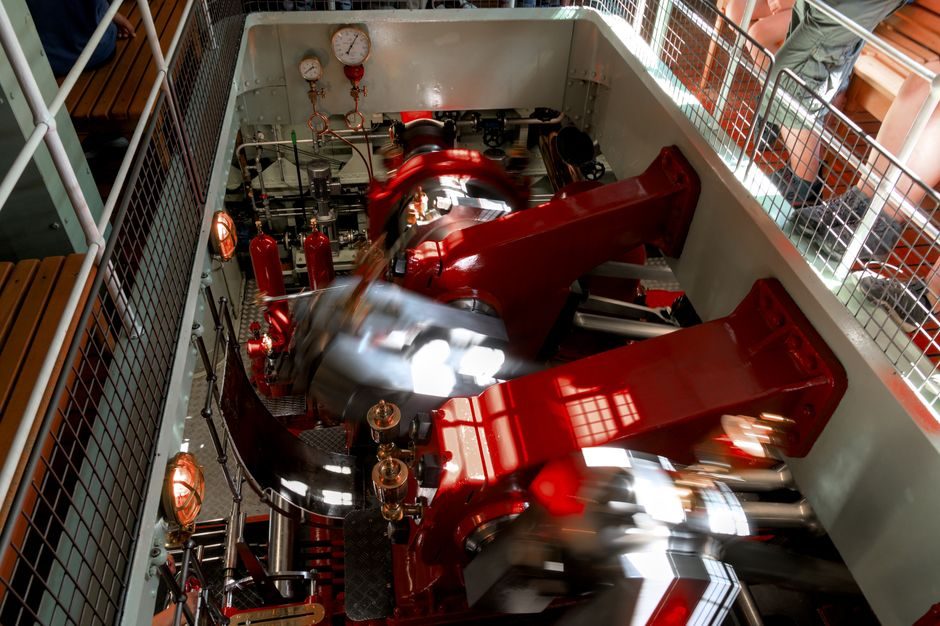
A shield machine and a dynamic compactor rarely compete for the same scope: one bores a lined tunnel below the water table, the other pounds the surface to push a granular layer past refusal.
Both sit in the 5–150 t equipment class, both run heavy hydraulics, and both are common on transport-infrastructure sites. Once the engineer locks in depth of work, ground stiffness, and required output (a bored tunnel versus a 20–40 t equivalent improved-bearing footprint per drop), the choice falls out of the spec rather than brand.
What a shield machine actually does on a job
A shield machine (also called a tunnel boring machine, TBM, in the soft-ground EPB or slurry variant) advances by thrusting hydraulic jacks off previously installed segmental lining while a rotating cutterhead excavates the face. Cutterhead design varies with ground: in mixed-face urban soft ground, a spoke-style head with scrapers and disc cutters is common, and the cutterhead diameter typically spans 6–15 m for metro projects [S1].
Steering is the heart of the machine. The vertical-plane attitude is corrected by differential thrust on paired shoe groups at the rear of the shield, monitored against a laser or gyro theodolite target; rectification techniques target deviation of ±30 mm at the tail skin for typical 6 m diameter shields [S1]. Disc cutter wear in rocky sections drives cutterhead intervention cycles — cutter disassembly mechanisms in modern shields let crews change a 17–19 in disc ring without breaking the working face pressure [S2].
What a dynamic compactor actually does on a job
A dynamic compactor drops a heavy tamper weight (commonly 10–25 t, with 30–40 t units available for port and airfield work) from a controlled height of 10–25 m onto a defined grid, generating a stress pulse that collapses voids and rearranges granular grains into a denser packing. Manufacturer listings from Chinese suppliers such as Anhui Hefei plants catalogue tampers in this weight band alongside the gasoline-driven reversible plate models used for trench backfill [S3].
Improvement depth is roughly proportional to tamper weight: a 15 t weight at 20 m drop typically improves granular soils to 8–12 m depth, with 3–6 passes at 5–8 m grid spacing. The 6 m diameter impact craters left on the working surface are normally back-bladed and re-compacted between passes.
Side-by-side: decision criteria on one page
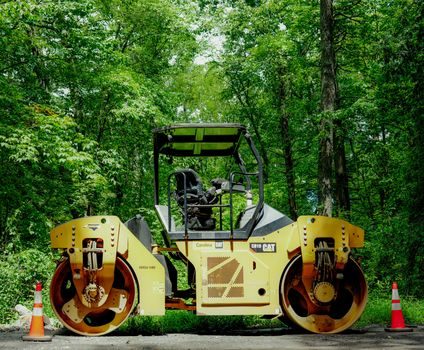
For procurement and method-statement engineers, the practical split comes down to four gates: [S1]
1. Direction of work. A shield machine removes material forward through a screw conveyor or slurry line; a dynamic compactor displaces material downward with no spoil. If the project produces muck, the shield is in scope. If it produces a stable platform, the compactor is in scope.
2. Depth of effect. Dynamic compaction reaches 8–12 m with 15 t / 20 m drops, deeper with heavier weights and greater drop heights; improvement falls off with depth, so a 25–40 m thick loose fill usually needs either pre-driven stone columns or vibro compaction in tandem. Shield excavation is depth-agnostic in the sense that the cutterhead can grind through 50 m of cover, limited by face pressure and segment handling rather than compaction physics.
3. Ground type. Shields handle soft alluvium, clay, mixed face, and rock up to ~120 MPa UCS with the right disc cutters. Dynamic compaction only works in free-draining granular soils (sands, gravels, demolition fills) — high fines content or a high water table makes the impact pressure dissipate without grain rearrangement, and the technique fails.
4. Output unit. Shields quote advance rate in mm/min or rings/day (a typical EPB on a 6 m metro bore targets 8–12 rings/day, each 1.5 m wide). Compactors quote area treated per shift, with one pass covering roughly 250–400 m² on an 8 m grid with a 15 t tamper.
Where the two machines meet on the same site
On a metro or high-speed-rail alignment, both often run in sequence: a shield bores the running tunnel while dynamic compactors densify the portal area, the approach embankment, and any temporary access pads that have been built up from granular fill. Specifying both machines in the same bid package is normal; specifying one to do the other's job is the failure mode that method statements have to police. [S2]
Cutterhead intervention discipline on a shield (cutter disassembly via dedicated retractable fixtures [S2]) is analogous to tamper-weight inspection on a compactor — both are the operations-and-maintenance items that decide whether the rate of advance is steady or stalled.
Standards, monitoring, and what to require in a spec
For shield drives, the engineer typically references a thrust-and-bedding-pressure envelope, a face-pressure limit tied to ground cover, and a segment-lining standard (commonly referenced against European or Japanese metro segment specifications). For dynamic compaction, the spec usually names grid spacing, tamper weight, drop height, number of passes, and an acceptance criterion (SPT N-value or CPT cone resistance) at a defined depth. Chinese ground-improvement practice has been documented in this area for at least a decade, with case-history compilations tracking tamper energy in the 1,500–6,000 kJ per drop band for 15–40 t weights [S4].
For comparable works to those discussed on Belt vs Overhead Conveyor: Picking the Right Transport Geometry in 2026, the pitfall is to assume any "heavy machine" is interchangeable; a more useful parallel comes from the spec-driven framing in Stainless Steel vs Copper: Selection Criteria, Conductivity Gap, and 2026 Spec Frame, where each material is matched to a measurable requirement rather than brand preference.
Common misuses and limits
Three failure modes recur in tender documents: a compactor is specified for a silty or cohesive fill (the energy dissipates as pore pressure and the surface heaves rather than settles, with re-drilling often required); a shield is specified for a 30 m open cut where a roadheader or excavator-and-blast plan would do the job for 5–10 % of the plant cost; and both are asked to work in the same corridor without the surface treatment and the bore being sequenced — leading to a tamper pulse disturbing fresh grout behind the tail skin. [S3]
For procurement teams building a 2026 equipment shortlist, the rule of thumb is: spec the shield when the deliverable is a finished tunnel with a specified internal diameter, segment-ring count, and water-tightness test; spec the dynamic compactor when the deliverable is a measured bearing capacity or settlement tolerance at a defined depth on a granular layer.
Watch on the next tender cycle: whether metro and high-speed-rail packages in Asia continue to combine shield bores with dynamic-compaction treatment at portals, and whether new tamper-weight classes (toward 40 t at 30 m drop, with corresponding increase in improved depth to 15+ m) shift the ground-improvement envelope that currently keeps dynamic compaction out of deep loose-fills.
For component-level specifications, see dynamic balancing machine.