Industrial shielded-cable pricing on 2026-07-09 clusters at US$0.30–US$0.80 per metre for commodity 1.5 mm² PVC-jacketed shielded AC instrument cable at 300 m MOQ, with TUV/CE-class production lots running a documented US$0.45/m at 300 m and a transport package of seaworthy wooden drum [S2].
Higher-tier constructions — composite aerospace cable with AS9100 2026-2029 quality certification, and multi-pair Foil + tinned-copper braid (F/TCWB) instrumentation — list between US$8/m and US$40/m depending on conductor count, dielectric, and braid coverage [S1]. The single largest cost lever is the shield construction itself: braid coverage, foil overlap, and drain-wire gauge each add material and process steps that scale roughly with conductor count.
What the 2026 price bands look like by spec tier
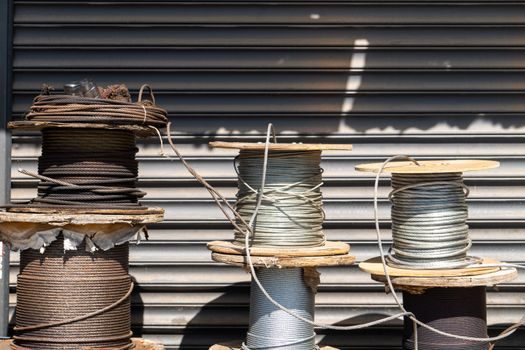
Commodity 1.5 mm² shielded AC cable sits at US$0.45/m at 300 m MOQ, with a published 10 000 m/day production capacity and standard seaworthy wooden-drum packaging [S2]. That floor corresponds to CE/TUV-class PVC-insulated, single-pair or 2-core constructions with aluminium/PET foil and a stranded tinned-copper drain wire — the default Chinese-export spec for instrumentation panels and meter leads.
Mid-tier multi-core control cable with steel-wire armour (SWA) and overall foil+braid lands between US$1.50/m and US$4.50/m at 1 km reels, and Foil + Braid instrumentation (the typical [PICU-style or 300 V analogue signal] construction referenced in our shielded cable overview) trades at US$2.20/m–US$6.50/m for 2- to 12-pair builds. Aerospace composite cable, built to AS9100 2026-2029 with controlled electricals, documents at US$8/m–US$40/m depending on conductor count, dielectric, and shield-coverage target [S1].
Spec levers that actually move the price
Moving from 1.5 mm² stranded bare copper to 2.5 mm² adds 35–55% to conductor cost; a 24 AWG aerospace build with silver-plated copper is roughly 2.5–3× the same cable in tinned copper [S1].
Shield construction is the dominant lever. Spiral serve (SPC) is the cheapest, typically +5–8% over an unshielded cable; aluminium/PET foil with drain wire adds 12–18%; a single tinned-copper braid (TCWB) at 60–70% coverage adds 25–40%; a double braid (TCWB/TCWB) at 85–90% coverage adds 60–90%; and a foil + braid (F/TCWB) combo used on instrumentation and signal cables lands in the +45–70% band [S1]. Braid-coverage percentage is non-linear above 80% — coverage from 85% to 95% can double braid copper weight on small-pair-count cable.
Jacket compound scales with temperature and chemical resistance: PVC is the floor; PE adds 8–15%; TPE/PU adds 20–35%; FEP and PTFE jackets used in aerospace and oil-and-gas add 80–160% over PVC at the same conductor count [S1]. Steel-wire armour (SWA) on a multi-core control cable build adds roughly US$0.60/m–US$1.20/m at 1.5–2.5 mm² and roughly doubles that on 4 mm² and above because of the heavier armour wire and larger bend radius.
Where the floors sit — China cluster vs US/EU stock

On 2026-07-09, the China cluster (Shenzhen, Dongguan, Liyang, Tianjin) remains the floor for commodity 1.5 mm² shielded AC cable at US$0.45/m at 300 m MOQ, FOB Jiangmen/Shenzhen [S2]. Comparable tinned-copper, foil+drain, PVC-jacketed 2-core cable from a Jiangsu or Hebei mill typically lands in a US$0.38–US$0.65/m band on the same reel size, with the gap explained by copper sourcing and braid-coverage percentage rather than labour.
US/EU stocking distributors (Allied, Anixter/Wesco, TPC, Lapp, Helukabel) typically print 1.8–2.6× the China FOB price for the same commodity spec, once duty, freight, palletisation, and distributor margin are added. For drag-chain flexing grades the delta widens to 2.5–3.2× — see our parallel drag-chain cable price & cost guide for the flex-rated side of this market. Aerospace composite cable in the US$8/m–US$40/m band is much less price-elastic; AS9100 2026-2029 line certification and PIC-style datasheet discipline keep the floor near US$8/m even on long runs [S1].
Who shielded cable is for — and who should not pay for it
Shielded cable is the right call where the installation runs parallel to VFD outputs, switch-mode power supplies, welding leads, or any conductor carrying >1 A of switched current; where the cable sits inside a metallic cable tray acting as a parallel path; where the signal is analogue mV, RTD, thermocouple, or low-level digital (RS-485, CAN, Foundation Fieldbus); or where the spec book or end-client mandates it for EMC compliance [S1].
Shielded cable is the wrong call on short (<2 m) point-to-point links between already-filtered devices, on DC power runs under 24 V with <2 A, and on any installation where the shield will be left floating at both ends — that practice is one of the most common failure modes in field retrofits, and the cable will perform no better than an unshielded one while costing 30–90% more [S1]. For a side-by-side decision on shielded vs unshielded in 2026, the shielded cable vs control cable sourcing breakdown is the more targeted reference.
Failure modes, limits and what burns budgets in the field
Three failure modes dominate field returns on shielded cable. First, shield termination: a shield that is not bonded at one end (or is bonded at both ends on a long parallel run) creates a common-mode antenna that injects noise rather than rejecting it. Second, jacket damage on flexing service: standard PVC-jacketed shielded cable is rated for a static bend radius roughly 4× OD; below that the foil creases and braid fatigues, opening the drain path [S1]. Third, moisture ingress on PET foil: standard aluminium/PET foil will wick along the cable once the jacket is cut for termination, and the foil-to-drain bond can lift over 18–36 months in wet environments. For outdoor or tray-exposed runs, longitudinal PET-foil with bonded aluminium (B- foil) or a flooded braid is the spec move.
Electrical noise is the engineering reason the cable exists in the first place — any conductor that carries switching transients radiates, and any adjacent low-level conductor that is not shielded will pick it up [S1]. For a deeper look at how shielded cable lands in the broader cable termination hardware stack and at gland-to-shield bonding, the encyclopedia entry on cable glands covers the EMC bonding half that the cable datasheet will not.
Sourcing rules, standards and what to put on the PO
The minimum datasheet line items for a defensible PO are: conductor metal and stranding (bare Cu / tinned Cu / silver-plated Cu), shield construction in shorthand (F/TCWB, TCWB 85%, SWA + overall F/TCWB, etc.), braid coverage percentage with tolerance, drain-wire gauge, jacket compound with temperature rating, voltage rating, and minimum bend radius static/dynamic. A PO that omits braid-coverage percentage almost always lands at 60–70% coverage on a Chinese commodity run and 85–90% on a US/EU stock — that single line item is worth 15–30% of unit price on a 12-pair build. [S1]
Standards to pin on the datasheet for industrial builds: IEC 60228 for conductor stranding, IEC 60332-1 for flame retardancy on single cable, IEC 60332-3 for bunched, and for EMC the harmonised EN 50575 / CPR Euroclass framework governs CE-marked construction products including cable. Aerospace builds reference AS9100 2026-2029 quality system and the relevant OEM datasheet [S1].
Next signal to watch: Q3 2026 copper cathode spot on the LME and SHFE, which on 2026-07-09 is the single largest variable in any 1.5 mm²–2.5 mm² shielded-cable quote. A 10% move in LME copper moves a 1.5 mm² commodity shielded AC cable roughly US$0.07–US$0.10/m at the 300 m MOQ floor [S2], and roughly 2–3× that on a 24-pair F/TCWB instrumentation build. The second signal is braid-copper premium over bare copper rod — when that premium widens past 12–15%, expect foil+single-braid prices to lag foil+double-braid by more than the historical 30–40% gap.