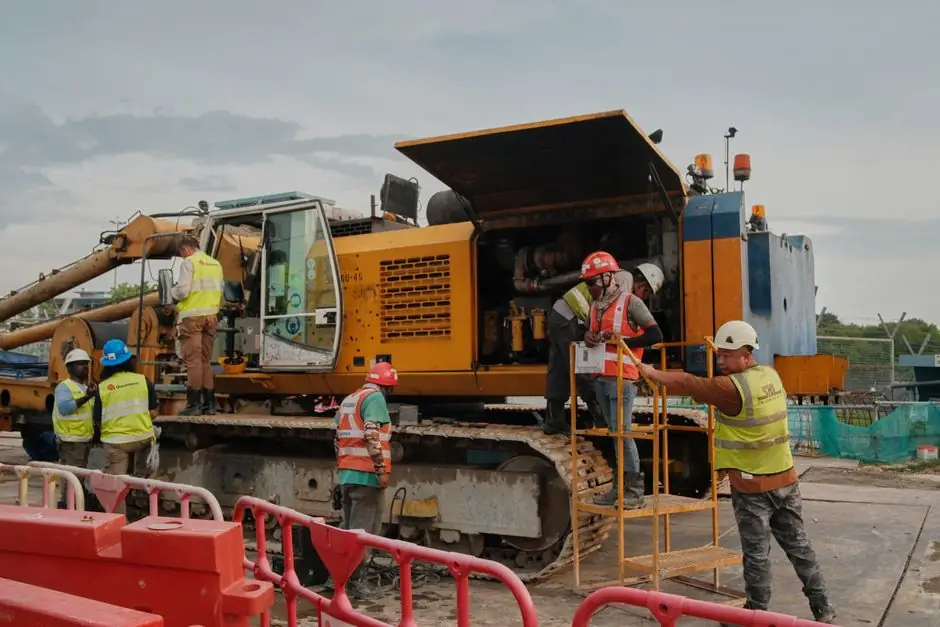
Bridge construction shotcrete work in 2026 runs on wet-mix hydraulic pumps in the 20–40 m³/h class, with 40 m³/h units such as the Grandever DHBT40-11-82 (82 kW, 32 MPa system pressure, 100 m vertical / 400 m horizontal conveying) being the most specified for new deck soffit, pier-cap, and abutment pours [S2][S3].
Selection is driven by three bridge-specific constraints: vertical reach to pier caps and arch intrados (typically 15–16 m on 40 m³/h chassis), maximum aggregate size compatibility with reinforcement spacing (≤15–25 mm), and the ability to hold a low-rebound wet-mix line on overhead work. Output class, chassis type, and pumping pressure dominate the decision tree more than brand.
Output Class and Pump Pressure for Bridge Concrete Delivery
Bridge abutments and large pier shafts need 20–30 m³/h wet-mix output to keep formwork-free cycles on schedule, matching the "Wet-Mix Shotcrete Machine (Large)" band of 20–30 m³/h at 0.4–0.6 MPa air pressure and 15–22 kW power consumption per published equipment tables [S6]. For deck soffits and arch intrados where the boom must reach 15–16 m above the chassis, 40 m³/h truck-mounted rigs with 11 MPa concrete pumping pressure (DHBT40-11-82 platform) are the working baseline, and the same platform is sold explicitly as suitable for "tunnels, bridges, roads, and high-rise building projects" [S3]. Robotic shotcrete arms occupy a separate niche of 15–25 m³/h output and are used on complex pier-cap geometry where a fixed boom cannot reach [S6].
Pumping system pressure is the second discriminator: the Grandever wet-mix pump runs 32 MPa hydraulic system pressure with 140 ml/r pump displacement, giving 11 MPa at the concrete cylinder and a transport package footprint of 550 × 190 × 200 cm at 5,000 kg [S2][S3]. For smaller abutment repair or parapet re-profiling, compact wet-mix units such as the Tytion TYSP-90C deliver 3–9 m³/h at 20 MPa working pressure, 100 m horizontal and 30–40 m vertical conveying, with ≤15 mm aggregate, which fits hand-position nozzle work on tight bridge approaches [S8]. A useful side-by-side view of road-maintenance selection logic, which overlaps with bridge deck patching, sits in the shotcrete selection for road maintenance guide.
Reach, Chassis, and Aggregate Size Constraints
Vertical reach governs pier-cap and arch work: published 40 m³/h wet-mix rigs give 15–16 m spraying height and 24–26 m spraying width, on a 17–20.5 ton four-wheel-drive engineering chassis with 20°–29% gradient climbing ability, sized for site delivery rather than highway speed [S5]. For most bridge sites, that means a separate low-loader move between abutments rather than a long-distance drive.
Aggregate size is the silent killer of wet-mix bridge work. 40 m³/h units handle 15–25 mm aggregate, with 25 mm treated as the practical upper limit, and the chassis envelope needs roughly 4 m of clear tunnel/underpass height to pass under existing structures [S5]. Dry-mix machines, by contrast, are limited to 10–15 mm aggregate at 2–5 m³/h and 0.5–0.7 MPa air pressure, so they only compete on small-volume overhead patches and on sites with no reliable water supply [S6]. For an overview of how these machines sit inside the broader construction machinery and equipment category, the encyclopedia page covers chassis classes, prime movers, and CE/ISO9001 conformance patterns. Pneumatic projection equipment, including rotor-diameter and hose-inner-size choices, is catalogued under the shotcrete machine reference, and dry-mix rotor plates (350–480 mm diameter, 0.3–0.6 MPa air, 3–15 m³/min air consumption depending on hose size) sit at the small-output end of that family [S4][S7].
Wet-Mix vs Dry-Mix: Bridge Decision Criteria

The wet-mix versus dry-mix call on a bridge project reduces to four numbers: dust, rebound, water control, and output. Wet-mix cuts dust because water is mixed before pumping, holds rebound to ≤10% on a tuned 40 m³/h rig, and gives consistent water-cement ratio across the layer, which matters for durability class exposure on deck soffits [S5]. Dry-mix stays useful where site water is unreliable, where hose runs exceed what a wet-mix pump can push, or where the contractor already owns a rotor-dry setup (0.4–0.6 MPa, 7–8 m³/min air for a 51 mm hose, 12–15 m³/min for a 64 mm hose) and only needs 2–5 m³/h output for patch work [S4][S6].
For bridge abutment, pier-cap, and arch-intrados work, the call lands almost universally on wet-mix, because rebound on overhead surfaces is the productivity killer, and wet-mix keeps it under 10% against the 15–25% typical of dry-mix on vertical/overhead surfaces [S5]. Robotic arms (15–25 m³/h, 0.5–0.7 MPa air, 20 mm max aggregate) are a third lane for complex geometry where a human nozzle operator cannot hold consistent stand-off distance [S6]. A useful contrast comes from the landscaping spec map, where smaller 5–15 m³/h wet-mix units dominate and the 40 m³/h chassis is overkill, as covered in the shotcrete machine selection for landscaping reference.
Power, Hydraulics, and On-Site Integration
Rated power is the primary electrical hookup constraint: 40 m³/h wet-mix rigs are 82 kW machines, with wireless remote control as standard so the nozzle operator can stand clear of rebound and keep stand-off distance consistent on overhead work [S2][S3]. Most current 40 m³/h chassis pair an electric main drive with a diesel emergency drive, which lets a bridge site keep spraying through a generator switchover and supports sites without three-phase grid [S5].
Air supply is the second integration item: a 40 m³/h wet-mix rig typically wants an onboard or towed compressor at 15–20 m³/min, because site air is rarely sized for a wet-mix surge, and the wet-mix process still needs atomising air at the nozzle even though the bulk mixing is done upstream [S5]. For robotic arms the air figure is the same 0.5–0.7 MPa but volume is lower because the boom is smaller; for compact wet-mix units at 3–9 m³/h the air requirement drops enough that a small site compressor suffices [S6][S8]. Concrete-mix design is not optional: aggregates must be held to ≤25 mm and the mix designed for pumping, otherwise pulsation and blockages eat the productivity gain the rig was bought to deliver [S5]. A broader process view of construction tools used alongside the rig (nozzles, vibrators, screed boards, curing sprayers) is in the related encyclopedia entry.
When Shotcrete Is the Wrong Tool on a Bridge
Shotcrete is not the right call where formwork is cheap and accessible, where the pour volume is below roughly 2 m³/h sustained (a small concrete pump and formwork is faster), or where the reinforcement spacing is tighter than 3× the maximum aggregate size, since the wet-mix cannot physically pass the rebar mat [S1][S5]. Dry-mix is the wrong tool where workers are in an enclosed box girder without forced ventilation, because dust loading on a 0.4–0.6 MPa dry-mix pass reaches levels that standard PPE does not filter [S1][S6].
For a bridge deck where the contractor needs a flat, trowelled finish to a tight tolerance, shotcrete also loses to a conventional boom-placed, vibrated pour with formwork, because shotcrete's surface tolerance is governed by nozzle operator skill and rebound, not by formwork rigidity [S1]. The published guidance is explicit: shotcrete performance depends on mix design, spraying method, equipment quality, and curing, and a skilled nozzle operator is non-negotiable on vertical and overhead work [S1]. Robotic arms reduce that labour risk but introduce a 15–25 m³/h output cap that does not match a 40 m³/h abutment cycle [S6].
Standards, Certification, and Sourcing Signals
Current production wet-mix shotcrete rigs for bridge work are typically built to ISO9001:2000 quality systems and carry CE marking for the European market, as stated on the Grandever DHBT40-11-82 platform documentation [S2][S3]. Bridge-specific concrete performance (durability, chloride resistance, freeze-thaw) is not controlled by the shotcrete machine itself but by the mix design and the sprayed concrete standard referenced in the project specification; the machine vendor's role is to deliver the rated output and pumping pressure consistently, which is what the 1-year warranty and 100% pre-delivery inspection cover [S2][S3].
Factory-direct sourcing signals to watch on a 2026 bridge order: ISO9001:2000 and CE certificates on the nameplate, 1-year warranty, ≤15-day lead time for in-stock models, monthly factory capacity around 150 complete sets, and an FOB/CIF/CFR/EXW Incoterms option out of Qingdao for OEM/ODM branded units [S2][S3]. Trackable next nodes: confirmed aggregate size on the project mix (≤15 mm for compact units, ≤25 mm for 40 m³/h chassis), compressor sizing on site (15–20 m³/min for a 40 m³/h rig), and tunnel/underpass clearance (≥4 m) for chassis transit between abutments [S5].