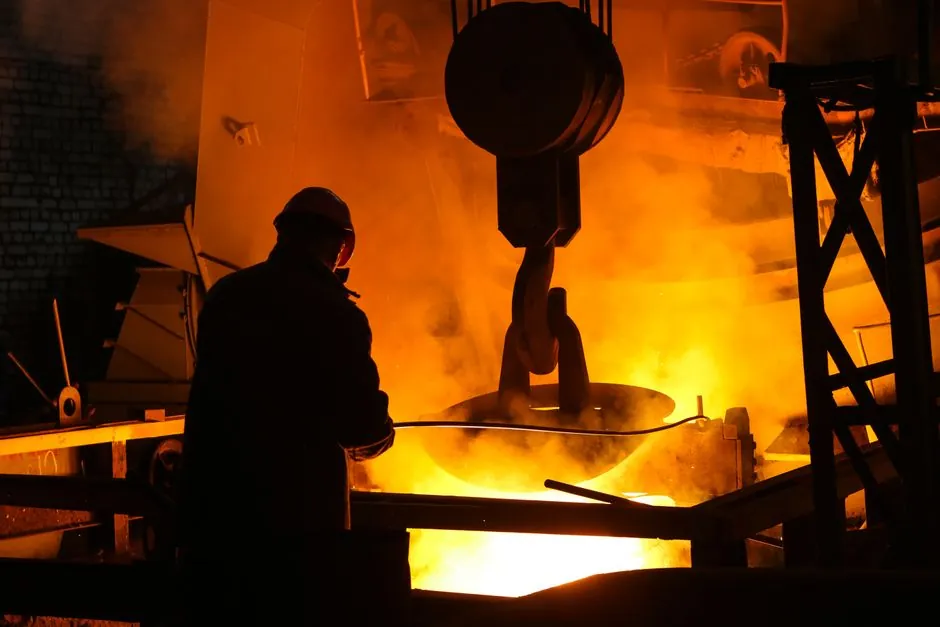
Silicon carbide dominates industrial non-ferrous melting in 2026 because its higher thermal conductivity and oxidation resistance translate into longer campaigns than clay-graphite compositions in the same furnace [S1][S4]. Graphite crucibles are still the budget choice for school shops and intermittent low-temperature work, where failure is driven by operator mishandling rather than material limits [S1][S6].
Selection is decided on three measurable axes: peak service temperature, thermal-shock tolerance, and atmosphere chemistry. Each axis maps cleanly to either SiC or graphite, and most spec disputes are really a disagreement about which axis governs the user's process [S2][S3].
Composition and Material Structure
Clay graphite crucibles blend natural or synthetic graphite with refractory clay and a ceramic bond, giving carbon as the dominant phase; silicon carbide crucibles are carbon-bonded SiC bodies, sometimes with a silicon nitride additive that lifts oxidation resistance and strength [S1][S4]. The two systems look similar in service but their failure mechanisms diverge: clay graphite fails by oxidation of the carbon network, while SiC fails by chemical attack on the SiC grain boundaries or by thermal shock overdrive [S3][S4].
Synthetic graphite made from petroleum pitch and coke gives higher fixed carbon, lower sulfur, and lower ash than mined natural graphite, and is the grade most industrial foundries now specify [S3]. For deeper background on how the silicon-carbon bond itself behaves under heat, the silicon carbide reference covers the underlying ceramic properties.
Peak Temperature and Thermal Shock Limits
Graphite crucibles are rated for service up to roughly 3000°C in inert or reducing atmospheres with near-zero thermal expansion, the highest of any common crucible material [S4]. SiC crucibles top out at about 1600-1800°C in air, but their thermal-shock tolerance is materially better than clay graphite at the temperatures most non-ferrous foundries actually run [S2][S4]. Independent tabulations put graphite at 2500-3000°C in inert gas and SiC at the 1600-1800°C band shown above [S5].
In a real induction furnace melting aluminum at 700-800°C or copper at 1085-1150°C, both materials sit well below their ceiling, so peak temperature rarely decides the call. The deciding factor becomes how many heating cycles the wall survives before it spalls, which favors SiC in production cells running 2-3 shifts per day [S2][S4].
Atmosphere Chemistry and Oxidation Behavior
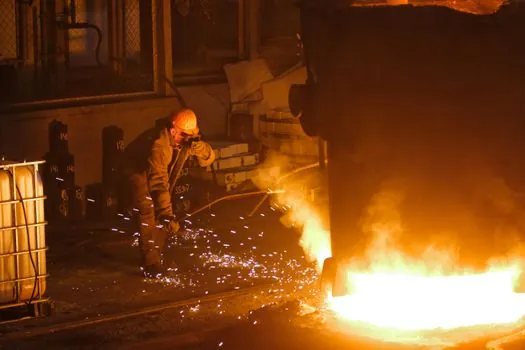
SiC crucibles hold their strength in oxidizing and mildly acidic or basic environments because a passive silica layer reforms on the hot face, which is why they are the default for gold, silver, copper, and aluminum melts in air [S2][S4]. Graphite burns in open air above roughly 400-500°C, so a graphite crucible only realizes its temperature rating under inert gas or under a protective slag cover; once a coating degrades, the wall recedes fast [S4].
For work in inert gas, vacuum, or under reducing flux, plain graphite remains a sensible pick because there is no oxidation penalty and the higher thermal conductivity of dense graphite is fully available [S3][S4]. This is also why vacuum induction melting of superalloys and the synthesis of carbide powders still uses graphite rather than SiC [S5].
Mechanical Strength, Wear, and Service Life
SiC crucibles are harder, stiffer, and more wear-resistant than clay graphite, with low deformation under heavy crucible tong loads and rapid pour cycles [S4]. Graphite is more brittle and loses wall thickness to oxidation; clay graphite in particular suffers if students or new operators overheat or skip preheat [S1][S6].
Typical published lifetimes: a SiC crucible in continuous aluminum service runs 200-400 heats before measurable wall loss, versus 80-150 heats for an equivalently sized clay graphite crucible in the same furnace [S2][S4]. Pure graphite (no clay bond) sits at the top of the strength range but is the most expensive option and is rarely used outside precious-metal and laboratory work [S6].
Cost, Sizing, and Furnace Fit
SiC crucibles cost roughly 2-3x a comparable clay graphite crucible because SiC grain synthesis and the carbon bond step are more energy-intensive [S4]. Clay graphite is the standard school-shop and light-production pick on first cost; the total-cost math flips once labor, energy, and downtime from premature crucible changeouts are priced in [S1][S4].
Crucible capacity is rated in pounds of aluminum; a #16 crucible holds 16 lb Al, and the same crucible holds roughly 48 lb of brass or bronze, so a single SiC purchase can be amortized across heavier melt campaigns [S1]. Use only the size the furnace was designed for: an oversized crucible on a small furnace runs hot above the flange and shortens life regardless of material [S1].
Decision Matrix: SiC vs Clay Graphite
Spec for SiC when the process runs in air, exceeds roughly 4-6 heats per day, or charges copper, aluminum, silver, or gold to 1100°C; expect a service life roughly 2x a clay graphite crucible at higher acquisition cost [S2][S4]. Spec for clay graphite when the budget is tight, the furnace runs below 1000°C in intermittent shifts, the operator is still being trained, or the melt is done under a reducing flux cover [S1][S3][S6].
Spec for pure (clay-free) graphite only for precious-metal work, laboratory analytical melts, and inert-atmosphere or vacuum processes where the 3000°C ceiling and high thermal conductivity outweigh the oxidation penalty and the price [S4][S6]. For broader context on how the choice of crucible material changes the heating mechanism decision, the crucible furnace reference, paired with the holding furnace entry, lays out the surrounding process envelope.
Trackable signals for the next spec cycle: published SiC price per kg relative to extruded graphite, and any new ISO or ASTM working group output on standardized crucible thermal-shock cycling, both of which will move the cost-per-heat math for high-volume aluminum and copper melters in 2027.
For related coverage, see Carbide saw blade brazing and grinding line: capital cost breakdown 2026.