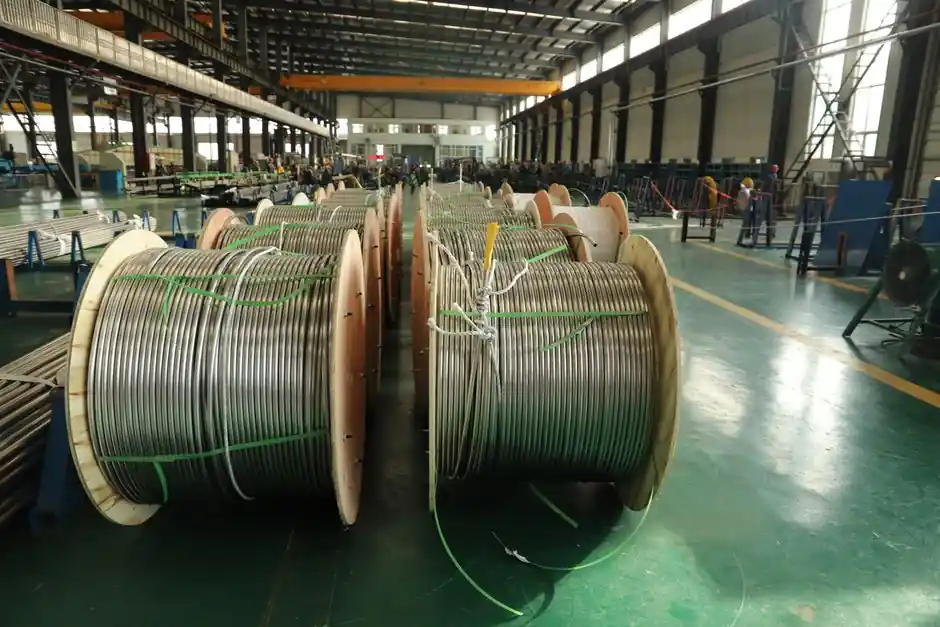
Silicon steel is a magnetically soft Fe-Si alloy engineered for low core loss, not for through-hardening, wear resistance, or compressive die loading. Common CRNGO (cold-rolled non-oriented) electrical grades carry 1.0-3.5% Si in 0.50 mm or 0.65 mm gauges, annealed to a final hardness typically below HRB 85 [S1].
Die shops specifying "silicon steel" for blanking, forming, or plastic-injection cavities are usually paying a premium for a magnetic property they cannot use, while losing the hardenability, impact toughness, and wear life a proper tool & die steel would deliver.
Material Boundaries: Electrical Steel vs Die/Mold Steel
Electrical steels are defined by their magnetic loss per kilogram (W/kg at 50/60 Hz and 1.5 T) and by lamination stacking factor, both of which are meaningless in a punch, cavity, or bolster [S1]. By contrast, a cold-work die steel such as D2 (1.55% C, 11.5% Cr, 1.0% Mo) is specified for 58-62 HRC working hardness, 2-4× the wear life of low-carbon sheet, and is governed by ASTM A681.
Plastic-mold work uses P20 (1.0-1.4% Ni, 1.8-2.1% Cr, 0.35% C) pre-hardened to 30-36 HRC, or H13 hot-work die steel (0.40% C, 5.0% Cr, 1.5% Mo, 1.0% V) for die-casting tooling that sees 600-700°C surface peaks. None of these performance windows is reachable by annealing a 0.5 mm Si-Fe strip to a soft condition.
Where Silicon Steel Genuinely Belongs Inside a Die Stack
Laminations punched from 0.35-0.50 mm CRNGO or CRGO do appear inside a die, but only as functional magnetic parts: motor stator and rotor stacks, solenoid pole pieces, lamination carriers for sensors, and magnetic clamping or lift fixtures. CRGO (grain-oriented) grades target 1.7-1.9 W/kg at 1.7 T/50 Hz; CRNGO grades target higher mechanical isotropy at a higher loss, around 2.3-5.0 W/kg at 1.5 T/50 Hz [S1].
For these parts, the die is consumable. A rule-of-pocket steel-rule die from Essential Products uses matched tooling sets (Rayform, DuraCore, PolyCore, DuraPly die boards) cut to IADD tolerances, with steel counters hardened specifically to survive the hundreds of thousands of cuts needed to produce motor laminations [S2]. The lamination material and the die material are deliberately decoupled.
Selection Criteria When Specifying Silicon Steel for a Lamination Die
Only after those gates should you pick the mill form: full-hard CRNGO coil for high-speed progressive die punching, or semi-processed anneal-grade coil that is blanked first and stress-relief annealed at 780-820°C in decarburising-free atmosphere after punching, to recover magnetic properties damaged by cold work.
Three Common Misapplications to Reject
Misapplication 1: using CRNGO strip as a structural punch or die shoe. The 0.50-0.65 mm gauge cannot carry the bending loads a 12-25 mm thick tool & die steel plate is designed for, and it will deform within hundreds of strokes. Misapplication 2: specifying a Si-Fe casting as a casting mold face. Molten aluminum at 680-720°C will dissolve low-silicon iron rapidly, and the magnetic annealing structure has no hot-strength reserve. [S1]
Misapplication 3: using electrical-steel scrap as a cheap raw feed for silicon carbide reaction sintering, or as a silicon nitride precursor. The 1-3.5% Si is far below the 60-70% Si needed for SiC reaction bonding, and tramp Mn, S, and Al from electrical sheet will sit as oxide inclusions at the grain boundary, dropping strength by 30-50% versus a clean Si metal feed.
Supplier Channels and Stock Form Reality

Primary silicon steel is sold by integrated mills in coil form with declared core loss at 50 Hz and 60 Hz, surface insulation rating, and a guaranteed thickness profile. Secondary channels, such as Taiwan-based trading houses, move silicon steel scrap, used rail, steel billets, CRC sheet, and HRC sheet together as commodity lots, with negotiable minimum order quantities down to 1 metric ton [S3].
For a die shop, this means: buy prime CRNGO/CRGO coil with full mill certs for any part that ends up in a magnetic flux path; treat scrap channels as a sink for stamping offcuts, not as a procurement route for production lamination stock. Mixing prime and scrap in a stator stack is a guaranteed 10-20% core-loss penalty that no anneal can recover.
Quick Comparison: Silicon Steel vs Die/Mold Steel
On four decision axes, the materials diverge sharply. (1) Primary function: silicon steel optimises W/kg at 1.5 T; tool steel optimises wear life at 58-62 HRC. (2) Operating temperature: silicon steel is stable to 200°C continuous with the magnetic anneal intact; H13 die steel runs to 600-700°C surface peaks. (3) Thickness form: silicon steel ships as 0.35-0.65 mm coil; P20 mold base blocks ship as 100-600 mm forged or rolled plate. [S3]
(4) Cost basis: prime CRNGO at typical 0.50 mm gauge runs 1.4-2.2× the price of cold-rolled commercial-quality sheet of the same gauge, while D2 or H13 tool steel runs 3-5× the price of plain AISI 1040 in equivalent weight. The price premium of electrical steel is paid for a property that has zero value in a structural die; the price premium of tool steel is paid for a property that has zero value in a magnetic core. Cross-specifying them is pure loss.
Specifying Silicon Steel for a Lamination Die Build
Lock the lamination grade first: CRNGO 50W470 (0.50 mm, 4.7 W/kg max at 1.5 T/50 Hz) for a high-efficiency industrial motor stator, or CRGO 30P120 (0.30 mm, 1.20 W/kg at 1.7 T/50 Hz) for a distribution transformer core. [S1]
For a parallel spec exercise on the structural side, the Silicon Steel Selection for Construction: GO vs NGO Spec Gates reference covers GO vs NGO gating at the building-systems level, and the Aluminum Die Casting Machine Selection for Energy Equipment: 2026 Spec Map article documents the H13-class hot-work envelope that a real die-casting die must survive. Cross-check both when the lamination stack is destined for an EV traction motor housing or a transformer tank.
Trackable signals to watch over the next two quarters: mills publishing revised 0.23-0.27 mm domain-refined CRGO data sheets for ultra-low-loss EV drive motors, and a second wave of IADD tolerance revisions for matched steel-rule die sets cutting sub-0.30 mm lamination stock at production rates above 600 strokes/min [S1][S2].