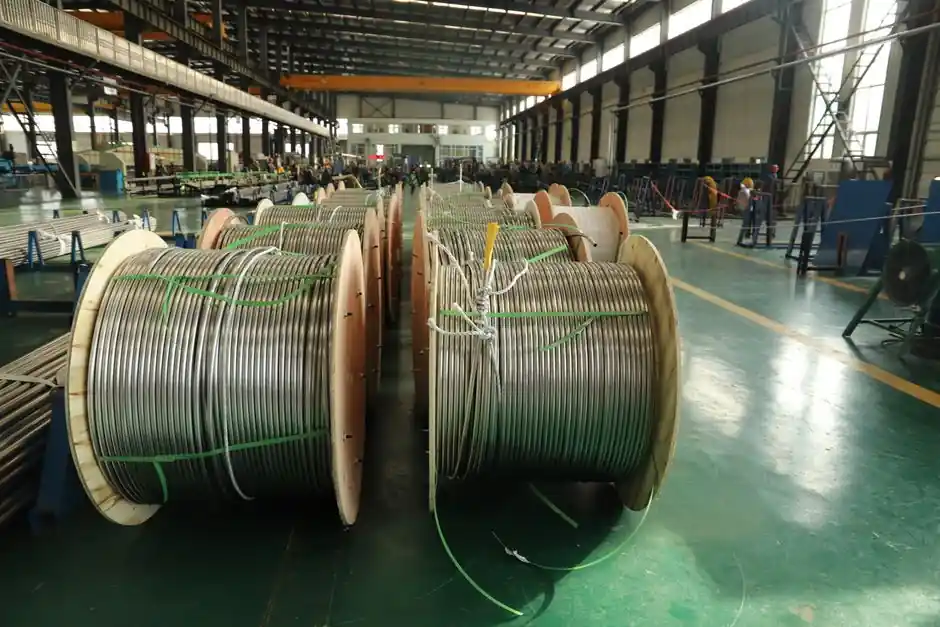
Silicon steel, often called electrical steel, is a silicon-iron alloy with 1.0–3.5% Si content and controlled grain structure, used for its magnetic properties in transformers, motors, generators, and building power systems rather than as a primary structural member.
Selection of silicon steel for construction projects focuses on electrical and magnetic performance, while structural load-bearing frames use conventional carbon or alloy steel grades. The construction industry consumes silicon steel primarily for on-site distribution transformers, elevator drive motors, HVAC equipment, and emergency generator cores.
GO vs NGO: Two Product Families, Two Use Sites
Grain-oriented (GO) silicon steel is produced with a Goss texture (110)[001] that delivers low core loss in the rolling direction, making it the specified material for transformer cores where flux flows along a defined path [S8]. NGO silicon steel has isotropic magnetic properties in all in-plane directions, which is required for rotating machines such as elevator hoisting motors, HVAC compressors, and standby generator rotors [S2].
Within the construction supply chain, GO grades (e.g. 30Q120, 27Q140) feed pad-mount and dry-type distribution transformers, while NGO grades (e.g. 35WW270, 50W600) feed motors and small power transformers. Both families share a common process chain: continuous casting, hot rolling, cold rolling, decarburising anneal, and final coating application [S2].
Spec Gates: Thickness, Core Loss, Grade, and Coating
Four parameters drive the procurement specification: lamination thickness (0.23, 0.27, 0.30, or 0.35 mm), core loss at 1.5 T and 50 Hz (commonly 0.90–2.50 W/kg), grade designation per IEC 60404-1-2 or AISI M-series, and surface coating type (C2, C3, or C4, with C5/C6 for high-stress winding). [S8]
For pad-mount transformers in commercial buildings, 0.30 mm GO grade 30P120 or 30Q120 is widely used; thinner 0.23 mm grades (e.g. 23P90) deliver lower no-load loss but at higher material cost. Coating selection matters where interlaminar resistance must exceed 5 Ω·cm² to limit eddy current losses, which is tested per ASTM A717/A717M for coating insulation quality.
Processing Lines Behind Construction-Grade Electrical Steel
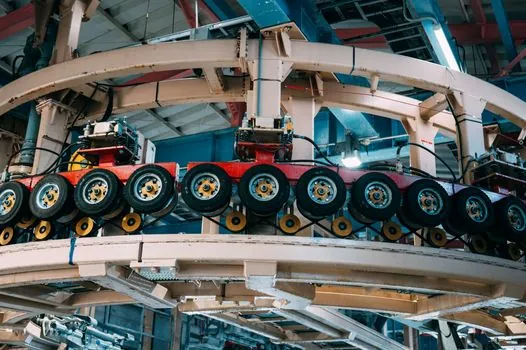
NeoKoil® strip processing lines from Fives cover the full electrical steel process chain, with APL (annealing and pickling line) and ACL (annealing and coating line) feeding the silicon-steel route, and DCL (double cold rolling) plus FCL (final coating line) completing GO and NGO grade production [S2].
This line-up matters to construction buyers because mill source determines the achievable grade: DCL enables 0.23–0.27 mm thin-gauge GO output, while conventional single-rolling NGO lines typically stop at 0.35 mm minimum. Procurement specifications should reference the mill route because the same nominal grade from a DCL line versus a single-reduction line has different texture control and core-loss repeatability.
Material Comparison: GO vs NGO on 4 Decision Criteria
On four decision criteria commonly used by construction specifiers, GO and NGO silicon steel separate cleanly: magnetic anisotropy (GO: highly directional, NGO: isotropic), typical core loss at 1.5 T/50 Hz (GO: 0.90–1.30 W/kg, NGO: 2.0–6.0 W/kg depending on thickness), price per kg (GO: roughly 2–3× NGO at equivalent thickness), and primary in-building use site (GO: distribution transformers, NGO: motors and small reactors). [S1]
Where the project includes both a substation transformer and elevator motor drives, the buyer will typically order GO coils from one supplier and NGO coils from another because the mill setups, coating chemistries (GO: MgO-based forsterite primer + C3/C4 overcoat; NGO: organic/inorganic composite directly on the strip), and annealing atmospheres differ. Material handling rules also diverge: GO must be kept stress-free to preserve magnetic properties, whereas NGO tolerates moderate punching shear stress up to about 5% degradation if stress relief anneal follows.
Who Should Specify Silicon Steel in Construction
Silicon steel specification fits a narrow role: electrical engineers and MEP (mechanical, electrical, plumbing) consultants who detail transformer rooms, motor control centres, and standby power systems. It is not the right material for structural beams, columns, or rebar; those are specified as stainless steel, carbon steel, or concrete reinforcement grades. [S2]
For the structural framing of a steel-framed college wing or a commercial warehouse, the supply chain is separate: SCI member publications, BCSA guidance, and standards like EN 1090-2 and EN 10025 govern the alloy steel section, hollow sections, and plate grades [S1][S3]. Specifying silicon steel instead of structural steel for load-bearing members is a category error and would fail any peer review.
Limitations, Lead Time, and Common Procurement Failures
Three failure modes recur on construction silicon-steel procurements: specifying NGO grade for a transformer application (the wrong family entirely), ordering GO without confirming coating compatibility with the winding oil or epoxy impregnation, and accepting core-loss figures without the test frequency and flux density (50 Hz vs 60 Hz, 1.5 T vs 1.7 T) attached. [S2]
Lead time for mill-direct GO coils runs 6–12 weeks depending on gauge and coating, and warehouse NGO stock is typically available within 1–2 weeks from service centres. For a project under tight construction programme, switching from mill-direct to service-centre stock for NGO motor laminations can shave 4–8 weeks off the delivery, with a typical 8–15% price penalty versus mill-direct tonnage. Material handling guidance for transformer laminations is documented in SCI Advisory Desk Notes covering punching, stress relief, and stacking factor (typically 0.95–0.97) for built-up cores.
Trackable signals for the next procurement cycle include the quarterly AISI M-grade core-loss tables and mill announcements on thin-gauge 0.20 mm GO capacity expansion, both of which are referenced alongside the silicon steel specification chain when MEP consultants lock in their transformer room schedules.
This topic is covered further in Aluminum Die Casting Machine Selection for Telecom Enclosures.