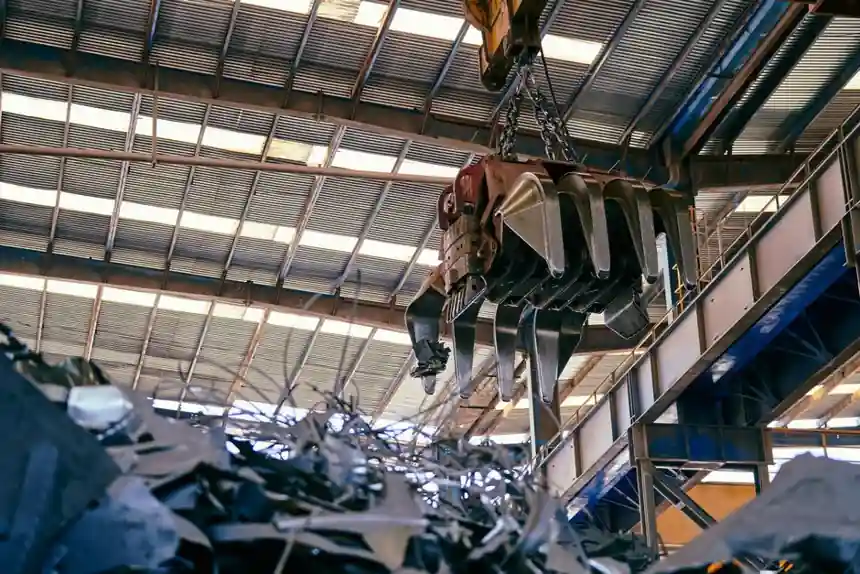
Single girder overhead cranes cover a standard envelope of up to 20 tonnes capacity [S1], and are generally specified as the practical choice for lifts up to 15 t across spans of 65 ft or less [S2]. For landfill transfer stations, material recovery facilities (MRFs), and leachate-pump maintenance bays, that envelope overlaps directly with the dominant load profiles: roll-off containers, bales, compactor components, and pump skids.
Double girder cranes extend that range to 540 t with no hard cap on span [S3], and that step-change is the comparison axis for any landfill spec. This article lines up single girder vs double girder vs mobile alternatives against landfill-specific criteria: capacity, span, corrosion, duty cycle, and methane exposure, then flags where the single girder boundary breaks.
Landfill Load Profile vs the 20 t / 15 t Single Girder Envelope
Landfill and transfer-station lifting tasks cluster in three weight bands: 2-5 t for pump skids, blower housings, and small compactor wear parts; 5-10 t for roll-off hoist components, screen decks, and conveyor head pulleys; and 10-20 t for large baler rams, generator sets, and crane-served truck loading. The 15 t / 65 ft single girder envelope [S2] covers the first two bands completely, and the third band sits exactly at the upper limit of the 20 t single girder cap [S1].
Anything heavier, a tracked compactor powertrain, a large hammer-mill rotor, a leachate evaporator skid, falls outside the single girder window and forces a step up to a double girder build [S3]. Spec-first practice: write the heaviest single-piece lift on the data sheet before choosing the crane, not after.
Corrosion, Methane, and the IP Rating Question
Landfill duty is wet, acidic (leachate condensate has pH 4.5-7.5 with H2S), and methane-bearing. Single girder cranes delivered as standard end-stop painting are not adequate for permanent outdoor or semi-enclosed landfill bays; the duty-class hoist and panel must be specified to at least IP55, with stainless or hot-dip galvanized wire rope and trolley hardware where H2S exposure is sustained [S1].
Methane is the controlling question for landfill-cell interiors. Standard single girder electric hoists are not certified for Zone 1 or Zone 2 group IIA atmospheres; if the crane is to operate over an active well-field or enclosed flare building, the spec must move to an IEC 60079 or ATEX-certified hoist, or the crane must be relocated outside the classified boundary. A single girder crane sized for capacity is not the same as one sized for the atmosphere.
Single Girder vs Double Girder on the 4 Decision Criteria
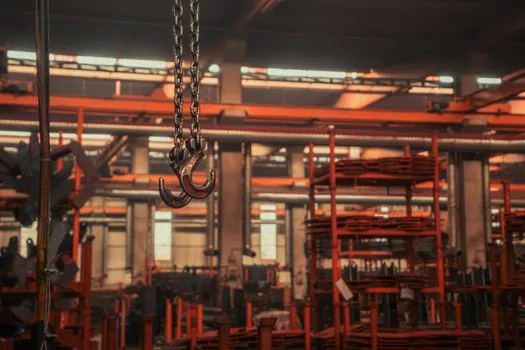
The single girder / double girder decision reduces to four criteria, and on three of them the single girder wins for landfill-scale work. (1) Headroom: single girder mounts the hoist under the beam, saving 12-24 in. of building height, a real saving on a transfer-station retrofit. (2) Self-weight: a single girder for 10 t / 40 ft typically runs 60-70% of the double girder mass, which lowers runway beam cost. (3) Installed cost: DRS SARL positions single girder as the practical low-to-mid capacity solution [S1], while double girder is positioned as engineered-to-order [S3]. (4) Capacity / span: double girder wins clearly, 540 t and unlimited span [S3] vs 20 t and ~65 ft [S1][S2].
For landfill work under 15 t, the single girder is the right default. For loads above 20 t, long-span greenfield sites, or heavy-duty cycles above FEM 2m / CMAA Class D, escalate to double girder [S3]. A gantry crane is a third option where fixed runway columns are impractical, e.g. ground-mounting on a slab over a geomembrane, but that is rarely a first choice for a covered transfer station.
Duty Class, Hoist Selection, and Service Life on Landfill Cycles
Landfill transfer stations are not light-duty. A crane serving a baler feed or trommel discharge point can log 20-40 cycles per shift, which puts a standard H4 / FEM 1Am hoist near its design limit. Specifying up to FEM 2m or CMAA Class D is cheap insurance, the hoist and motor are sized for the actual starts-per-hour, not the optimistic nameplate. [S1]
Single girder cranes pair with either electric wire-rope hoists or electric chain hoists; for landfill work, wire-rope wins on wear tolerance, with the trade-off being rope inspection every 500-1000 hours under H2S exposure. End-carriages, end-trucks, and bumpers should be specified to a CMAA impact rating that matches the actual approach speed; a 100 fpm bridge on a single girder needs more buffer than a 30 fpm manual-side-pulling unit.
When a Single Girder Crane Is the Wrong Choice

Single girder is the wrong crane for landfill work in four specific cases. (a) Single-piece lifts above 20 t, where the design must escalate to double girder [S3]. (b) Hazardous-area (Zone 1 / Zone 2) operation over active landfill gas collection, where the hoist must be ATEX or IECEx certified, not just IP-rated. (c) Outdoor uncovered service in coastal or high-rainfall sites, where a standard-paint single girder will see first-coat failure inside 24-36 months, pushing the spec to galvanized plus stainless fasteners. (d) Long-span transfer halls above 65 ft, where a gantry crane on rails or a double girder will deflect less under off-center loading.
For demolition-style duty in adjacent cells, a purpose-rated demolition single girder is a different machine from a standard factory unit; the spec and duty class there follow their own rulebook.
What to Confirm on the Vendor Data Sheet Before Signing
Five numbers on the vendor data sheet decide whether a single girder crane will survive landfill duty. (1) Capacity at the worst-case hook position, not nameplate mid-span, with the 15% derate for off-center pickup applied. (2) FEM or CMAA duty class as a printed line item, not a verbal assurance. (3) Hoist IP rating, minimum IP55, with panel IP65 where wash-down is routine. (4) Wire-rope grade and coating, with H2S-resistant rope specified explicitly. (5) End-truck wheel load on the runway, sized against the existing runway beam reaction, not against a generic "suitable runway" note [S1].
Two trackable signals for the next 6 months: the Single Girder Crane Selection for Demolition: Spec-First Decision piece, which overlaps on duty class, and a published OEM revision of an AS/RS System Selection for Warehouse Automation reference for the higher-throughput MRF case where a stacker crane replaces the single girder on the bale side. Both signal the trend: landfill-spec cranes are migrating from "crane in a building" to "crane as a data point in a sorted-stream workflow."
For the relevant spec sheets and selection criteria, see crane scale.