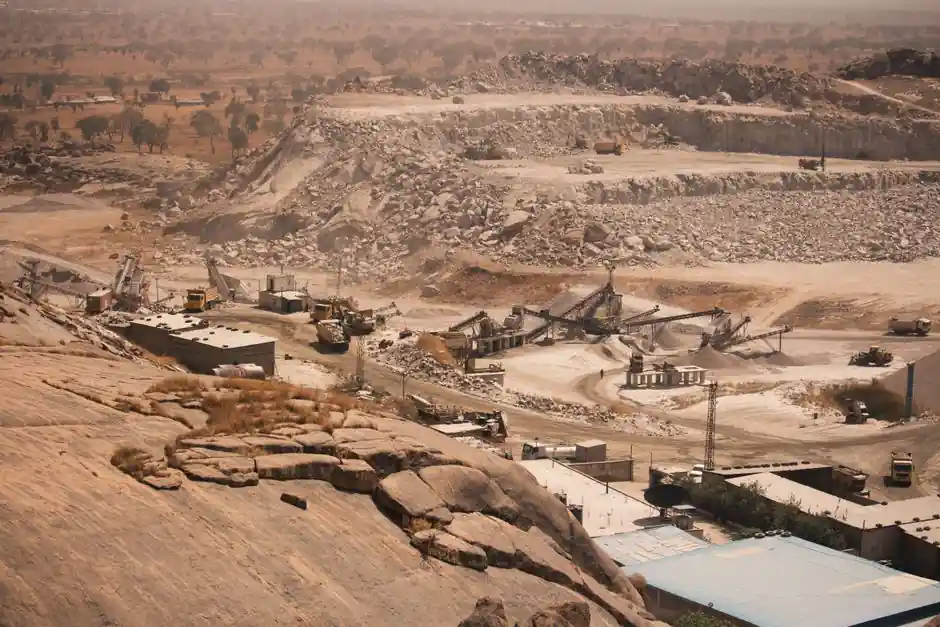
A 2–10 t single girder grab crane configured with a clamshell bucket is being marketed for quarry and bulk-material sites handling coal, waste rock, and sand, with a lightweight single-girder frame to keep deadweight and runway load low [S1]. The same single-girder architecture is also being deployed as a 20 t rubber-tyred gantry (RTG) crane in a Lithuanian precast plant, built around a European wire-rope hoist with 0.7/4.0 m/min dual-speed lift and 1.0–10 m/min variable-speed travel on 380 V / 50 Hz 3-phase power [S2].
Both product paths confirm that single-girder construction is no longer limited to light indoor jibs: when paired with the right hoist and travel package, it covers bulk-bucket duty in stone plants and flexible mobile lifts on open precast yards [S1][S2]. A related overhead bridge crane selection guide for urban infrastructure projects covers the parallel fixed-runway case for spec teams evaluating indoor vs outdoor duty.
Quarry and Mining Service Profile
Mining and quarrying cranes are documented as handling equipment assembly, plant construction, and primary bulk lifting at the face, which is a markedly different load profile from indoor factory duty where ambient air is clean and operators are close to the runway [S3]. The bulk-handling variant of the single girder is built with a grab bucket rated 2–10 t and is described as a lightweight, cost-effective overhead solution for coal, waste, and sand flows, with a structure weight kept low so existing gantry rails can be reused without reinforcement [S1].
For a quarry engineer that means the single-girder vs double-girder choice is not academic: a single main beam cuts self-weight by a measurable margin, but the hoist, end-carriage wheels, and bucket pivot become the wear-critical parts, not the girder itself. Outdoor service adds dust, water spray, and thermal cycling, which is why the precast-yard reference unit specifies IP55 enclosure protection for the hoist and electricals, the minimum level most European OEM datasheets treat as the entry point for outdoor service [S2].
Single Girder Grab Crane: 2–10 t Bulk Configuration
The grab-bucket configuration is built around a single main girder with a motorized grab hoist that opens and closes the clamshell on the same drum, which simplifies the headroom compared with a separate closing hoist. The 2–10 t bracket covers most aggregate, sand, and recycled-aggregate duties, and the OEM positions the design as a lower-cost alternative to a double-girder grab crane for waste-to-energy, stockpile reclaim, and quarry screening houses [S1].
Selection constraints in quarry service are bucket cycle rate and bucket deadweight: a 5 t grab with a 1.5 t clamshell reduces payload to 3.5 t, and the hoist must be rated for the combined load, not just the bulk payload. The grab configuration also requires the crane to be supported on runway beams rated for the dynamic vertical and horizontal forces of digging, which are higher than a standard hook-duty crane of the same SWL. For reference, the single girder crane encyclopedia entry describes the structural economy that makes this configuration viable at the 2–10 t level.
20 t Single Girder RTG Crane: Mobile, No Fixed Runway
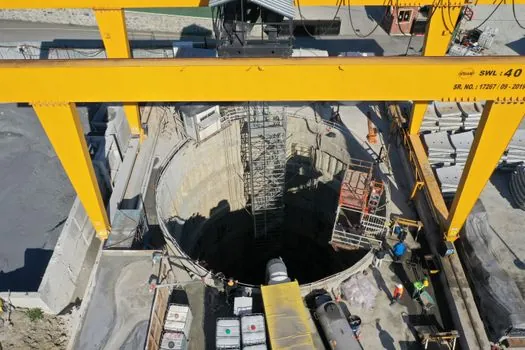
Where the quarry or precast yard cannot install a permanent runway, the single-girder design is mounted on a rubber-tyred gantry chassis and powered through a 380 V / 50 Hz 3-phase supply via cable reel or busbar, with the operator on remote control. The Lithuania project ships a 20 t SWL unit on a 7.5 m span with 10 m lift height, sized to lift concrete moulds in the 16–18 t range, with a European wire-rope hoist providing 0.7 m/min creep and 4.0 m/min full-speed lifting [S2].
The travel package is the differentiator: 1.0–10 m/min variable speed on both trolley and bridge gives the operator controlled positioning for fragile moulds, and rubber tyres remove the need for embedded rails so the crane can serve multiple working zones in the yard. This is a useful counter-example to the assumption that single-girder cranes are restricted to indoor hook duty, and the gantry crane reference page covers the structural category this RTG belongs to.
Selection Criteria and Comparison
Four criteria drive the call between a fixed-runway single-girder grab crane and a mobile single-girder RTG: lifting capacity, mobility, headroom, and installed infrastructure. The grab configuration is cheaper to install on an existing building steel structure but locks the crane to a fixed runway, while the RTG costs more per unit but covers an open yard without civil-works rail. [S1]
For quarry aggregate flows the deciding line is whether the load point moves: stockpiles under a fixed conveyor feed favour the grab crane, while multiple loading bays or temporary pits favour the RTG. A mobile crane reference covers the wheeled carrier alternative when road or off-road mobility outweighs yard manoeuvrability, and the crane scale entry is the right starting point if the spec must include legal-for-trade weighing on the hoist line.
Standards, Compliance, and Sourcing
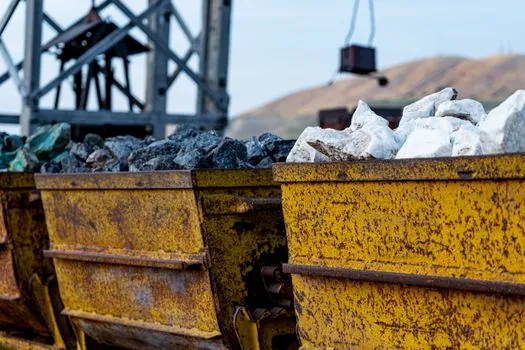
European-built single-girder RTG units on the precast-yard reference are stated to be designed to European standards, with the European wire-rope hoist typically built to FEM 1Am or 2m duty classification for repeated lifting cycles [S2]. Outdoor bulk-handling cranes in quarry and waste service need ingress protection to at least IP55 on the hoist and electrical enclosures to keep dust and water out of motor windings, and the grab-bucket supplier lists lightweight single-girder construction as the cost-down lever for the 2–10 t class [S1][S2].
For a sourcing decision, the practical checklist is: confirm FEM duty classification, verify IP55 on the hoist and electrical panel, check the 380 V / 50 Hz 3-phase compatibility with the site's existing MV/LV transformer, and require variable-speed drives on both hoist and travel for precise load control on a 20 t mould or a swinging grab load. Sourcing the hoist as a recognised European assembly (Stahl, Demag, Verlinde, Donati-class) is what lets a Chinese or Turkish girder builder quote to European standards without flagging at the European buyer's engineering review.
Limitations and Failure Modes to Plan Against
The single-girder format has known limits that show up fast in quarry service. Wheel-load and runway-beam wear is amplified when the same runway also carries a grab bucket digging cycle, which produces horizontal snatch loads that a hook-only crane never sees, and the girder's lower lateral stiffness means end-carriage alignment must be checked every shift. The RTG variant adds tyre wear and steering-system maintenance that a fixed crane does not have, and the 1.0–10 m/min variable-speed travel is only useful if the VFD is correctly parameterised for the loaded vs empty condition. [S2]
For grab-bucket cranes, the failure mode to design against is bucket-line fouling on the girder, since the closing line and the holding line both run inside the same drum and a mis-spool will saw into the rope. Spec teams should require rope-reeving diagrams, an anti-two-block on both lines, and a bucket-capacity test certificate on first lift, because grab cranes in quarry service are the most likely single-girder class to fail a safety audit. Sourcing teams evaluating indoor stacker-crane alternatives for parts storage can cross-reference the stacker crane encyclopedia entry when the lifting need shifts from bulk to unit load.
Track on (a) the next FEM 1Am / 2m datasheet revisions published by the European hoist OEMs in Q4 2026, since revised thermal ratings will shift how often a 20 t RTG must be de-rated for high-cycle precast work, and (b) any quarry-site IP rating upgrades beyond IP55 for wash-down areas, which several EU bulk-handling operators are now writing into new tender documents.