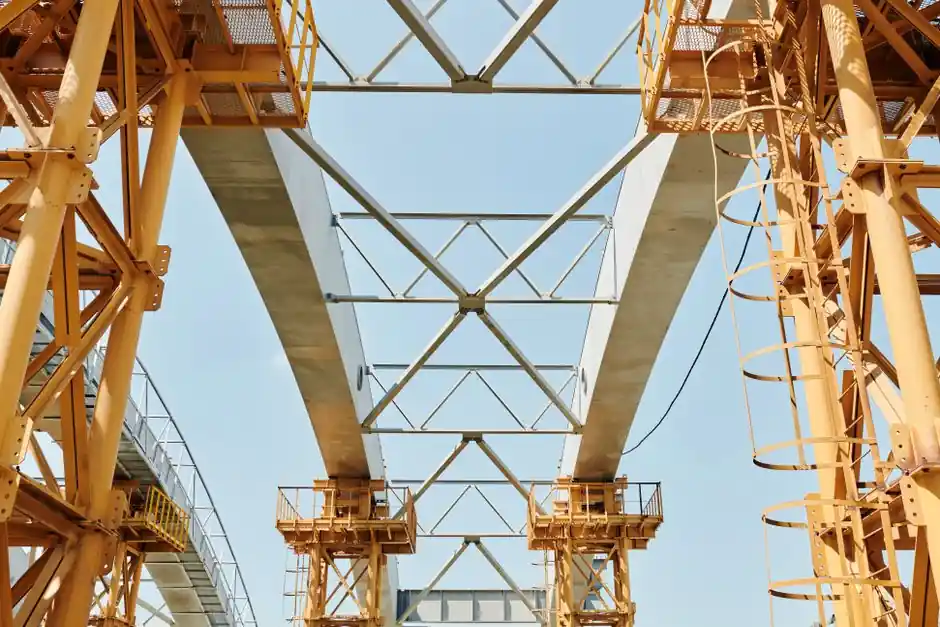
Single girder cranes cover the 5-20 t sweet spot for tunnel auxiliary lifting, with 5 t units starting around $5,000 ex-works from Chinese OEMs and 10 t single girder units in the $10,000-$22,000 band for 10-28 m spans at A3-A5 duty [S3]. For TBM-driven segment erection in metro and hydropower tunnels, the lifting class jumps to 100-400 t, and those units are almost always double girder, U-frame, rail-mounted gantries, not single girder [S6]. The decision is not "single girder vs double girder" in the abstract, it is a spec match against tunnel diameter, segment weight, lifting cycle, and duty class.
Underground construction imposes hard constraints: limited vertical and horizontal headroom, restricted assembly windows, and continuous-cycle demands tied to TBM advance rate [S1]. Picking the lightest crane that fits the duty is a process-engineering decision, not a procurement preference, because every extra metre of structural height can push a tunnel cross-section up a size, with cascading cost on excavation, muck haul, and segment count.
When a Single Girder Crane Fits the Tunnel
Single girder EOT cranes have a compact structure, light self-weight, and low wheel load, which makes them a practical match for lighter loads and narrow tunnels [S1][S4]. In tunneling, "lighter loads" is a defined band: rebar cages, ventilation duct sections, small formwork panels, segment handling for inner-ring utility shafts, and muck-car spotting, typically in the 3-20 t range. Below this band, a portable gantry or single girder crane on a runway embedded in the invert is usually the lowest-cost path.
The geometry constraint is the discriminator. A typical metro running tunnel has an internal diameter of 5.4-6.0 m, leaving a working envelope of roughly 4.5-5.0 m above the track. A low headroom single girder design with a CD1 or MD1 wire rope hoist suspended below the single beam typically achieves 1.5-2.5 m of hook-to-rail headroom, which is the only way to keep a 5-10 t hoist inside the tunnel envelope [S1]. For shafts and access galleries, a gantry crane on rails mounted to the shaft wall gives the same benefit with one leg omitted, freeing a traffic lane.
Capacity Bands and Where Single Girder Stops
Below is a decision comparison based on the lifting class and tunnel role. Numbers are sourced from the research; the qualitative call-out reflects established tunneling practice [S1][S3][S6].
Lifting class 3-10 t, light auxiliary (rebar, duct, small panels): single girder EOT on embedded runway, 10-22 m span, CD/MD hoist, A3-A4 duty. Landed cost roughly $7,000-$28,000 for 5-10 t class from Chinese OEMs [S3]. Lifting class 10-20 t, medium auxiliary or inner-shaft segment handling: single girder or semi-girder gantry, 10-28 m span, MD hoist, A4-A5 duty. Landed cost band $20,000-$40,000 [S3][S5]. Lifting class 20-50 t, ring build or utility erection: double girder EOT, 16-32 m span, A4-A6 duty, landed cost $36,000-$68,000 [S3]. Lifting class 50-400 t, TBM segment erection and back-up gantries: double girder U-frame, rail-mounted gantry, A5-A7 duty, with TBM gantry cranes typically specified at 100-400 t for metro and underground lifting [S6]. The single girder ceiling in tunneling is effectively the 20 t mark; beyond that, hoist geometry, trolley stability, and structural stiffness push designs to two girders.
Spec Variables That Drive Tunnel Selection

Four variables dominate the tunnel spec, and each one is a separate conversation with the OEM. First, lifting capacity, defined as true SWL including all lifting attachments (spreader beam, hooks, sling weight), not the nominal hoist rating [S3]. Spec padding is a common cause of cost creep; the price curve is roughly exponential above the actual load, so a 20 t unit at A6 duty can cost 30-40% more than the same SWL at A5 [S3]. Second, span. In a tunnel the span is set by the invert or runway rail spacing, typically 6-12 m for a single-track running tunnel and 10-22 m for a cross-passage or cavern; every extra metre adds steel and rail cost linearly [S3][S1].
Third, duty class. Count daily cycles honestly: a crane used to feed segments into a TBM backup runs at a much higher cycle rate than one used to offload consumables. The A5-to-A6 jump alone can add 30-40% to unit price [S3]. For continuous-cycle TBM segment erection, A6 or A7 is normal, which is why those units end up double girder [S6]. Fourth, headroom envelope. This is the variable that rules single girder in or out before capacity is even discussed; low headroom single girder designs with the hoist underslung below the beam are the standard answer when tunnel diameter is tight [S1]. For engineers also evaluating auxiliary lifting outside the tunnel, the same capacity-vs-headroom logic applies on the surface, as in single girder crane selection for mining auxiliary lifting, where low headroom and A4-A6 duty are the recurring constraints.
Configuration Variants for Tunnel Service
Five configuration patterns show up in tunnel work, and the naming is often confused. A single girder EOT crane rides on a runway beam, with the hoist on a trolley under the single girder [S4]. A single girder gantry crane adds legs running on a ground or floor rail, used where a structural runway cannot be installed. A semi-girder gantry keeps the trolley and hoist on a single girder over one leg, leaving the other side open for truck or muck-car access [S5]. A low headroom gantry crane is a design family, not a configuration; it minimizes the distance from the rail top to the hook, applicable to single or double girder layouts and the typical answer in tight tunnels [S1]. A rail-mounted double girder gantry is the TBM workhorse, sized 100-400 t for segment handling in metro and underground lifting [S6].
For tunnel auxiliary work in the 5-20 t class, the pattern is usually a single girder gantry on embedded rails in the invert, with the hoist underslung for headroom. For TBM backup and segment yard work above 50 t, the pattern flips to a double girder U-frame on rails. The semi-girder pattern is a useful middle ground when one side of the tunnel must stay clear for muck cars or pipe carriers, a common requirement in NATM sequences with concurrent invert work [S5].
Environmental and Safety Constraints Underground
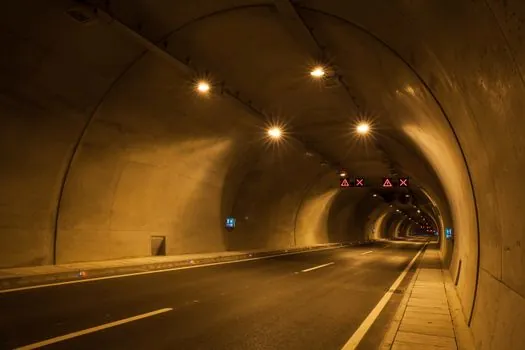
Tunnel cranes operate in humid, dust-laden, sometimes gas-prone atmospheres, and the spec must reflect that. Anti-corrosion and dust-proof coatings are standard for long-term reliability, explosion-proof hoists are required in gas-prone or mining tunnels, and modular or mobile options matter where tunnel excavation progresses and the crane must relocate or extend its runway [S1]. The selection sequence is: confirm tunnel dimensions and segment weights, choose single or double girder design based on actual project demand, and include environmental and operational adaptations to avoid future modifications [S1].
Duty class must also be reconciled with the actual installation environment. A crane rated A5 in clean shop conditions drops in effective rating when operating in a wet, dusty tunnel with frequent starts and stops; conservative specs typically select one duty class above the calculated value. For the segment erection crane, the practical floor is A6 [S6]. For the auxiliary crane, A4 is often sufficient but A5 is the safer pick if the crane will be resold or redeployed at project end. Surface pipeline and utility sites use a similar envelope-driven logic, as seen in overhead bridge crane specs for pipeline construction sites, where span, headroom, and duty class interact in the same way.
Cost Anchors and Procurement Reality
Price discipline matters because the difference between a 10 t single girder and a 20 t double girder is roughly 2-3x in unit cost before installation, and installation inside a tunnel is never cheap [S3]. Landed cost estimates in the research cover ocean freight, basic import duty, and destination port handling, but explicitly exclude installation, runway rails, and local electrical connection, which in a tunneling context can equal or exceed the crane price once shaft access, temporary works, and commissioning are added [S3].
Two procurement rules hold across the capacity bands. First, the price per tonne falls as capacity rises, but the absolute price climbs; a 50 t double girder is in the $65,000-$130,000 ex-works band and reaches $80,000-$160,000 landed, while a 5 t single girder is $5,000-$12,000 ex-works and $7,000-$16,000 landed [S3]. Second, the line items that swing price the most are lifting capacity, span, hoist type, and duty class, in that order; control system and paint spec are second-tier variables that should be specified after the structural envelope is fixed [S3]. For the tunnel engineer, the practical implication is to lock SWL, span, duty class, and headroom before talking price; reverse-engineering a low quote against a vague spec produces a crane that fails in service.
Trackable next nodes: confirm whether the tunnel cross-section drives a low-headroom single girder under 20 t, or pushes the spec into the 100-400 t double girder TBM gantry range, and validate duty class against TBM advance rate before issuing the inquiry. Engineers weighing similar decisions in adjacent service environments can compare the same envelope logic in overhead bridge crane specs for pipeline construction sites and single girder crane selection for mining auxiliary lifting.
For the relevant spec sheets and selection criteria, see crane scale.