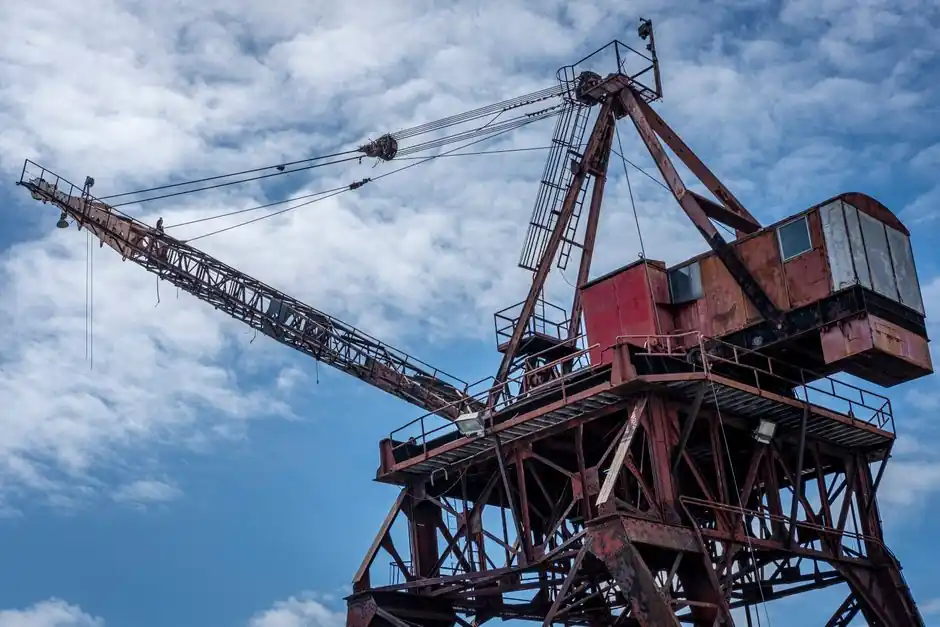
In mining operations, single girder overhead cranes most often serve maintenance shops, pump rebuild bays, crusher liner stores, and concentrator warehouses where lifts sit in the 1-20 ton band and spans stay under roughly 31.5 m; the bridge is one box-type or wide-flange beam with a hoist trolley on the bottom flange [S2][S4].
Selection breaks down to five engineered numbers, not brand preference: lifting capacity in tons, span in metres, lifting height, FEM/ISO duty class, and crane control mode, with rated supply typically three-phase AC 380 V 50 Hz on Chinese-built units [S4]. For a closer look at the standard product category, the single girder crane overview covers girder construction and hoist mounting in detail.
Why Mines Pick Single Girder at All: Capacity, Span, and Dead Load
Single girder cranes normally stay in the 1-20 ton range, with some custom builds reaching 32 tons, while double girder designs pick up at 5 tons and run to 300+ tons over 50 m+ spans [S3]. In a mine context, that ceiling matters: a single girder unit handles motor swaps, conveyor idler drum lifts, pump casings, and small mill liner crates, but is not the right tool for hauling a 60 ton crusher head or a 120 ton SAG mill shell.
Dead load is the second spec engineers underestimate. A single girder bridge puts one beam across two end-trucks, so the structure is lighter, foundations see less vertical load, and existing shop columns often accept the runway without retrofit. That is a real advantage in older concentrator buildings where adding a heavier double girder bridge would force a structural upgrade [S2]. For a side-by-side criteria pass against gantry-style alternatives, the gantry crane reference lays out leg-supported spans and rail vs wheel travel.
LD, LX Suspended, and European Single Girder: Three Real Configurations
Single girder is not one product. Three configurations show up on RFQs from mine EPCs: the standard LD supported type, the LX suspended underhung type, and the European single girder with an integrated hoist embedded inside the box beam [S4]. Each maps to a different headroom and structural constraint, which is what makes the choice site-specific rather than catalogue-specific.
LD supported single girder cranes mount on rails fixed to side columns (top-running), carry 1-32 ton loads across 7.5-31.5 m spans, and demand the largest headroom; they fit open-bay maintenance shops with healthy vertical clearance [S4]. LX suspended units hang directly from the roof steel via the bottom flange, keep hook approach close to the wall, but are limited to about 0.5-10 tons and short to medium spans, which suits tight crusher lube-room rebuild cells [S4]. European-design single girder cranes embed a compact hoist inside the main beam, drop headroom demand to a minimum, run variable-frequency drives for soft starts, and stay inside 1-20 tons with custom spans for export projects [S4].
Duty Class, Hoist Position, and the Mining Maintenance Reality
Chinese single girder product lines list A3, A4, and A5 work classes, with A3 for occasional light use, A4 for moderate cycling, and A5 for busier shifts [S4]. In a mine concentrator, a pump-rebuild bay running two shifts can easily push the bridge into A4 territory, so specifying A3 to save cost usually ends in a worn-out hoist within a few years. Where lifts exceed A5, the honest engineering call is to step up to a double girder crane rather than overrate a single girder unit.
Hoist position drives hook height, and this is where single girder cranes lose ground to double girder. With the hoist riding under the beam, single girder designs give up 18-36 inches (about 450-900 mm) of usable lift compared with a top-running double girder where the hoist sits between the two girders [S3]. For a 10 m hook height target, that lost headroom can mean the difference between fitting inside an existing bay and tearing the roof off. Under-running top-running terminology is not interchangeable: top-running hoists ride above the beam, under-running hoists hang below it, and the building column spacing, runway bracket type, and end-truck design all change between the two [S2].
Decision Criteria: Single Girder vs Double Girder vs Gantry for a Mine Shop
Three decision criteria cleanly separate the options for mine buyers: lifting capacity in tons, span in metres, and available headroom in millimetres. Below 20 tons and under 31.5 m span, with adequate headroom, a single girder LD unit is the lowest-cost fit [S3][S4]. Above 20 tons, or when hook height above floor must be maximised, a double girder crane with top-running hoist and a maintenance walkway becomes the right answer, typically adding 8-12% to project cost but unlocking auxiliary hoist capability and cab access [S5].
Where the crane has to move between buildings outdoors, or sit on a ground-level rail instead of an elevated runway, a mobile crane or a gantry crane leg-supported on rails may replace the overhead bridge entirely. The crawler crane reference covers track-mounted heavy-lift alternatives for haul-pad or stockpile work. Pit-floor or shaft-sinking heavy lifts, by contrast, sit well outside single girder territory and belong to a different machine class altogether.
When Single Girder Is the Wrong Call: Failure Modes and Mining Constraints
Single girder overhead cranes fail in mining duty for three predictable reasons, and recognising them at RFQ stage saves a forced rebuild. First, the underhung hoist trolley on the bottom flange of a wide-flange beam can fatigue at the flange-to-web weld if the crane is run at A4 or higher duty with near-rated-capacity lifts; the cure is a true box-type girder, not a rolled I-beam [S4]. Second, suspended (LX) units depend on the existing roof steel to carry the full dead load plus live load, and many older mine buildings were not designed for that reaction, so a structural check on the runway beam is mandatory before specifying an underhung configuration [S4].
Third, custom low-headroom, explosion-proof, or insulation requirements can be built into a single girder crane, but only at the order stage, and they change the duty class and price band, so RFQs in corrosive or hazardous zones must flag this at the engineering brief, not after delivery [S4]. For related safety-instrumentation pairing on the same mine floor, the crane scale reference covers load-cell integration that prevents overload trips on single girder hoists. The parallel selection logic for perimeter guarding on the same bay is well laid out in this spec-first safety light curtain guide for mining, which spells out Type 4, IP67, and ATEX Zone 2 thresholds that frequently apply next to a single girder run.
Standards, Documentation, and International Project Reality
For a mining buyer sourcing single girder cranes across borders, the engineering document package is the spec, and CE marking, ISO 9001/14001/45001 audited certifications, and region-specific compliance such as EAC for Russia or NR-12 for Brazil now come up on every serious RFQ in 2026 [S5]. Rated supply on most Chinese-built single girder units is three-phase AC 380 V 50 Hz, so a 60 Hz North American site, a 440 V Brazilian site, or a 415 V Australian site must trigger a transformer or motor change at the order stage, not at commissioning [S4][S5].
Two trackable signals are worth watching through the rest of 2026: the spread of variable-frequency drive (VFD) controls as standard rather than optional on European-design single girder cranes, since soft starts cut both mechanical wear and inrush current on weak mine-site power; and the wider availability of A5-rated single girder packages, which would push the practical ceiling for single girder use upward from the current A4 mainstream [S4]. Where heavy-lift scope is creeping toward 30+ tons, however, the honest specification call remains a double girder bridge, a mining dump truck-class haul cycle, or a heavy gantry, not a stretched single girder build.