
Overhead bridge cranes serve indoor material handling while crews clear roof, yard, and access snow on adjacent structures, so the crane itself must run in a cold but sheltered bay with low ambient humidity and wide temperature swings [S2].
Snow-handling facilities, including transit depots, cold-storage warehouses, and municipal works yards, typically pair an indoor overhead bridge crane with outdoor loaders and spreader bars, so the indoor crane is the stable workhorse that has to keep lifting in near-freezing conditions all winter.
Operating envelope and ambient temperature class
For snow-prone sites, the indoor bay commonly sits between -10 °C and +5 °C in mid-winter, with door openings causing sharp swings, so the crane must be specified for a cold-shop duty class rather than a standard 0 to +40 °C ambient [S2].
Wire rope lubrication grease, hoist gearbox oil, and brake fluid are the three items most affected: standard lithium grease thickens below -10 °C, while synthetic cold-rated grease (typically rated to -30 °C or -40 °C) keeps the rope sheaves turning under load [S2]. Operators should treat the spring inspection cycle as the first hard check on winter damage, with corrosion at the rail clamps and main-beam welds being the most common failure mode called out in field service plans [S2].
Single girder vs double girder for snow-shed bays
Single-girder cranes with electric hoists cover most snow-removal support tasks in the 1 to 10 ton range, while double-girder configurations above roughly 15 to 20 tons are used where roof panels, salt-spreader assemblies, or plow blades are pre-staged indoors [S2].
A direct comparison of the two configurations against the four criteria that actually drive selection in a snow depot:
Capacity: single-girder up to about 10 t, double-girder from 15 t up to 32 t for the heavy-spreader class. Headroom: single-girder needs less hook-space, which matters in older low-clearance bays. Cost: a typical single-girder 5 t unit is materially cheaper than a 20 t double-girder of the same span, based on the catalog spread for LD-type units versus QDY-type foundry units [S4]. Service access: double-girder puts the hoist on top of the bridge, so a technician can service it without going under a suspended load, which is a real safety plus on a slick floor. The lightweight 5 t single-beam cantilever gantry variant and the 5 t underslung LX model are both listed as standard stock items for warehouse use, which mirrors what snow-shed operators actually order [S4].
Safety options that matter in winter operation
The 10-option safety list for an overhead crane includes spare remote control, anti-collision laser, end-of-travel limit switch, rotating beacon, load display, and crane lighting, all of which become non-optional in a cold bay where the operator is wearing gloves and visibility is poor [S1].
A standard 8-button spare transmitter costs around $1,000 while a custom joystick-equipped spare can run up to $10,000, and the spare is a real reliability item when the primary remote fails mid-shift at -15 °C, because a load left hanging any longer than necessary is a direct hazard to workers on a slippery deck [S1]. Anti-collision is laser-based by default: when two cranes share a runway, the system drops the trailing crane to low speed and then stops it, which directly limits sway and is the standard remedy on tandem-lift tracks [S1]. End-of-travel limits, rotating beacons, and a load display are the baseline, and lighting is a non-negotiable for the short-day winter months when natural light is gone before the second shift starts [S1].
Runway, electrification, and cold-weather build details
An enclosed runway with festoon or conductor-bar power, rail sweeps at each end-carriage, and heaters on the hoist motor and brake are the four field-proven build details for snow-region cranes, and they all show up as recurring scope items in spring service reports [S2].
Spring service work calls out rail-clamp and anchor inspection specifically for outdoor and semi-outdoor cranes, which means the indoor crane in a snow shed still gets the same rail-clamp check because salt-laden slush gets tracked in and corrodes the anchor bolts [S2]. Limit switches on both hoist and travel must be tested each spring, because moisture intrusion over the winter is the dominant cause of false trips, and gear oil that has emulsified or gone milky from condensation has to be replaced, not topped up [S2]. A four-step commissioning flow, no-load test, light-load test, rated-load test, and overload cut-off test, is the standard handover procedure after a winter maintenance cycle, and any crane going into the next snow season should be put through all four before November [S2].
Selection criteria vs. real site constraints

For snow-removal support, the four binding constraints are span (typically 10 to 30 m), lift height (4 to 9 m under-hook), ambient (down to -20 °C inside the bay, lower at the door), and duty class (CMAA Class C/D for moderate shop use, Class E for near-continuous salt-bag handling) [S1][S2].
Spec-first guidance: lock span and runway length before talking to vendors, then pick girder type by the 10 t threshold, then layer safety options, starting with the spare remote and load display, before spending on anti-collision unless a second crane is actually on the same runway [S1]. Buyers often under-spec the hoist motor brake heater on the assumption that the bay is "indoor", but in a snow shed the door is open half the day in January, and a cold brake that does not release cleanly is the single most common winter breakdown called out in field data [S2].
Failure modes and what to inspect before the snow season
The four recurring winter failure modes for overhead cranes in cold bays are: (1) thickened grease stalling the rope drum, (2) condensation shorting the control panel, (3) corroded rail-clamps at the outdoor apron, and (4) brittle seal failure on the hoist motor, all of which are caught by the spring checklist when run in reverse before the next winter [S2].
Wire rope should be checked for broken wires and reduced diameter, hooks inspected for throat opening growth, and the safety latch function verified, because any of those failing under load in a cold bay is far harder to recover than in summer [S2]. The drum grooves, end-carriage bearings, and main-beam welds at the rail joints are the next three items, and the emergency-stop must cut power immediately on the test button, not after a delay [S2].
Related applications and product context

The same capacity and span logic that drives crane selection for snow removal also drives selection for quarry and urban infrastructure sites, where enclosed runways, anti-collision, and high-cycle hoists are again the differentiators; see the quarry 2026 spec guide and the urban infrastructure selection guide for the parallel decision logic. [S2]
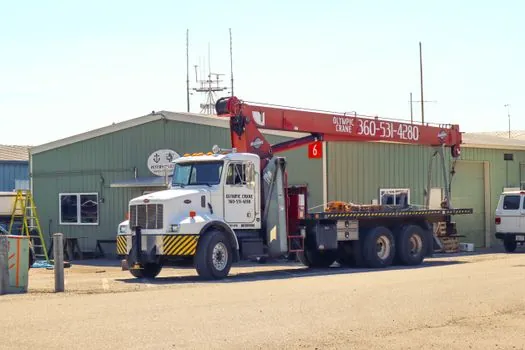
For facilities that are also handling bagged salt or treated aggregate indoors, a higher-capacity gantry crane is often paired with the bridge crane to cover the outdoor yard, while a mobile crane is used for one-off roof-panel lifts, so the indoor bridge crane stays on its primary duty of feeding the spreaders and the salt-handling line. The catalog pattern for a typical snow-shed fleet is a 5 t LD-type single-girder bridge unit, a 20 to 30 t QDY double-girder unit for heavy assemblies, and a 1 to 3 t electric hoist on a workstation jib, which matches the overhead conveyor feed at the salt-loading bay [S4]. A crane scale on the hoist is the cheapest way to verify that a salt loader is not over-filling the spreader before it rolls out, and it doubles as the load-display safety option called out in the top-10 list [S1].