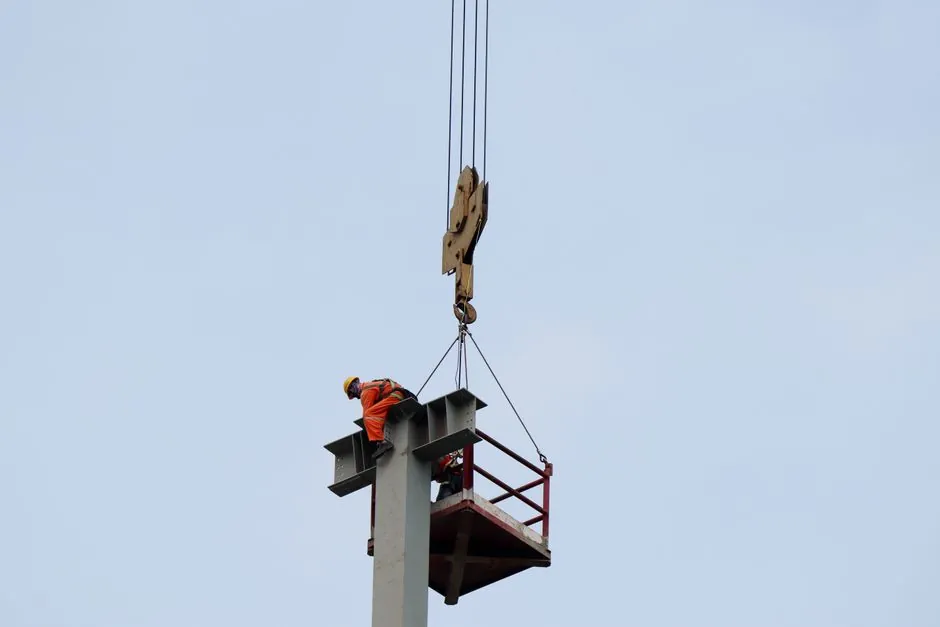
Single girder overhead cranes are rated by the majority of manufacturers at 10 to 15 tons maximum capacity, with 60 ft being the practical span ceiling for standard wide-flange sections [S3][S2].
Double girder bridge cranes are the default specification once a job exceeds 15 tons of rated load or 65 ft of span, and they remain the only practical configuration above 20 tons or 60 ft where fabricated box girders take over from rolled I-beams [S2][S5].
Where the 15-Ton, 65-ft Capacity Threshold Comes From
Industry guidance published in August 2026 and September 2026 frames the decision the same way: the single girder envelope caps out at 15 tons and 65 ft for cost-effective design, and anything heavier or longer routes to a double girder bridge [S1][S2]. One widely cited cost-effective design table lists single girder envelopes of 7.5 tons to 80 ft, 10 tons to 75 ft, 15 tons to 65 ft, 20 tons to 60 ft, 25 tons to 55 ft, 30 tons to 50 ft, and 35 tons to 45 ft, with the note that double girder is the better solution for capacities over 15 tons and spans over 65 ft [S2]. A second reference describes the typical single girder window as 5 to 20 tons [S7], and a third caps the upper bound at 10 tonnes with a 30 m maximum functional area [S4]. Where the line is drawn depends on the girder section (rolled wide flange vs welded box), the hoist class, and the duty cycle, not on girder count alone [S5].
For comparison, our related coverage of spur vs helical gears walks through the same kind of capacity-crossover decision where two architectures overlap in a usable middle band before one clearly takes over.
What Changes Above the 15-Ton Mark: Girder Section and Hoist Geometry
Once rated load passes 15 tons, the rolled I-beam or wide-flange single girder section runs out of headroom: standard structural beams are generally limited to 60 ft spans, with a slightly longer mill run available, and heavier single girder ratings force the section depth and weight per foot up fast [S5]. Above 20 tons or 60 ft, the only sensible construction is an engineered, CMAA-spec welded box girder, which lowers steel weight per foot at the cost of higher engineering and fabrication hours [S5].
Hoist geometry flips at the same boundary. A single girder crane uses an under-running hoist on the bottom flange, which keeps the whole package compact and saves headroom; a double girder crane moves the hoist on top of the girders, gaining 18 to 36 in of hook height in most cases and clearing the way for heavier open-winch hoists, split gearcases, and bridge-mounted service platforms [S4][S5]. That geometry change is also why a double girder crane can carry an auxiliary hoist for lighter or more precise lifts, something a single girder under-running trolley typically cannot accommodate [S1].
Single Girder vs Double Girder: Decision Matrix on Capacity, Span, Cost, Headroom
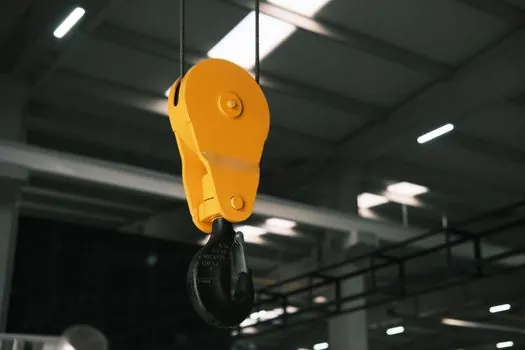
Lining the two options against the criteria that actually drive a buy: [S1]
Rated capacity. Single girder is commonly listed at 10 to 15 tons [S3], with one source quoting a hard 10-tonne ceiling [S4] and another putting the practical range at 5 to 20 tons [S7]. Double girder covers everything from the low end of the single girder envelope (with extra cost) up to heavy-mill ratings of 30 tons and beyond where box girders are mandatory [S2][S5].
Span. Single girder tops out around 60 ft for rolled sections, 80 ft in the most generous cost-effective table [S2][S3]. Double girder extends past that with fabricated box girders, which are the only practical option above 60 ft and 30 tons [S5].
Headroom and hook approach. Single girder under-running gives the best hook approach from both sides and the lowest building height for a given hook height [S2][S4]. Double girder top-running trades headroom for hook height, adding roughly 18 to 36 in of lift on most builds [S4].
Cost and installation. Single girder uses less steel, ships lighter, ties into existing building structure in many cases, and installs faster [S2][S4]. Double girder carries higher material, freight, and fabrication cost, partially offset above 20 tons and 60 ft by lower box-girder steel weight [S5]. For a deeper look at how material and weight decisions cascade into cost in adjacent equipment, see self-loading mixer truck vs transit mixer, which uses the same lightweight-vs-capacity trade-off pattern.
Duty cycle. Girder count does not, by itself, set duty class. End trucks, hoist, and trolley can be the same CMAA class A through F on either configuration, so a single girder can be specified for heavier service and a double girder for moderate service depending on the components [S5]. The default rule is to reach for double girder when the application is CMAA Class D (heavy service) or Class E (severe service) because the hoist package (open winch, split gearcase, heavy-duty motor, brake) needs the deck frame a top-running double girder provides [S5]. For a related duty-class discussion in a different product class, our plunger vs piston pump piece applies the same component-vs-frame logic.
Who a Single Girder Crane Is For, and Who Needs a Double Girder
Single girder is the correct call for light to medium duty lifts of 10 to 15 tons on spans of 60 ft or less, in facilities with limited headroom, existing runway structure, and lower cycle counts. Typical fits are warehouses, small machine shops, parts movement between workstations, and light fabrication [S1][S2][S3].
Double girder is the correct call for rated loads above 15 tons, spans above 65 ft, frequent high-cycle operation, applications that need maximum hook height, or any install that needs an auxiliary hoist or a service platform. Steel mills, foundries, iron and steel production, and heavy fabrication fall into this group [S1][S2][S5]. If your load creeps past 20 tons or your span past 60 ft, you are no longer choosing between single and double girder; you are choosing box-girder double girder, because the structural ceiling of a rolled wide-flange section has already been hit [S5].
Common Misconceptions That Drive the Wrong Spec

Two beliefs show up in nearly every buyer-side write-up and both are wrong. First, that a double girder crane is inherently heavier duty or longer lasting than a single girder crane: it is not. The hoist, trolley, and end trucks determine duty class, and those components can be identical on either configuration [S5]. Second, that girder count alone sets capacity: it does not. A well-engineered single girder crane can comfortably meet a 10 to 15 ton light-to-medium-duty job, while a poorly specced double girder crane at the same tonnage is just a more expensive way to do the same work [S1][S5].
The pragmatic rule is to size the system, not the bridge. CMAA classification (A standby through F continuous severe service), load weight, cycle count, span, and headroom all have to be locked in before the girder-count question even has a defensible answer [S3][S5].
How This Connects to Adjacent Industrial Spec Decisions
The single vs double girder decision follows the same logic as choosing between a 400 A and 630 A load break switch for a ring feeder, or between a vertical squeeze and a cold chamber die casting machine: a crossover band exists, and the correct answer is set by the rated operating point plus the surrounding constraints, not by the headline architecture. Our RMU load break switch sizing guide applies the same envelope-then-architecture pattern to a different product class, and the semi-trailer vs rigid truck concrete mixer comparison uses an analogous rated-capacity-and-duty trade-off. The single girder vs double girder crossover at 15 tons and 65 ft, with box-girder double girder mandatory above 30 tons or 60 ft, is the cleanest version of that decision pattern in the overhead crane catalog. [S1]
Trackable next signal: monitor CMAA 70/74 specification revisions and the box-girder fabrication cost trend, since the cost gap between fabricated box sections and heavy rolled wide-flange beams is what keeps moving the practical single-girder envelope up or down. Watch also for limit switch and limit switch box integration on higher-duty double girder hoists, where end-travel and overload cutouts are now bundled as standard on most Class D and Class E packages [S3].