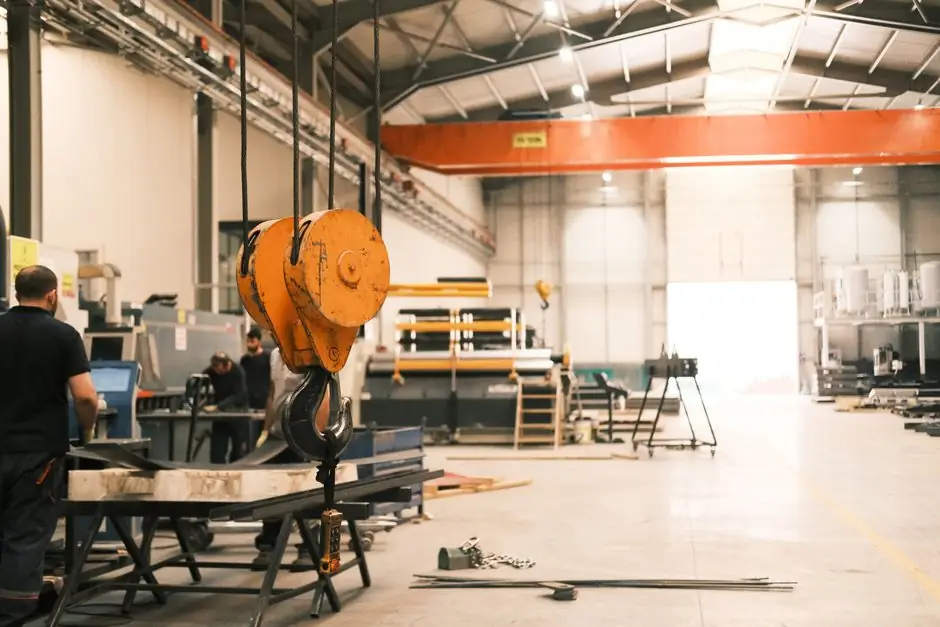
The crossover from a single girder crane to a double girder overhead crane sits at roughly 60–65 ft (18.2–19.8 m) of span for light-to-medium duty work, and shifts earlier, around 50 ft (15.2 m), once the lift climbs above 15 t [S1][S5].
For general factories running 5–20 t at moderate cycle counts, the practical single-girder envelope is 6 m up to about 18–20 m, with many standard models topping out near 30 m in lighter applications [S6]. Pushing past 31.5 m span or 32 t in a single-girder configuration typically forces the girder to switch to a fabricated box section or migrate to a double-girder system [S3].
Where the 60 ft / ~18 m Limit Comes From
The 60 ft ceiling is driven by the rolled-section supply chain, not by structural theory: standard wide-flange beams are commonly stocked in lengths up to 60 ft, and most single-girder cranes on the market are limited to spans of up to 60′ for that reason [S1]. At the heavier end of the single-girder range, cost-effective span shrinks linearly with capacity, dropping from 80 ft at 7.5 t to 45 ft at 35 t in the published cost-effectiveness table [S5].
That table draws a clear line: a double girder crane may be the better solution for overhead cranes that require capacities over 15 tons and spans over 65 feet (19.8 m) [S5]. Below that line, a properly designed single girder delivers comparable durability to a double girder in light to medium duty work, with less deadweight, lower freight cost, and a simpler tie-in to the existing building support structure [S1].
Single Girder vs Double Girder Across Decision Criteria
Hoist configuration is the most visible differentiator: a single girder carries an under-running or under-hung hoist on the bottom flange, while a double girder runs the hoist on top of the two parallel beams [S2]. That single change cascades into headroom, capacity, and span limits. A 20 t single-girder crane is typically restricted to spans of 10–25 m with a constrained lifting height, because the hoist body sits below the beam and consumes vertical clearance; a double girder at the same tonnage opens the full hook travel because the hoist rides above the girders [S4].
Cost follows the same shape: a single girder uses less steel and ships as one beam rather than two, which lowers both material and freight cost; a double girder carries more structural capacity into longer bays but adds end-truck complexity and runway load [S2][S5]. For layout planning, the FEM 1.001 / GB/T 3811 rule of thumb that crane span approximates column-center spacing minus 1.0–1.5 m applies to both types, but a double girder can hold its deflection tolerance over a wider center-to-center distance [S3].
Transport, Fabrication, and the 12 m Threshold

Beyond rolled-section length, physical transport introduces a second limit. The maximum legal transport length without special permits is around 12 m (40 ft), and any crane girder that exceeds this length requires either a special transport permit or on-site girder splicing [S9]. For a 20 m single-girder crane, that almost always means a field splice or a fabricated box girder, both of which start to erode the cost advantage that drives buyers toward single-girder designs in the first place.
That is also why a 20 m-plus single girder tends to be quoted as a fabricated box rather than a rolled I-beam: the cross-section stiffness per kilogram of steel improves, deflection at mid-span stays inside FEM 1.001 limits, and the splice can be engineered for the fatigue spectrum of the duty class [S3][S9]. A gantry crane variant handles the same span problem differently, with legs picking up the load, but for a building-mounted bridge the decision tends to split cleanly: stay rolled and single-girder up to 60 ft, switch to a fabricated box or a double girder above it.
Who a Single Girder Is For (and Who It Is Not)
A single girder overhead crane is the right answer for light to medium duty applications, including warehouses, small fabrication shops, parts movement between workstations, and loading bays where the load stays inside 5–15 t and the bay sits inside 18–20 m [S1][S2]. It is the wrong answer for steel mills, foundries, and iron and steel production facilities where loads regularly exceed what a single girder system can safely or efficiently handle, and where duty cycle keeps the hoist near rated capacity for sustained shifts [S2].
Capacity alone is not a clean signal: a 20 t single girder exists, but its maximum span typically ranges from 10 to 25 m and the lifting height is somewhat restricted by the under-hung hoist geometry [S4]. Once the application needs the hook to reach near the top of the building headroom and the span to clear a wide bay at the same time, a double girder takes over.
Failure Modes and Constraints Buyers Underestimate
Three constraints break single-girder designs in the field, and none of them are capacity at first glance. First, mid-span deflection: as span grows, the required girder depth grows faster than linearly, and rolled sections stop being cost-effective around 20 m for a Class C duty crane [S3][S6]. Second, end-truck wheel loads: a long single girder concentrates higher wheel loads on the runway rail, which can force runway upgrades that wipe out the single-girder material saving [S2].
Third, hook approach: the under-hung hoist steals a fixed block of vertical space (hoist body plus hook deadweight travel plus top safety clearance) that adds up to 700–1,000 mm of "lost" headroom in many real installations, and a single girder has no way to recover that space the way a top-running double girder can [S3]. Buyers focused only on tonnage frequently miss this until the crane is on the floor and the load will not clear the fixture it was meant to service.
Relevant Standards and Sourcing Anchors
Span, deflection, and safety-clearance deductions in modern single-girder and double-girder bridge cranes are typically engineered to FEM 1.001 and GB/T 3811, with U.S. installations often classified under the CMAA duty classes A through F (Infrequent through Continuous Severe Service) [S1][S3]. For buyers comparing an overhead conveyor or crawler crane against a bridge crane on the same factory floor, the same FEM framework applies, but the duty-class selection and the bay-length limits tend to drive the bridge-crane decision toward a double girder above the 20 m mark.
For procurement decisions specifically on the 15–25 t / 18–25 m crossover, a practical trackable signal is the supplier’s cost-effectiveness table: if the quoted single-girder span is below 50 ft at the required tonnage, or the duty class climbs to CMAA D or higher, expect the engineering review to redirect the quote to a double girder without changing the headline capacity number [S5]. A secondary signal is transport: any single girder quote that lists a girder length above 12 m should already include line items for field splicing, special transport permits, or both, and that line-item math is usually where the single-girder cost advantage quietly disappears [S9].
Related analysis: Heat alarm vs heat detector: sensing element, setpoints, and where each fits.