A complete skid steer loader pre-trip inspection is split into a pre-start visual pass and a post-start functional pass, with the Douglas County ORS-27 form listing 26+ check items across cab, undercarriage, engine, chassis, and interior zones [S1]. The Therma daily checklist mirrors the same structure and grades each line as P (Pass), F (Fail), or N/A, with a 200-character comment field for any F that explains the failure [S2].
Walkaround format is consistent across fleets: a single-page sheet captures date, hour-meter reading, operator name, and a vehicle sketch where damage is tagged with letter codes A through F, where A is scratch/scrape, B is broken, C is cracked, D is dented, E is loose, and F is missing [S1]. That taxonomy is the same one used by fleets logging skid steer loader service intervals into Cat Inspect or equivalent telematics portals [S5].
Phase 1, Pre-Start Visual Items: Fluids, Structure, ROPS/FOPS
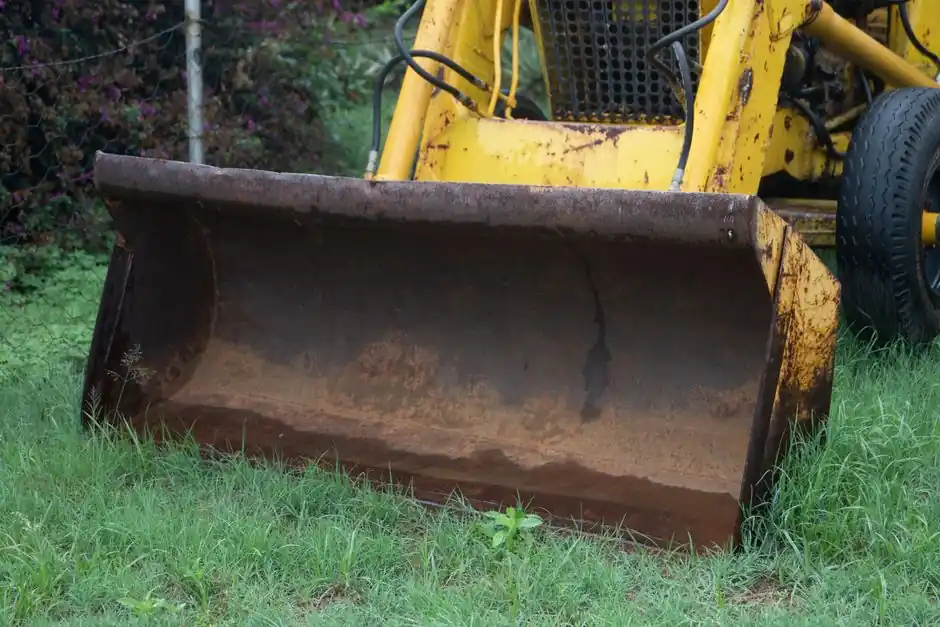
Pre-start items on the Krawford Skid Steer Pre-Inspection form include 16 line items to verify before key-on: bucket, cutting edge, mirror/windows, windshield, tires (cuts, wear, pressure, lugs), tracks if loader, ladder/grab handles, hydraulic cylinder lines, hydraulic level, exterior leaks, FOPS/ROPS, engine oil, coolant, belts, and air filter [S4]. Fuel level is logged as a quarter, half, three-quarter, or full circle on the same form, so a half-tank rule can be enforced before the operator leaves the yard [S4].
ROPS/FOPS verification is a hard gate: a missing or damaged falling-object protective structure is treated as a fail-to-start, and the seat bar plus seat belt are paired line items because both must latch before any lift-arm motion is allowed [S1][S4]. Operators also confirm battery terminals are tight, clean, dry, and secure, since vibration-induced terminal loosening is a top-3 cause of no-start on rented skid steer loaders [S1]. Hydraulic oil, engine oil, and engine coolant are checked cold, before the engine is turned over, because level readings on a warm system are unreliable [S2][S7].
Phase 2, Post-Start Functional Items: Controls, Alarms, Lift Cycles
Once the engine is running, the operator cycles backup alarm, horn, lights, and instrumentation, then runs the lift arm up/down and bucket/attachment tilt up/down to confirm hydraulic response [S2][S4]. Therma's daily form further requires confirming that the engine sounds normal, instruments read normal, controls operate normally, and the exhaust shows no leaks or excessive smoke [S2]. Forward and reverse steering are checked separately, because hydrostatic steering failure on one side is a common symptom of low hydraulic oil or a charge-pressure leak [S4].
Backup alarms are listed as a stand-alone check on every published form, including ORS-27, Krawford, and the Mitti pre-op template, because OSHA 1926.602(a)(3)(ii) requires an audible reverse signal on earth-moving equipment, and a muted alarm is a documented write-up line, not a pass [S1][S4][S7]. Operators also test the seat bar interlock: the lift arm and tilt must dead-head when the bar is up, which is the only verifiable test that the operator-presence switch is functional [S2][S4].
Quick Decision Table: Pass / Fail / N/A on the 4 Highest-Risk Lines

The four line items that most often force a machine off-rental are ROPS/FOPS, backup alarm, seat belt latch, and hydraulic line leaks, and they are graded against a fixed rule set: [S4]
1. ROPS/FOPS: any visible crack, missing bolt, or non-OEM weld = Fail, no N/A allowed [S1][S4].<br>2. Backup alarm: no sound at key-on = Fail; alarm present but < 90 dB at 1 m should be re-tested, not passed [S2][S7].<br>3. Seat belt latch: buckle does not click or webbing is frayed > 25 mm = Fail; retract failure alone = Fail [S1][S4].<br>4. Hydraulic line leaks: any active drip, not just a weep, from a cylinder rod, fitting, or hose = Fail; cosmetic residue with no fresh oil is typically N/A but logged in comments [S1][S2][S4].
This 4-line gate is the same logic Peterson Cat walks operators through before releasing a Cat 262D3 or 272D3 skid steer loader into a customer fleet, with the inspection results stored in Cat Inspect for warranty and telematics integration [S5].
Common Failure Modes Caught at Pre-Trip, Not Mid-Job
Track tension on compact track loaders sits at the top of mid-job failure lists, but the Krawford form makes it a pre-start item, since a loose track throws within the first 30 minutes under load [S4]. Counterweight bolts are checked on every shift because the cast-plate counterweight on a 2,500-3,500 kg skid steer transmits all bucket pry forces into the rear frame, and a single missing bolt shifts the load path and cracks the chassis [S1].
Hydraulic couplers for the bucket and attachment are also walked at pre-trip, with the operator confirming that the quick-connect is fully seated and the auxiliary lines are not crossed, since a crossed pair at start-up will swing the attachment the wrong way on first command and is a common cause of struck-by injuries on rental yards [S1][S4]. Operators also log the hour-meter reading, because pre-trip intervals on engine oil (typically 250 h), hydraulic oil (1,000 h), and filter change (500 h) are all hour-triggered on most models [S4][S7].
What the Inspection Form Will Not Catch

A paper pre-trip does not measure internal hydraulic pump wear, hydrostatic motor charge pressure, or final-drive chain stretch, and these are the failure modes that drive the rebuild-vs-replace decision covered in Skid Steer Lifespan and Replacement [S5]. For fluid analysis (S-O-S sampling) the form also does not replace a scheduled lab draw, so a Pass on hydraulic level does not mean the oil is still in spec after 1,000 h [S5].
Telematics platforms such as Cat Inspect, VisionLink, and Mitti add a digital layer for fault-code capture and photo evidence, but the operator still has to walk the same paper checklist at start-up, and federal- and state-level fleet audits (Douglas County ORS-27 included) require a wet-ink signature, not a tablet tap [S1][S3][S7].
Sourcing, Standards, and Record Retention
ORS-27 is the published reference form used by Douglas County, Georgia fleets and explicitly requires a daily signature, while the Therma form (2023-04-14) and Krawford form (2016 revision) are widely copied by contractors who want a 7-day grid for Monday-through-Sunday sign-off [S1][S2][S4]. Commercial logbook versions such as the LogBooks SCADD(SS) ship 75 carbonless 2-part forms per pad, with the duplicate retained for office records and the original left in the cab [S6].
For 100-page bound books, the Amazon B0BRQ64558 listing confirms an 8.5 x 11 in format that mirrors the same 26-line item count, and free Mitti and Cat Operator Training templates cover the same ground for fleets that prefer a digital-first workflow [S3][S7][S8]. Across all eight references, the inspection schema converges on the same two-phase, 30+ line structure, so a checklist written for one brand transfers cleanly to Bobcat, Cat, Case, John Deere, and Kubota skid steer loaders without modification [S1][S2][S3][S4][S5][S6][S7][S8].
Trackable signals for the next planning cycle: the OSHA 29 CFR 1926.602 subpart on vehicle-mounted cranes and earth-moving equipment, and any fleet adoption of Cat Inspect S-O-S hour-triggered alerts; both will shape whether paper forms remain the audit-of-record or shift fully to telematics-stored evidence [S3][S5].
Spec-level background on the components involved: backhoe loader, and wheel loader.