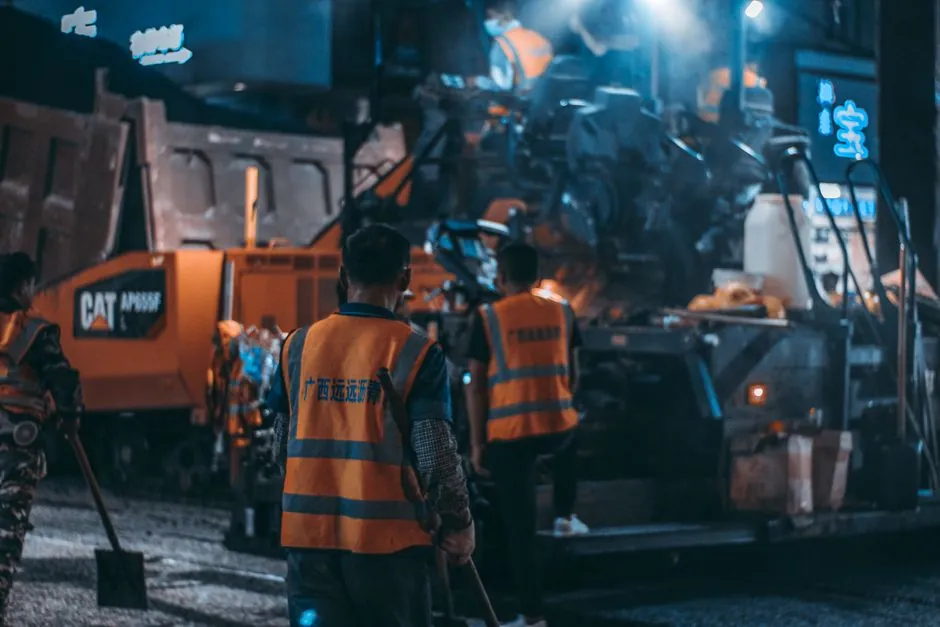
Skid-steer loaders are involved in crush, run-over, and rollover incidents that OSHA attributes chiefly to bypassed interlocks, defeated seat-bar interlocks, and untrained operators, with 100 recorded IMIS accidents between 1997 and 2007 tied directly to the machine class [S1].
The hazard profile is structural: the operator sits between the two lift arms and enters through the front by stepping over a lowered attachment, putting the operator inside the lift-arm movement zone whenever controls fire inadvertently [S2]. That geometry is what makes the control interlock, side screens, ROPS, FOPS, and seatbelt non-optional engineering controls rather than comfort features.
Mandatory Safety Devices and What Each One Actually Does
OSHA SHIB 01-12-2009 lists the four common safety features on a modern skid-steer loader as seatbelt, Falling Object Protective Structure (FOPS), Roll-Over Protective Structure (ROPS), and a Control Interlock System, with many machines also using a pull-down armrest or seat bar as the interlock actuator [S1]. The control interlock requires the seatbelt be secured or restraint bar be properly positioned before the operational controls can function, ensuring the operator is seated outside the lift-arm zone before any hydraulic motion is possible [S2][S3].
Side screens, integrated with the ROPS in metal or glass, stop the operator from leaning into a moving lift arm and also keep debris out of the cab [S2][S3]. SAE International standard J1388 (Surface Vehicle Standard) is the design guideline that addresses machine rollovers, lift-arm-to-frame pinch, and attachment-to-frame crush hazards on this machine class [S2]. On a skid steer loader the "zone of protection" is the combined envelope of ROPS + FOPS + side screens + operator restraint, and older units missing any of the four should be retrofitted through the OEM dealer before continued service [S5].
Operator Training and Qualification: What 29 CFR 1926.20(b)(4) Actually Says
29 CFR 1926.20(b)(4) requires the employer to permit only those employees qualified by training or experience to operate equipment and machinery, and OSHA's SHIB reinforces that the employer must train operators on the proper use of safety devices before assignment [S1][S3]. The Oklahoma State University CAO guidance goes further: skid-steer training is required prior to initial operation and annually thereafter, with operators required to wear safety belts every time the machine is started [S7].
Training must cover use and maintenance of all manufacturer-provided safety devices, safe entry and exit procedures, and safe operating procedures, and it must be documented [S3]. Workers on foot at the job site need separate awareness training and must use designated walkways plus high-visibility clothing, since struck-by and run-over risk is driven as much by ground-crew behavior as by operator behavior [S3].
Entry, Exit, and the Front-Access Crush Zone
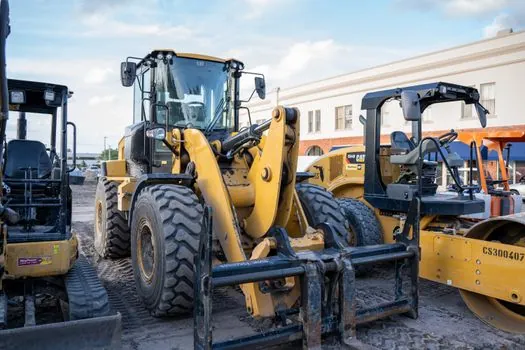
Skid-steer entry and exit is the single highest-risk routine task because the operator must step over a lowered lift arm and attachment; if controls fire during the maneuver the operator can be pinned between the lift arm and frame in under a second [S2][S3]. The accepted procedure is to enter and exit only when the bucket or attachment is flat on the ground, or when a lift arm support device is locked in place, while maintaining three-point contact with handholds and steps and never using foot or hand controls as grab points [S3].
Before leaving the seat the operator must lower the attachment flat, set the parking brake, and shut off the engine; the emergency exit is at the rear of the operator compartment or as specified by the manufacturer if the primary opening is blocked [S3]. A lift arm support device must be in place before anyone enters the space under a raised attachment, and improvised chocks such as concrete blocks or plain metal angle iron are explicitly disallowed because they can shift or collapse under even light loads [S3].
Slope, Load, and Center-of-Gravity Rules
The skid-steer center of gravity is concentrated at the rear between the wheels in an empty configuration, then shifts forward and higher whenever a load is carried in the bucket or on a front attachment, which directly drives tip and rollover risk [S5]. Carrying the load low, traveling straight up and down rather than across slopes, and pointing the heavy end of the machine uphill are the three operating rules that counter that shift, and an empty bucket should back up a hill while a loaded bucket drives forward up the hill [S5][S6].
Never travel across a slope, since the fixed-axle differential steering that gives a skid steer its zero-degree turn radius also means there is no steering recovery once the machine starts sliding sideways [S4][S6]. Recommended travel is up-and-down the fall line, with the heavy end pointed uphill and the load kept as low as the application allows.
Attachments, Hydraulics, and the Bypass Trap
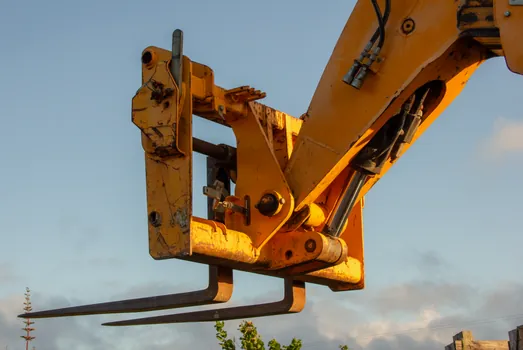
Attachment change-out is the most common origin of crush and injection injuries: hands and fingers get pinched during improper hook-up, and pressurized hydraulic fluid can be injected through the skin during a disconnected hose [S5]. The safest practice is to shut the machine down, exit properly, and engage the mechanical attachment locking device before any hands-on work; the operator manual remains the controlling document for torque values, pin engagement depth, and auxiliary hydraulic relief settings [S5][S8].
Never modify, disable, override, or bypass any safety system on the machine; if interlocks, seat belts, or the seat bar are found tampered with, the machine should be tagged out and the foreman notified before further use [S3][S4]. Operators should also confirm warning lights, gauges, and the attachment locking device are functional at the start of every shift, and that reverse signal alarms and beacon lights are present, since these are commonly missing on agricultural and ranch skid-steers and can be retrofitted [S5][S8].
Comparison: The Five Protection Systems vs Failure Modes They Counter
Matching the protective system to the specific failure mode is more useful than a generic safety checklist, since each device counters a distinct injury mechanism. ROPS + seatbelt together address the rollover ejection case; FOPS addresses the falling-load case; control interlock + seat bar address the inadvertent-control-activation case during entry, exit, and start-up; and side screens address the lateral-reach and lift-arm-strike case inside the cab [S2][S3][S5]. A unit that has ROPS and FOPS but a defeated interlock still leaves the operator exposed to the front-access crush scenario that drives the largest share of recorded fatalities [S1][S2].
The NTOF surveillance system lists the major fatal incident types as pinning between the bucket and frame, pinning between the lift arm and frame, crushing, rollovers, pinning between the loader and another object, and run-overs, which maps one-to-one onto the protection systems above [S2]. Injection injury from pressurized hydraulic fluid is a sixth mechanism that no structural device addresses and is controlled only by proper lockout before hose work [S5].
Standards, Source Hierarchy, and What OSHA Actually Enforces

OSHA construction regulations do not specifically address skid-steer loaders, so enforcement flows through 29 CFR 1926.20(b)(4) for operator qualification and the General Duty Clause (Section 5(a)(1) of the OSH Act) when a recognized hazard is not abated [S1][S2]. The applicable design standard is SAE J1388, which covers machine rollovers, lift-arm-to-frame, and attachment-to-frame crush hazards [S2]. OSHA's Powered Industrial Truck standard 29 CFR 1910.178 does not cover earth-moving skid-steers, which is a common mis-citation in field training [S1].
For sourcing decisions on replacement ROPS, FOPS canopies, interlock switches, and seat-bar kits, the OEM dealer network is the primary channel because the parts are model-specific and must match the certified structure, and the manufacturer manual remains the controlling document for any retrofit decision on older machines [S5][S8]. A practical next signal to track is the publication of any updated SAE J1388 revision or a new OSHA interpretation letter specifically addressing control-interlock bypass, since SHIB 01-12-2009 remains the most current federal guidance on this machine class [S1].
Spec-level background on the components involved: backhoe loader, and wheel loader.
For related coverage, see Tower Crane Spare Parts Catalog: Systems, Wear Items, and Sourcing.