
Backhoe loader downtime traces to five recurring failure clusters: hydraulic, electrical, tire, bucket/boom, and engine, each with distinct symptoms and service intervals [S2][S4][S5]. On a typical jobsite, emergency repair runs 3-9x the cost of the same job done on a planned schedule, which is why a documented daily walk-around outperforms ad hoc wrenching [S2].
Most unplanned stoppages on a backhoe loader start as small signals a 10-minute pre-shift check would have caught: a damp coupling, a slow boom under load, a tire losing 5-10 psi overnight, a frayed wire chafing against a valve bank. The five-system framing below maps each cluster to its dominant cause, its first symptom, and the prevention step that breaks the chain.
Hydraulic system: gradual wear versus sudden coupler failures
A gradual, season-long loss of lift and curl speed almost always traces to internal pump wear or piston-seal bypass, with oil escaping past gear faces, vane tips, or cylinder seals, and the machine keeps working but runs hotter and weaker every month [S2]. A sudden, complete loss of a function is a different failure class: a stuck quick-disconnect coupler, a collapsed suction line, or a relief valve dumping pressure; the fix is often a $15-50 part, not a pump [S2].
The temperature threshold that turns slow wear into fast damage sits around 180°F (82°C) in the hydraulic reservoir: above this, fluid begins to varnish seals and accelerate internal leakage, and a new pump installed on old, hot oil can fail in roughly 200 hours [S2]. The preventive moves are simple and cheap: check fluid level and condition on every walk-around, sample the oil at 250-hour intervals, and replace return and suction filters at the manufacturer interval rather than stretching them [S2][S4]. A wheel loader running the same fluid circuit will follow the same curve, so the 180°F ceiling and 250-hour filter rhythm transfer across fleets.
Electrical faults: wiring, fuses, and connector corrosion
Electrical faults on a backhoe loader are usually parasitic-current or no-start events traced to corroded connectors, chafed harnesses, and aged fusible links, and they are the second-largest unplanned-downtime bucket after hydraulics on most contractor fleets [S4][S5]. The early signals are intermittent gauge drop-outs, a starter that cranks slower on cold mornings, and a glow-plug or solenoid relay that only fails when the machine is warm.
Prevention is inspection density, not parts: every 50 hours, tug-test the main harness at the valve bank and at the cab-to-chassis pass-through, where vibration concentrates chafe; clean battery terminals and apply dielectric grease; and verify alternator output at 13.8-14.4 V engine running [S1][S4]. Lights, ROPS switches, and attachment harnesses should be functionally checked pre-shift, not assumed [S1][S6].
Tire wear and undercarriage stress on mixed terrain
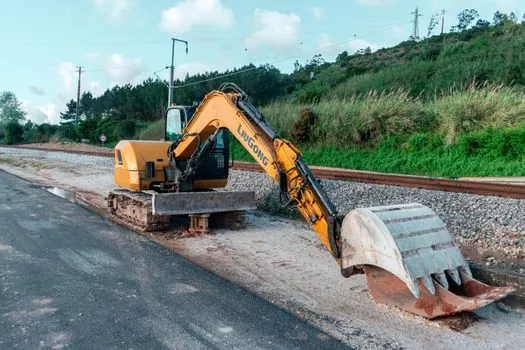
Backhoe-loader tires are a four-tire maintenance line of their own: cuts and sidewall damage from curbs and rebar, accelerated shoulder wear from chronic over-inflation, and center-bald wear from chronic under-inflation, each one tied to a specific pressure-management error [S1][S3][S5]. Operating pressures of 35-45 psi for the rear and 30-40 psi for the front are typical, but the exact number must come from the operator's manual and the load on the bucket at the time.
Daily checks should confirm inflation cold, before the machine has moved more than a few hundred yards, and a visual sweep for embedded debris in the tread and any bubbling on the sidewall. Stabilizer pads and swing-cast pins take real punishment when a machine is set up on asphalt or frozen ground, and a 30-second look under the rear frame often reveals the cracked pad or grease-less pin that will put the machine on a flatbed in two weeks [S3][S7].
Bucket, boom, and linkage: pins, bushes, and teeth
The bucket-and-boom cluster is mechanical and forgiving if the greasing schedule is held: worn pins and bushes cause the characteristic "chatter" at curl-back and a boom that drifts down when parked, while a single missing tooth sends impact loads back into the stick and the swing casting [S4][S5][S6]. A drifting boom is also a hydraulic symptom, which is why the gradual-versus-sudden split in the hydraulic section matters here too [S2].
Grease every 10 hours on the front loader linkage and every 50 hours on the backhoe boom, stick, and swing points, using the grade specified in the manual; off-brand greases with the wrong thickener will eat polyurethane bushings in months [S4][S6]. Inspect bucket teeth daily once wear exceeds about 30% of original length, and replace as a full set; mixing a new tooth against three worn ones loads the adapter unevenly and cracks the weld [S4][S5]. The construction machinery and equipment reference category lists common tooth profiles and pin dimensions for spec cross-checks.
Engine and powertrain: oil, coolant, and the overlooked air path
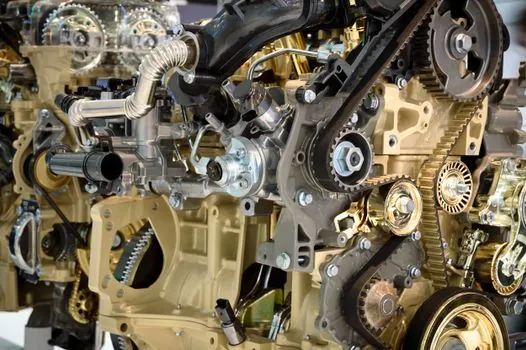
Engine failures on a backhoe loader are rarely "the engine": they are usually cooling-system neglect (a 50-cent radiator cap that lets pressure drift), fuel-quality issues from unfiltered site fuel, or an air filter that restricts until the turbo over-speeds the seals [S1][S4][S5]. Pre-shift checks should include engine oil on the dipstick, coolant level in the recovery tank, and a glance at the air-filter restriction indicator if the model has one [S3].
Stick to the engine-maker oil and coolant specs rather than generic substitutes: many modern diesels specify low-SAPS (sulfated ash, phosphorus, sulfur) oil to protect the aftertreatment, and the wrong grade will plug the diesel particulate filter well before its design service life. A similar power trowel maintenance schedule groups daily, 50-hour, and annual tasks; the same cadence translates to the backhoe engine, with daily checks, 250-hour oil and filters, and 1000-hour coolant and belt service.
Daily walk-around: 10 minutes that change the math
A pre-shift walk-around takes 8-12 minutes and replaces a $3,000 emergency repair: under the hood for fluid levels, under the machine for fresh drips on the swing casting, around the tires for pressure and damage, inside the cab for gauges and lights, and around the linkage for loose pins and chafed hoses [S1][S3][S6][S7]. The operator's report card after the walk-around should answer two questions: "What is different from yesterday?" and "Is any fluid level more than a finger-width below the full mark?" [S2].
Two trackable signals to watch: (1) hydraulic reservoir temperature climbing more than 5°F per shift, which is the earliest measurable signal of internal pump bypass, and (2) the dollar-cost ratio of planned versus emergency work, which should fall toward 1:1 as the inspection cadence matures. Pairing this rhythm with a lighting equipment check on the work lights, plus a daily ROPS-and-seatbelt verification, closes the safety loop on the same walk-around rather than adding a separate round [S1][S3].