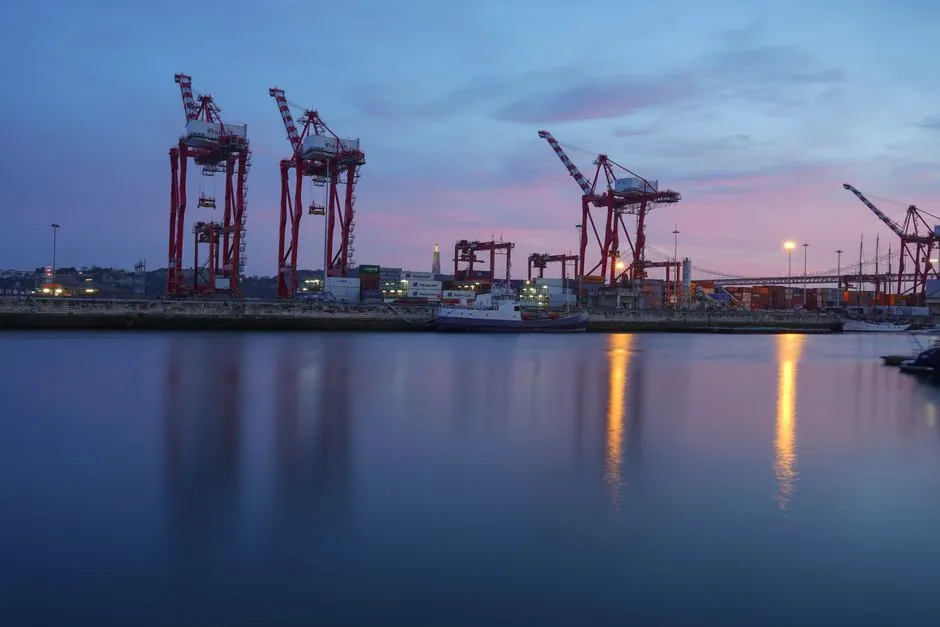
A skid steer replacing a worn unit at the Louisville Riverport Authority dock in 2024 had to clear residual bulk from barges, recover spillage during transload, and load locally produced Sul-4-Plus fertilizer, with the quoted CAT 255 priced at $81,508.78 and a 12-week dealer delivery [S1].
That single procurement, filed under Kentucky's KRI grant program, illustrates the operating envelope most inland terminals actually need: ROC in the 1,500-2,700 lb band, diesel or diesel-equivalent power around 60-75 hp, and a hinge-pin height sufficient to dump into standard 4 ft hopper walls. A general skid steer loader reference frames the rest of the spec map below.
ROC and Operating Weight Bands Used at Working Terminals
Rated operating capacity is the single most cited number in port and rail-yard applications, because the bucket typically loads cement raw feed, fertilizer, and aggregate oversize at 1.5-2.0 times bucket struck capacity per pass [S2].
Across the 2017 OEM spec table, small-frame radial-lift models cover the 1,050-1,350 lb ROC range at 4,000-5,130 lb operating weight, suitable for sweep-and-clean duty on flat wharf decks [S2]. Mid-frame vertical-lift machines move into the 1,800-2,400 lb ROC band at 6,000-7,500 lb operating weight, which is the working envelope for hold-edge scraping where the bucket must reach over coaming steel [S2]. The LRA's CAT 255 sits in that mid-frame band, displacing a machine that had logged over 2,025 operating hours in three years, a duty cycle consistent with two shifts of transload cleaning [S1].
Auxiliary Hydraulic Flow, High-Flow, and Attachment Fit
Standard-flow auxiliary hydraulics in the 14.5-18.5 gpm range run most buckets, brooms, and pallet forks, but rotating cutters, snow blowers, and high-pressure wash heads need 23-25 gpm high-flow circuits [S2].
ASV's RS-75 radial-lift platform ships with 21.3 gpm (80.6 lpm) auxiliary flow at 3,335 psi (230 bar) system pressure, with dual 1/2 inch flat-face quick couplers plus a 3/8 inch case-drain line, which is the geometry needed for powered brooms and rotary cutters at terminal apron edges [S6]. Cat's larger D3-Series range covers 50.1-82.0 kW gross power (67.1-110.0 hp per SAE J1995:2014) and 1,550-3,700 lb ROC, with operating weights from 5,849 lb (226D3) to 9,573 lb (272D3 XE) [S3]. For comparison, the broader market runs from 370 lb ROC compact units up to 4,130 lb ROC heavy-frame machines, with operating weights spanning 1,750-18,528 lb [S7].
Engine Power, Tier Compliance, and Diesel Strategy
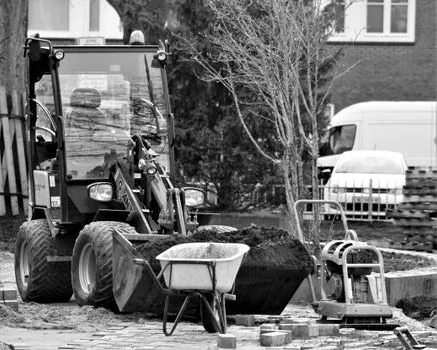
Most working terminals standardize on diesel because of refuel logistics, with 60-85 hp covering 90% of ROC classes from 1,500 to 3,000 lb [S2].
Cat's D3-Series maps cleanly: 226D3/232D3 use the Cat C2.2 turbo at 50.1 kW gross, 236D3/242D3/246D3/262D3 use the Cat C3.3B DIT at 55.4 kW, and 272D3/272D3 XE step to the Cat C3.8 DIT at 73-82 kW [S3]. Kubota's SSV65 and SSV75 sit at 64 hp and 74.3 hp respectively, paired with 1,950 lb and 2,690 lb ROC [S2]. Yanmar's S220R-1 and S270V-1 deliver 70.7 hp at 2,200 lb and 2,700 lb ROC with 23.5 gpm standard flow, a useful upper-mid benchmark for ferry apron and rail-truck transfer duties [S2].
Lift Path: Radial vs Vertical, and Why It Matters at the Coaming
Vertical-lift linkages give parallel lift through the working arc, which keeps a loaded bucket from tipping forward when reaching over a barge coaming; radial-lift linkages give higher peak breakout force at ground level but arc backward as they rise [S2].
For hold cleaning and reach-over loading, vertical-lift platforms in the 1,800-2,700 lb ROC band, with hinge-pin heights of 120-130 in, are the standard recommendation [S2]. Cat's 246D3 at 1,000 kg (2,200 lb) ROC and 246D3/262D3 at the same ROC with 55.4 kW gross illustrate the typical vertical-lift mid-frame package [S3]. The ASV RS-75, while a radial-lift design, demonstrates that compact radial platforms still serve in sweep and material-handling roles where reach height is not the gating constraint [S6].
Dimensions, Visibility, and Apron Maneuverability
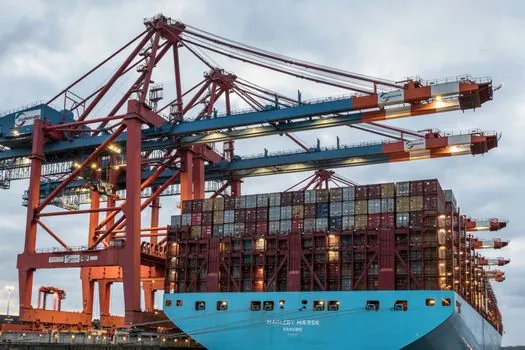
Static dimensions matter because terminals run mixed fleets through the same choke points: aprons, rail-car doorways, and barge-deck hatches impose width and height limits before they impose weight limits [S4].
JCB's small-frame skid steers (models 155, 175, 210, 215) share an 11 ft 5 in (3.49 m) overall length, while the large-frame 250, 270, 300, 330 stretch to 12 ft 6 in (3.8 m), with radial and vertical variants in each frame [S4]. For the LRA application, the CAT 255 footprint had to clear barge-deck coamings and rail-car thresholds, which is why a 3.5-3.8 m overall length is the practical working envelope for transload-class machines [S1][S4]. Cab-forward designs with low-profile booms, such as Yanmar's S-Series, are specifically engineered to give side-to-side visibility when working next to rail cars and vessel sides [S2].
Use Cases, Limitations, and Operator Notes
Inside a working port, a skid steer is most often deployed in four roles: barge and rail-car hold-edge scraping, spillage recovery under hoppers, fertilizer and cement-raw-feed loading, and seasonal snow/ice clearing on apron and rail lead tracks [S1].
Limitations are real. Standard-flow hydraulics will not run a high-demand rotating cutter without a high-flow kit; a radial-lift machine will spill a loaded bucket if extended too far past a coaming; and a 1,000-1,300 lb ROC machine, while cheaper, cannot lift a half-yard aggregate bucket through a full lift cycle at the rates a two-shift transload operation demands [S2][S6]. For broader fleet context, see this backhoe loader spec map for urban infrastructure, which addresses the larger carrier class used at intermodal yards. For adjacent bulk-handling equipment pairing a skid steer with, the bucket elevator selection map for port logistics walks through matched throughput sizing. A related selection exercise for road-building sites, covered in the skid steer loader selection for road construction: spec map and decision gates, shares the same ROC-vs-flow decision gates but tilts the application toward grading and trenching.
Decision Snapshot: Which Skid Steer Class for Which Terminal Duty
Small-frame radial-lift, 1,000-1,500 lb ROC, 33-45 hp, suits sweep-only duty on flat wharf decks and light spillage recovery where machine footprint and shipping weight dominate the spec [S2].
Mid-frame vertical-lift, 1,800-2,700 lb ROC, 60-75 hp with 17-24 gpm standard flow, is the default for hold-edge scraping, fertilizer transload, and rail-car cleaning; this is the working envelope the LRA's CAT 255 procurement falls into [S1][S2]. Large-frame vertical-lift, 3,000-3,700 lb ROC, 74-110 hp with high-flow hydraulics, is reserved for intermodal yards, scrap handling, and snow-blower duty on apron lead tracks, where lift height and sustained hydraulic power outweigh acquisition cost [S3][S4]. For comparison, Wacker Neuson's SW24 (74.3 hp, 2,350 lb ROC, 6,717 lb breakout) and SW28 (2,800 lb ROC) sit in the upper mid-frame and are commonly specified for mixed-fleet terminal use [S2].
Track the next procurement signal at port authorities like LRA, and watch for whether 2026 RFQs spec high-flow auxiliary kits or stick with standard-flow at the 17-24 gpm range; the answer will tell operators whether the market is migrating toward powered broom and rotary cutter attachments, or sticking with buckets and forks as the dominant work tools [S1][S2].
Detailed specification references: terminal block, and backhoe loader.