
Landfill duty is a worst-case envelope for a compact loader: mixed demolition debris, daily-cover soil, MSW, green waste, occasional C&D, and standing water on a working face that grades from 3:1 to 4:1. Mid-size skid steers in the 1,750–2,200 lb rated operating capacity band with 50–70 HP engines remain the most rented class for solid-waste sites, because they pair ROC with a tire package narrow enough to cycle on haul roads and tip floors [S5].
Selection drivers differ sharply from landscaping or general construction: dust ingestion, abrasive wear on buckets and quick-couplers, hot surface contact with decomposing waste, and the need to push, rather than just carry, cover material. Those constraints reorder the usual criteria (size, ROC, lift path, attachment) and push buyers toward high-flow auxiliary hydraulics, sealed cabs with HEPA-style filtration, and puncture-resistant tire options [S2][S3].
Wheeled vs. Tracked on a Working Face
Tracked compact loaders (CTL) win on soft, uneven terrain because of lower ground pressure and superior flotation over churned-up cover soil and wet tipping floors, while wheeled skid steers remain faster on hard haul roads and graded pads [S3][S5]. On a typical municipal landfill, the daily face is a moving mix of compacted clay cover, shredded green waste, and standing leachate, so most fleets still default to wheeled machines and reserve a CTL for the leachate pond perimeter and gas-well work.
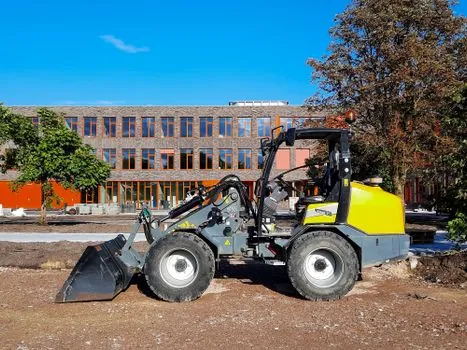
For a wheeled unit on a working face, specifying solid or foam-filled tires, or heavy-duty pneumatic with thick sidewalls, is non-negotiable: rebar, nails, and broken glass are routine, and a single sidewall failure stalls a truck-loading cycle. The trade-off is ground pressure: a wheeled 2,000 lb ROC skid steer at full load exerts roughly 35–40 psi per tire on a hard surface, several times a track's footprint, so operators stage CTL support for soft areas rather than running wheels into them [S2][S3].
Engine, Hydraulics, and ROC Class for Waste Handling
Landfill work loads the hydraulic circuit continuously: pushing a 72–84 in. landfill bucket, powering a drum mulcher for green waste, or running a 4-in. trash pump for leachate. A 50–70 HP mid-size skid steer with 18–25 gpm standard-flow hydraulics covers routine bucket and broom duty, but high-flow (around 30–40 gpm) auxiliary circuits are required for hydraulic drum mulchers and cold planers used in cap repair [S5].
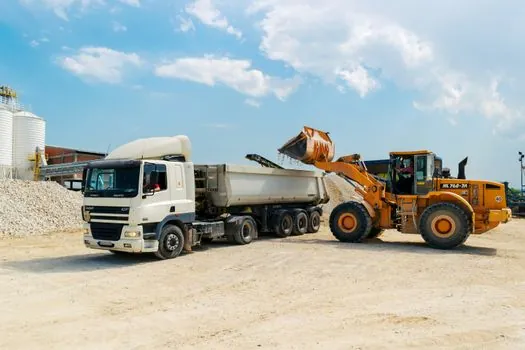
Rated operating capacity must be matched to the densest material routinely moved. MSW in a loose face runs 250–400 lb/yd³, while saturated cover soil can exceed 1,500 lb/yd³; specifying 2,200 lb ROC for a 72 in. bucket gives roughly a 50% margin against overloading when the bucket cheats full on wet clay. For sites that load transfer trailers or intermodal containers, the radial-lift path is preferred over vertical-lift because the heavier breakout force and longer reach at mid-height suit truck loading [S2][S9].
Enclosure, Filtration, and Operator Protection

Landfill air contains particulate, VOCs from decomposing waste, and hydrogen sulfide near the working face, so a sealed, pressurized cab with category-2 or higher filtration is standard on new specifications, paired with an outside air intake rather than recirculation [S2]. Most landfill operators also require backup cameras and reverse alarms, because approach angles to the working face can exceed 25% and visibility over a 72 in. bucket is limited.
Heat is the second enclosure driver: waste decomposition raises surface temperatures, and summer working faces can hold 50–60°C at midday. A cab with integrated HVAC, tinted polycarbonate doors, and LED work lighting is now common; machines without it are typically restricted to morning or winter shifts. Routine maintenance intervals are shortened in landfill service: air-filter service at 250 hours versus 500 in general construction, and hydraulic return filters at 500 hours rather than 1,000 [S6][S7].
Attachment Strategy for Daily Landfill Tasks
Daily cover and pushing is the highest-hour task, so a 72–84 in. general-purpose or landfill bucket with a bolt-on cutting edge is the primary attachment, paired with a tooth bar when the cover material includes demolition debris. For green-waste and brush processing, a hydraulic drum mulcher rated to 8–10 in. diameter material handles typical yard trimmings; for larger C&D wood, a horizontal grinder is more efficient but requires a wheeled loader in the 3.0–4.5 yd³ class rather than a skid steer [S1][S4].
Specialized landfill attachments include landfill compactor wheels (which a skid steer does not run), leachate aerators, and trenchers for gas-well laterals. Quick-coupler standardization matters: a hydraulic quick-coupler lets an operator swap a bucket for a drum mulcher without leaving the cab, which on a landfill shift can add 30–45 productive minutes per day. Operators are also advised to use bucket-level indicators and ride-control, because loaded travel on rough cover at 8–12 km/h is the most common spill and tire-damage scenario [S2][S6].
Tire, Undercarriage, and Maintenance Intervals
Tire selection is the single highest-wear cost line on a landfill skid steer, so spec sheets should call for heavy-duty pneumatic with reinforced sidewalls, solid or foam-filled for the most contaminated cells, and a documented rotation interval of 250–500 hours. Tracks on a CTL, when used, need daily clean-out of debris from the sprocket and idler area; landfill grit accelerates pin and bushing wear, and undercarriage life can drop to 1,500–2,000 hours versus 3,000+ in general construction [S3][S6].
For more on the ROC and lift-path decision tree that drives loader class selection, the skid steer loader reference page covers frame size and lift geometry. Where a site needs a larger bucket than a skid steer can carry, the wheel loader selection map is the next step up the size curve. For sites that pair a skid steer with a compactor on a tight tip floor, the backhoe loader reference covers the backfill and trenching side of cell construction.
Spec Comparison: Wheeled Skid Steer vs. CTL for Landfill Duty
The two machine families trade off across four decision criteria that matter on a working face. On ground pressure, a CTL at roughly 4–6 psi wins on soft cover and leachate pond perimeters, while a wheeled skid steer at 30–40 psi per tire is restricted to graded haul roads and dry pads. On travel speed, the wheeled machine's 12–18 km/h beats the CTL's 8–11 km/h, which is decisive on larger sites with long transfer distances. On undercarriage wear, a wheeled machine carries only tire cost (typically $400–800 per set replaced at 1,000–1,500 hours), while a CTL's full undercarriage rebuild at 2,000 hours is materially higher [S3][S5][S6].
On attachment flexibility, both run the same quick-coupler standard and high-flow hydraulics, so a single attachment inventory covers the fleet. On operator comfort and visibility, wheeled machines offer a wider cab footprint at the same ROC class, while CTLs sit lower with better sightlines over a 72 in. bucket for fine grading. For most municipal landfills, the practical answer is a mixed fleet: 70–80% wheeled mid-size skid steers for the bulk of daily cover and truck-loading, plus one or two CTLs staged for the wet cells and gas-well work [S2][S5].
Limitations, Failure Modes, and Sourcing
Skid steers are not landfill compactors: a wheeled unit does not produce the kneading action or the sheepsfoot-style foot that a dedicated compactor uses to achieve refuse density, and using a skid steer for primary compaction yields lower in-place density and more cover-soil consumption per ton. They are also not suitable for steep working-face grading above roughly 30% slope, where a tracked dozer or purpose-built compactor maintains traction and stability. Routine failure modes on landfill duty are hydraulic contamination from dust ingestion, quick-coupler pin wear, and electrical faults from vibration and heat; a rigid PM schedule with 250-hour air-filter service and 500-hour hydraulic-filter service is the most cost-effective mitigation [S6][S8].
Sourcing guidance: most municipal buyers in 2026 are moving to 5-year total-cost-of-ownership procurement rather than lowest-bid acquisition, with a guaranteed buyback at year 4 or 5, and with telematics (VisionLink-equivalent or OEM-native) required for undercarriage and engine-hour reporting. Rental fleets are specified at 1,750 lb ROC as the entry size and 2,200 lb ROC as the workhorse, with a smaller share at 3,000+ lb ROC for transfer-station and C&D-cell duty. For broader compaction and grading work that sits outside a skid steer's envelope, see the motor grader selection map for quarrying as a reference for higher-power class comparison.
Trackable signals to watch over the next 6–12 months: OEM announcements on diesel-electric hybrid skid steers aimed at landfill and indoor transfer-station duty, updates to operator-station dust standards (likely tightening in jurisdictions that follow ISO 17916 for operator-controlled compact equipment), and any revision of SAE J1113 / J1455 electromagnetic compatibility test levels as more electrified loaders enter waste service. Buyers specifying in late 2026 should lock in cab-filtration, high-flow, and undercarriage options now, because lead times on purpose-built landfill-spec machines routinely run 4–6 months.