Quarry haul-road economics are decided by the motor grader, not the dump truck, because a 1% rolling-resistance increase on a poorly maintained pit road burns measurable fuel across every loaded cycle [S2]. For aggregate and dimension-stone operations, the right machine is a 250 hp+ rigid-frame mining grader with a 14–16 ft moldboard, not a 150 hp road-build unit that has been dressed up for the rock pit [S3][S4].
Selection falls into three load-bearing axes: power class (hp and operating weight), frame configuration (rigid versus articulated, number of axles), and moldboard geometry matched to haul-truck wheelbase and pit width [S5][S6]. Each axis has hard disqualifiers, which is why quarry procurement teams should treat motor grader specs the way they treat crusher liner profiles: as a long-tail operating cost driver, not a one-line catalog choice.
Power Class Bands and What They Actually Mean in a Quarry
Small graders cover 80–150 hp and target landscaping, subdivision roads, and light utility work, where machine mass stays under roughly 13 t and moldboard lengths sit at 10–12 ft [S5]. These units lack the front-axle weight and torque reserve to push a windrow of shot-rock spillage or hold a crown on a wet clay bench floor, so they are wrong for any active pit ramp with 40 t class haul trucks.
Medium graders span roughly 150–250 hp and handle municipal road base, ditching, and snow removal, with operating weights in the 13–19 t band and moldboards around 12–14 ft [S5]. Some contractors deploy them in small aggregate quarries, but the limiting factor is not horsepower, it is machine mass: a 16 t grader cannot hold a consistent grade under a 50 t loaded articulated truck without continuous rework passes, which inflates labor cost per kilometer of maintained road [S3].
Large mining graders start around 250 hp and run past 500 hp, with operating weights of 30 t and up and moldboards in the 14–16 ft range, sized to straddle a haul-truck wheel track in a single pass [S1][S4]. Caterpillar's mining-grade 24-class and 18-class machines are positioned specifically for this duty, with all-wheel drive, frame-articulation, and a 16 ft moldboard standard on the largest units [S1]. For an aggregate or hard-rock quarry running 40–100 t haul trucks on continuous production schedules, this is the only class that pencils out on a per-meter-of-maintained-road basis.
Frame and Axle Choices: Rigid, Articulated, and All-Wheel Drive
Motor graders come in three frame configurations that map directly to maneuverability and traction: rigid frame, articulated frame, and articulated frame with all-wheel drive (AWD) [S5][S6]. Rigid-frame units are cheaper to maintain because they have fewer wear items at the articulation joint, but their turning radius is materially larger, which is a problem on tight quarry benches and switchback ramps under 8 m wide.
For quarry work, articulation is effectively mandatory below a pit-floor width of about 20 m; above that, rigid frames remain acceptable for long, straight haul-road maintenance.
All-wheel drive adds a driven front axle and a no-spin differential, and is the single biggest traction upgrade a quarry can specify, because pit floors run wet, oily, and shot-rock-strewn for the entire operating life of the pit [S1][S3]. AWD graders hold a load on a 10% adverse grade that a 2WD equivalent simply cannot, and they do it without the operator feathering the throttle, which is when moldboard chatter and premature blade wear both spike.
Moldboard Geometry: Width, Arc, and Pitch
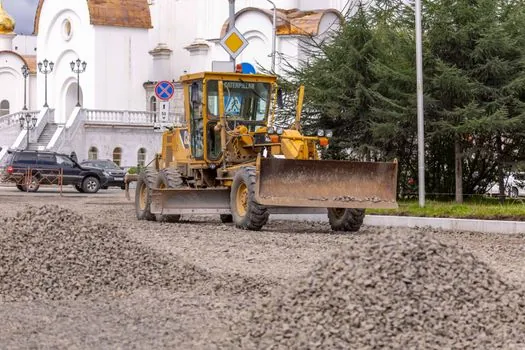
The moldboard is the working tool, and three numbers control its productivity in rock: width, arc, and pitch [S3][S4]. Width is the easy one: 14 ft for medium pits with 40 t trucks, 16 ft for large pits with 90 t and up trucks, because the blade must straddle the tire track in a single pass to avoid the "bird-bath" centerline depression that pumps water into the subgrade and accelerates tire wear on every loaded truck [S2].
Arc (the angle of the blade to the direction of travel, typically controlled between roughly 0 and 90 degrees off-center) determines whether material rolls ahead of the machine or side-casts off the shoulder [S3]. For quarry bench work, operators run a 30–45 degree arc to windrow spillage to the windrow side, then return on a flatter arc to spread and crown. Pitch controls the cutting angle relative to the ground, and a steeper pitch bites harder into compacted shot-rock but burns fuel and stresses the drawbar; quarry operators typically run a moderate pitch for finish work and a steeper one for windrowing only.
For comparison, a small (10–12 ft) moldboard on a 150 hp grader cannot match the productivity of a 16 ft blade on a 400 hp unit on a per-pass basis, and the cost differential is roughly an order of magnitude at acquisition, with entry-class units at $100,000–$200,000 and large mining graders at $800,000–$1,800,000 [S4]. On a per-meter-of-graded-haul-road metric, the large grader usually wins, because it covers the same strip in one pass that the small unit needs three passes to finish, and finish quality on the second pass is what controls haul-truck tire life.
Attachments and Options That Actually Pay in a Quarry
The four attachments that earn their keep in quarrying are: front-mounted rippers or scarifiers, rear-mounted brooms, V-plows for cleanup, and 2D/3D grade-control systems [S1][S4]. Rippers are mandatory on any bench floor that has compacted shot-rock spillage, because a moldboard alone cannot break the crust; a single ripper-tooth pass at 100 mm depth fractures the layer so the blade can then move it.
2D grade control (sonic or laser) and 3D GNSS-based systems hold cross-slope and elevation to within roughly ±10 mm without a survey stake crew, which is the labor line item that has grown fastest in the past decade [S4]. On a 2 km pit loop graded monthly, eliminating a four-person survey crew pays for the grade-control option in under 18 months at current labor rates, before any rolling-resistance fuel savings are counted.
Auto-articulation and blade-flip are newer operator-assist features that reduce fatigue on long shifts and extend moldboard life by automatically repositioning the blade at the end of each pass, a small but compounding win on 10-hour quarry shifts [S4]. Modern graders also offer joystick controls replacing the traditional 8–14 lever layout, which materially shortens the learning curve for new operators and reduces the lever-damage line item on the maintenance budget.
Selection Criteria Comparison: Small vs Medium vs Large Mining Graders
Across the three power classes, the decision criteria that actually move a quarry spec are: power (hp), operating weight, moldboard width, frame configuration, and indicative price band [S4][S5]. A small 80–150 hp unit is wrong for any active pit ramp serving haul trucks; a medium 150–250 hp unit fits small aggregate quarries with truck payloads under about 30 t; a large 250 hp+ rigid-frame AWD unit is the correct default for any hard-rock or dimension-stone pit running 40 t and up haul trucks [S1][S5][S6].
Operating weight tracks power roughly linearly in this category, with small units under 13 t, medium units at 13–19 t, and large mining units at 30 t and up, which directly affects blade-down pressure and therefore crown-holding ability on wet subgrade [S5]. Frame configuration (rigid, articulated, articulated AWD) is the second-order decision after power class, and the wrong pick here costs more in lost productivity than the wrong power class by a wide margin on tight pit floors.
Pricing is the tiebreaker when the first two axes are close: $100,000–$200,000 for entry, $200,000–$600,000 for the medium band, and $800,000–$1,800,000 for the large mining class as of February 2026 [S4]. The buy decision should be made on cost-per-meter-of-maintained-haul-road over a 5–7 year ownership window, not on acquisition price, because the large unit typically halves the labor passes needed to maintain a given pit loop.
Use Cases, Failure Modes, and Sourcing
For pit-ramp maintenance in a hard-rock quarry with 90 t trucks, a 16 ft moldboard on a 400+ hp articulated AWD grader is the only realistic match, and operating cost is dominated by moldboard wear, tire life, and fuel rather than acquisition depreciation [S1][S2]. For a small sand-and-gravel pit with 25 t trucks on a 500 m loop, a medium 200 hp articulated unit with a 14 ft blade is the right size, and over-spec'ing to a 400 hp mining grader simply burns extra fuel without productivity gain [S5][S6].
The two most common failure modes are (1) under-sized moldboard on a long pit loop, which forces the grader into multiple offset passes and leaves a centerline depression that traps water, and (2) 2WD configuration on a wet clay bench, which causes the front wheels to spin and the moldboard to skip, producing a washboard surface that accelerates truck tire wear [S2][S3]. Both failure modes are specification errors, not maintenance errors, and both are visible in the haul-truck tire-replacement line item within the first 12 months of operation.
On sourcing, OEM lines to evaluate are Caterpillar's 14/16/18/24-class mining graders, John Deere's G-tier mining series, Komatsu's GD-class, and Case's C-series, with the selection tool on the motor grader product page useful for matching engine power to haul-truck payload [S1]. For quarry teams also sizing ancillary powertrain equipment such as generator drives or hydraulic pump drives, the ac motor and hydraulic motor reference pages are useful cross-checks when comparing grader hydraulic systems against stationery-plant equivalents. Where a quarry is adding a stationary or semi-mobile crushing line next to the pit, the drive motor selection reference applies to apron-feeder and conveyor drives, which are commonly spec'd from the same vendor shortlist as the mobile fleet.
For broader fleet context alongside the grader, a related mining-truck spec map is published at Mining Dump Truck Types: Structural Classes, Payload Bands, and Selection Map, which pairs cleanly with the grader selection logic because truck wheelbase sets blade width and truck payload sets required motor-grader weight class. Trackable signals for the next 6 months: OEM price-list updates for the 24-class mining graders, and any revision to Tier 4 Final / Stage V emission-content guidance that changes the aftertreatment package on 400+ hp units, both of which will shift the per-meter operating-cost math for new quarry builds.