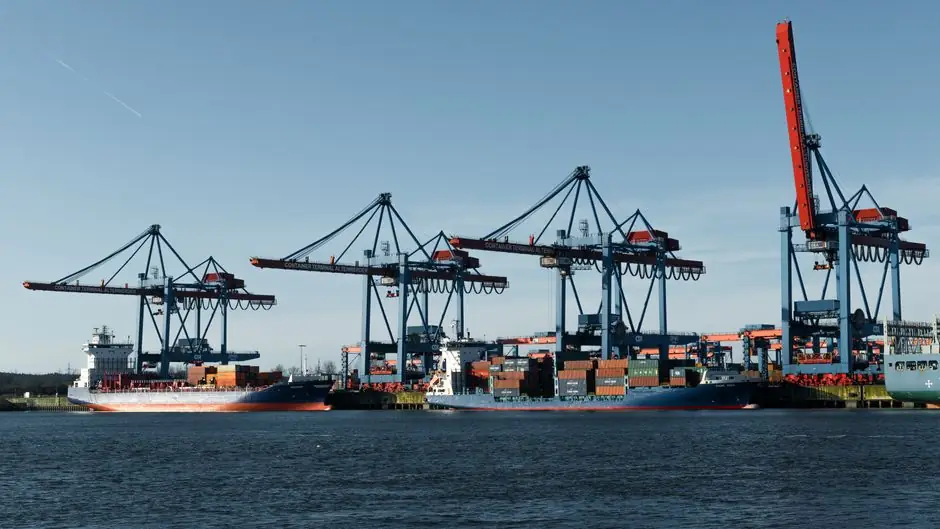
A motor grader sized for a container yard or bulk terminal is not the same machine a county roads department buys, and the spec math should reflect that. Operating envelopes inside ports push machines into a narrow band: 17,000–19,000 kg operating weight, 128–200 kW engine power, 3.7 m moldboard, and all-wheel drive for traction on wet aggregate, spilled cargo, and ramp transitions [S4].
Entry-level road-maintenance graders sit at the bottom of that band, and large mining-class 24 ft / 500 hp units sit well above it, with the port-use case falling between [S2][S4]. Total cost of ownership also separates these machines: a used 120-class can land in the $100,000–$200,000 entry range, while a new 14M/16M mining grader can approach $800,000 with options [S2]. For a detailed look at how graders compare to other heavy equipment classes used around terminals, see the construction machinery and equipment reference.
Port duty cycle versus roadbuilding duty cycle
Port and terminal motor graders rarely run continuous pass-after-pass finish grading the way a highway crew does; they run short, repeated maintenance cycles, cleaning spillage from container slots, restoring cross-fall on haul roads, and dressing lay-down yards after each ship discharge. That duty profile rewards machine weight, frame stiffness, and moldboard geometry over high travel speed. [S2]
A 140-class machine at 128 kW base power, 17,271 kg, and 3.7 m blade width is a common starting reference for general road construction, but port yards typically want the 150-class jump to 136 kW and 18,991 kg for the extra mass to hold grade under load [S4]. Heavy-construction 150 AWD with differential lock auto lock/unlock is the most commonly specified configuration for terminal yards because the auto-locking differential keeps the front wheels pulling during articulated turns on loose surface material [S4]. The broader grader category is catalogued on the motor grader encyclopedia page, which covers the size-class logic in more depth.
Power, weight, and blade geometry decision map
The 120 series is positioned for road maintenance, snow removal, and small construction projects, with a fuel-efficient next-generation cab and integrated technologies, not for sustained bulk-yard grading [S4]. The 140 series at 128 kW / 17,271 kg / 3.7 m is the general-purpose baseline, while the 150 series at 136 kW / 18,991 kg / 3.7 m is the more aggressive cutting configuration with auto differential lock and aggressive blade angles plus large throat clearance [S4]. The 160-class 139 kW / 17,706 kg variant is a flexible construction option, also using a power shift countershaft transmission [S4].
For port work, the practical decision compares four specification dimensions across the main candidate classes:
Blade width is consistent at 3.7 m across the 140 / 150 / 160 series, which simplifies attachment inventory; what changes is power-to-weight ratio and frame section [S4]. Mining-class M-series units (12M, 14M, 16M, 24M) are heavier and more powerful than 120-series machines and are described as best for mining access roads and large earthmoving projects, with the 24M at 500 hp and 24 ft blade marking the top of the production-mining range [S4]. For comparison, port bulk-handling fleets more often run wheel loaders in the same yard, and a useful cross-reference is this wheel loader spec map for port and terminal bulk handling.
Driveline, AWD, and grade-control options
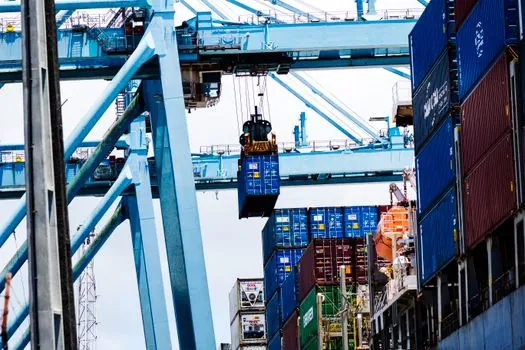
All-wheel drive is essentially mandatory in a port environment because the machine constantly works on compacted aggregate, wet concrete aprons, and areas where cargo dust has been wetted down. The 120 AWD, 140 AWD, and 150 AWD variants exist as the AWD derivatives of their respective base models, with the 140 GC and 140 Next-Gen differentiated by their power shift countershaft transmission and optional autoshift, and the 140 Next-Gen integrating a 10-inch touchscreen with Cat Grade and adding centralized maintenance access [S4].
Modern graders now ship with 2D and 3D grade control, machine protection features that help prevent moldboard and frame damage, and unique operator tech like auto-articulation and blade flip, which together replace the historical eight to 14 lever setup with joystick controls [S2]. These features matter in a port because the surface tolerances for container slots and RTG runways are tighter than typical road cross-fall work, and because the operator is constantly transitioning between full-cut and feather-touch passes. The 140 Next-Gen, which debuted at Bauma 2025 with production from Q1 2026, is the most current spec to anchor a new port-yard fleet order around [S4].
What a motor grader will and will not do in a port
A motor grader in a port cleans spillage, restores cross-fall on internal haul roads, and finishes surfaces after dozer or wheel loader rough work, but it is not a primary bulk-mover. For sustained stockpile management and ship-loading face work, fleets pair the grader with a wheel loader sized for the throughput target, and a structured approach to that pairing is covered in this wheel loader selection guide for port and terminal bulk handling. [S2]
Common specification mistakes in port tenders include specifying a 24M-class mining grader for a 5-hectare container yard, where the 24 ft blade and 500 hp output cannot be used productively inside the lane geometry, and conversely specifying a 120 GC municipal unit for 18-hour daily yard maintenance, where the lighter frame will not hold tolerance under repeated heavy cuts [S4]. Operator comfort is repeatedly flagged as a fatigue driver on long shifts, with cab design, sightlines, and noise isolation carrying real productivity weight beyond the brochure spec [S5].
Standards, sourcing, and ownership economics
Procurement decisions in this category are driven less by formal ISO/EN machinery standards and more by dealer footprint, parts availability, and telematics integration, with the four most commonly named contenders in heavy-duty construction being the Caterpillar 140H, John Deere 770G, Komatsu GD655-6, and Volvo G930, alongside the CASE 865B VHP [S6]. Serviceability and parts commonality are cited by operators as more important than peak engine power when a machine is on a 24/7 port rotation [S5].
Build cost is well documented: entry-level motor graders will set a buyer back between $100,000 and $200,000, while big mining motor graders can cost $800,000, with some configurations approaching $1.8 million [S2]. For ports ordering at the 140/150 AWD level, a realistic budget band sits inside the construction-class range, with the 140 Next-Gen adding a touchscreen and centralized service access that reduces daily maintenance time per shift [S4]. Daily walkaround discipline catches the small leaks, loose hardware, and trash accumulation that become the dominant failure-mode cause if ignored [S2].
Trackable next signals for port buyers in this segment: the 140 Next-Gen production ramp through 2026, AWD derivative availability at the 160-class level, and any 3D-grade-control factory fitment updates for the 150 AWD. Watch dealer lead times in the 128–200 kW band, since port fleet renewals tend to cluster on three-to-five-year cycles and that is where the supply pressure will show up first.
Detailed specification references: terminal block.