
Steel-mill slewing bearings sit in the heaviest-duty band of the global slewing ring market, alongside port cranes handling 100+ tonne lifts and large wind turbine yaw systems, and are normally specified as three-row roller or large crossed roller units [S1].
Continuous casting ladle turrets, stripper cranes, coil handling turntables, and continuous-caster swivel segments all rely on a single large-diameter ring to carry combined axial, radial, and overturning loads while the upper structure rotates through 360° [S3].
Why Steel-Mill Duty Sits at the Top of the Load Spectrum
Mill-duty slewing rings are commonly produced in bore diameters from 1,500 mm up to 4,500 mm, with the global slewing bearing size envelope running 200 mm to over 6,000 mm across all industries, and a small set of specialty units exceeding 8 m [S1][S3].
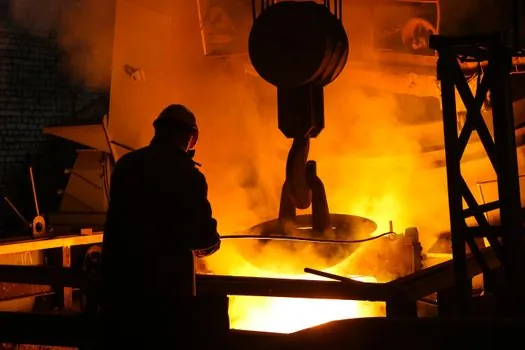
The defining difference versus construction or wind applications is the steady-state thermal load: a ladle turret bearing sees radiant heat from a molten-steel ladle, scale fallout, water and steam spray, and shock loading during ladle set-down, all on a slow-rotating platform that may only index a few times per hour [S1].
Three-row roller slewing bearings are the default choice for the heaviest applications including steel mill equipment, port cranes over 100 t, and bucket wheel reclaimers, because the three independent raceways share axial, radial, and moment load paths through one ring [S1][S3].
Bearing Type Comparison for Mill Service
Four-point contact ball slewing bearings are compact and light, fit for moderate combined loads in excavators and smaller cranes, but their point contact limits static load capacity and they are rarely used for primary ladle-turret duty [S2][S3].
Crossed roller slewing bearings place cylindrical rollers at alternating 90° axes, giving line contact, high stiffness, and a 1:1 load path in each direction, which suits mill applications that need precision indexing and moment rigidity in a narrow envelope [S3][S4].
Three-row roller slewing bearings are the largest and most robust design, with two axial raceways plus a radial raceway, and they handle the extreme loads in ladle turrets, bucket wheel reclaimers, and heavy port cranes where single-row ball designs run out of capacity [S1][S3].
Double-row ball slewing bearings offer higher static load capacity than single-row four-point contact designs and a simpler structure, and are typically used in deck machinery, mining, and lighter mill handling positions where moment load is moderate [S2][S3].
Materials, Raceway Hardness, and Heat Management

Standard slewing bearing rings are most commonly made from 50Mn steel, with 42CrMo alloy steel used for higher-strength or larger-diameter mill-duty units, and induction-hardened raceways reaching HRC 55–62 to resist rolling contact fatigue [S1][S5].
The 50Mn grade is the workhorse carbon-manganese choice for general industrial slewing rings, while 42CrMo adds chromium and molybdenum for through-hardening depth, impact toughness, and elevated-temperature strength needed in mill environments; the related alloy steel reference covers the broader 42CrMo family used in heavy rings.
For comparison, common carbon steel grades like 50Mn are cheaper and easier to source, but cannot match the through-section hardenability and 400°C+ strength of quenched-and-tempered 42CrMo, which is why larger mill rings migrate to the alloy route [S5].
Sealing is the second critical material decision: mill-duty rings run hot and dirty, so dual lip seals plus a labyrinth channel are standard, with grease relubrication points on both rings; an installer-side review of the broader slewing bearing family is useful when validating seal geometry against the host structure.
Selection Checklist for Mill Buyers
Confirm the maximum simultaneous axial load, radial load, and overturning moment at the most loaded position of the duty cycle, plus shock factors for ladle set-down and crane slewing braking, before sizing a slewing ring bearing [S4].
Define the operating profile: rotation angle per cycle, indexing speed, acceleration, continuous versus intermittent motion, expected service life in operating hours, and ambient plus process-side temperature at the bearing location [S4].
Lock down the gear train if the ring is driven: external, internal, or no gear; module, tooth count, pressure angle, backlash class, and pinion access envelope, all of which must be on the inquiry drawing alongside the bolt pattern and bolt grade [S4].
Specify mounting flatness, supporting structure stiffness, preload versus clearance, grease or oil lubrication, seal arrangement, and contamination level, because for a preloaded crossed roller ring the support flatness directly drives achievable rotational accuracy [S4].
Common Failure Modes and Field Constraints
Raceway brinelling from ladle impact is the dominant mill-side failure, accelerated when mounting flatness is poor or bolt preload relaxes under thermal cycling, and it shows up as increased indexing torque and discrete spall marks rather than uniform wear [S4].
Seal failure under scale, water, and steam ingress is the second most common field issue, and the remediation path is a dual lip plus labyrinth arrangement with grease purged through both seal zones at defined relubrication intervals [S1][S4].
White etching cracks and premature rolling contact fatigue appear when the raceway hardness target of HRC 55–62 is missed, when lubricant film thickness collapses at slow indexing speeds, or when contamination bypasses the seals, all of which shorten service life well below the design L10 figure [S1][S5].
Where Mill Slewing Rings Are NOT the Right Answer
For light indexing tables, small rotary tables, and machine-tool positioning axes under 500 mm bore, a four-point contact ball ring or a standard crossed roller bearing will be cheaper, easier to source, and accurate enough, so a heavy three-row mill unit is over-specified [S2][S4].
For high-speed continuous rotation above roughly 10 rpm, slewing rings lose their economic advantage versus standard slewing drives or large cylindrical roller bearings, and the mill duty profile, slow and shocky, is the opposite of what slewing drives handle well [S1][S3].
Standards, Sourcing, and Trackable Signals
Mill slewing bearings are produced to manufacturer-specific designations drawing on rolling bearing standards for dimensional series, tolerance classes, and material specifications, with 50Mn and 42CrMo as the dominant ring materials per current supplier documentation [S5].
Specifying engineers should request the full designation, raceway hardness certificate, gear inspection data, and a load-case calculation on the inquiry drawing, because two rings with the same boundary dimensions can carry very different load ratings and bolt patterns [S4].
Track for the next 6 to 12 months: published case histories on ladle-turret retrofits in integrated steel plants, supplier announcements of larger 42CrMo ring capacity above 4,000 mm, and any revisions to ISO 15 and ISO 84 dimensional series that touch large-diameter rolling bearings.
This topic is covered further in Slewing Bearing Selection for Cement Plants: Load Case, Raceway, Seal, Gear.