
For 2026 procurement, a slewing drive is best treated as a fully integrated gear reducer-plus-bearing assembly — a worm (or in some cases a planetary worm pair) driving an external-geared slewing ring bearing through a single sealed housing, sized across published diameters from 3" (≈75 mm center bore) to 25" in mainstream catalogs [S8].
Buyers in 2026 are mainly concentrated in four application families: solar trackers (single- and dual-axis PV, CSP), construction machinery (aerial work platforms, truck cranes, excavator turrets), port and welding positioners, and waste-water/forestry rotating tables [S2][S4]. Across all of them, the same five engineering gates — load case, output speed, holding torque, backlash, and IP/environment — decide which catalog row survives the RFQ.
Slewing Drive Types: SE, WEA, Worm, and Dual-Axis Envelopes
The mainstream 2026 product split is between SE-series light/medium slew drives (typically used on single-axis solar trackers and small work platforms) and WEA-series heavy curved-tooth slew drives, where the curved tooth form is sold specifically for "better anti-fatigue and bonding ability, suitable for heavy-duty, medium-speed applications" [S5]. A 12" heavy-series unit aimed at bridge inspection equipment was listed in May 2026 in the US$480–500/piece band on a 1-piece MOQ basis [S6].
Beyond the SE/WEA taxonomy, Chinese factory catalogs continue to offer worm-tooth medium-load units with 75 mm rotary center diameter, module 5, single worm shaft, hydraulic input — a configuration that lines up with what the same vendor labels as a 3" slewing drive [S8]. The slewing drive is also sold as a sub-assembly of the slewing ring bearing itself, which is why the bearing and the drive share the same OEM and the same QC file [S4].
Five Engineering Gates to Lock Before RFQ
Gate 1 — Load case. Vertical load (down-force + moment from wind on a panel array, or payload + boom moment on an aerial work platform) and tilting moment must be converted to axial load + radial load + overturning moment on the slewing drive output race. Vendors publish holding-torque curves rather than generic "load" numbers; the same 25" drive can sit in a 6 kN·m or 80 kN·m class depending on gear geometry [S2][S5].
Gate 2 — Output speed. Worm-gear slew drives commonly run in the 0.5–5 rpm output range for solar tracker duty; WEA heavy units push this to medium-speed work tables and weld positioners where 5–20 rpm is typical [S4][S5]. For high-speed indexing the servo drive pairing is what matters, not the slew drive itself — most worm units do not tolerate the input speeds that servo indexing demands.
Gate 3 — Holding/back-stopping torque. A worm gear set is inherently self-locking, which is exactly why slew drives need no external brake on a solar tracker. Confirm the static holding-torque figure on the data sheet, not the dynamic rating, if the application involves wind-uplift or a parked boom.
Gate 4 — Backlash and precision. Standard worm slew drives in this class show roughly 0.1°–0.5° backlash; curved-tooth WEA units can land closer to 0.05°–0.1° on factory test sheets [S5]. If the application is a weld positioner feeding a linear guide or a crossed-roller guide downstream, lock backlash on the same drawing as the table flatness.
Gate 5 — IP, grease, temperature. Solar-tracker SE drives are typically IP65 with −30 °C to +70 °C grease ratings; offshore and port duty escalates this to IP66/IP67 with marine-grade grease and 316 hardware. Ocean-platform crane OEM specs, by way of comparison, call out sealed slewing-ring support bearings plus an integral brake (braden or band brake) to hold the boom against sea-state loads [S9].
Typical 2026 Pricing and Sourcing Channels
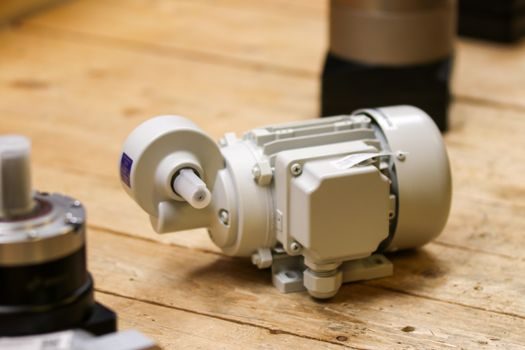
Catalog pricing on the Made-in-China index in May 2026 shows entry-level small SE drives in the US$50–150 range, mid-size 7"–17" units clustered between US$300 and US$800, and 12" heavy bridge-inspection drives at US$480–500/piece on 1-piece MOQ [S6]. The Slewing Drive Selection: 5 Engineering Gates Buyers Must Lock Before RFQ in 2026 article lays out the same gate logic in a flow you can paste into the RFQ cover sheet.
For European and North-American buyers the channel split in 2026 is roughly: (a) OEM-direct from Chinese factories (Jiangyin Sunslew and similar, founded 2014, solar + construction focus) [S2]; (b) Western brand-and-distributor (often with shorter lead time and 24-month warranty, 30–60% higher list price); (c) engineering packagers who will integrate the slew drive into a truck crane or an aerial work platform and own the CE/UL paperwork.
Material, Tooth Geometry, and Manufacturing Reality
Mainstream slewing-drive gears are 42CrMo or 50Mn forged steel, case-hardened to roughly HRC 55–62 on the tooth surface, with the slewing ring raceway induction-hardened on the same material [S4][S5]. The WEA curved-tooth profile is sold as a fatigue-life upgrade over straight-tooth worm gears — vendors cite the bonding pattern (longer tooth contact line) as the reason for the higher cycle rating under medium-speed reversing loads [S5].
For low-temperature or food-grade plants, most Chinese catalog slewing drives can be quoted in 304/316 stainless hardware with food-grade grease; lead time stretches from a stock 15–25 days to 45–60 days, and price roughly doubles on the small SE end. Large WEA units on the same stainless conversion add 20–35% rather than doubling, because the gear steel itself is unchanged.
Standards and Certification You Can Verify
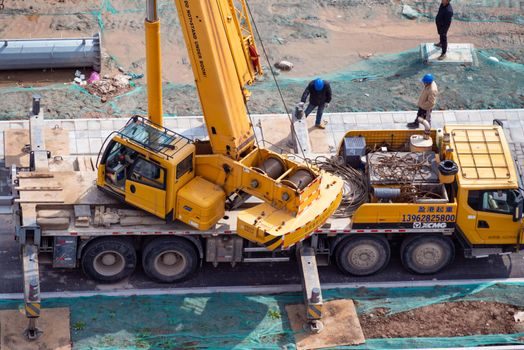
For CE-marked construction-machinery integration, expect to see EN 13000 (crane safety) and EN 280 (aerial work platform safety) on the integrator's file, with the slew drive itself typically shipped with an ATEX/IECEx option only when the host machine goes into Zone 1/Zone 2 — for standard PV and construction use, IP65 + CE on the assembly is the usual baseline [S2][S3]. Made-in-China supplier listings in May 2026 flag "CE certified (contact issuer for details)" on the heavy slewing-drive category page, with the issuer being the exporter rather than an EU notified body unless the buyer asks for the certificate file [S3].
For offshore / marine slewing drives, factory test reports should reference ISO 12944 corrosion class, and the host machine (e.g. an ocean-platform crane) will be designed to API 2C or comparable classification-society rules — confirm the slew drive vendor's test sheet covers radial runout, axial runout, and holding torque on the same test stand, not just gear mesh noise [S9].
Who a Slewing Drive Is For — and Who Should Walk Away
A slewing drive is the right component for slow, high-moment rotation under 50 rpm, where self-locking matters, and where the structure is welded or bolted to a fixed base. Solar trackers, aerial work platforms, truck-mounted cranes, weld positioners, and small radar pedestals all fit this profile [S2][S4][S5]. The 3"–25" envelope covers most of them; outside it, factory customisation is possible but lead time stretches into months.
A slewing drive is the wrong component for high-speed indexing (a precision servo drive on a crossed-roller guide is the correct stack), for continuous high-rpm operation (a planetary gearbox is more efficient thermally), and for sub-arc-second pointing (no worm-gear unit in this catalog will deliver it). Buyers looking for a 0.001° positioner are in the wrong category and should re-spec to a direct-drive torque motor before going further.
Verification Checklist Before Releasing the PO

Lock the four numeric values on the data sheet: output raceway diameter, gear ratio, holding torque (static, not dynamic), and IP rating. Cross-check them against your gate-1 load case — a 17" drive with a 3 kN·m holding torque is not a 17" drive with an 8 kN·m holding torque, and the catalog photo will not tell you which one you are buying. Ask the factory for the as-built test report, the steel-grade certificate, and the seal kit part number; if any of these are not on the quote, treat the price as preliminary. [S1]
Trackable signals to watch through the rest of 2026: the Made-in-China heavy slewing-drive index at [S3] continues to refresh weekly, with the May 2026 snapshot still showing a 12" heavy unit at US$480–500/piece on 1-piece MOQ [S6] and the WEA curved-tooth line expanding into the 17"–25" envelope at XZWD [S5]. Any movement in the MOQ floor (currently 1 piece on the heavy bridge-inspection drive) or in the CE certificate file naming will be the first sign of a re-tiered 2026 supplier list.