A slewing drive is a compact gear assembly that combines a slewing bearing with an integrated worm, planetary, or helical gearset in a single sealed housing, used to rotate loads through controlled arcs. M6 export suppliers in Wuxi and Hangzhou list standard models from SE3 to SE25 with output torque bands from roughly 1 kN·m to 60 kN·m and IP66 sealing as a baseline [S1][S2].
Wrong selection shows up fast: cracked housings under crane swing loads, seized worm gears on solar trackers after 18 months, and gear backlash that breaks radar tracking. A 2026 buying decision should start from the load cycle, not the catalog page.
Gate 1 — Output Torque and the Tilt-Moment Trap
Static holding torque is the headline figure buyers see — SE3 at ~1 kN·m, SE7 at ~7.5 kN·m, SE12 at ~15 kN·m, SE17 above 20 kN·m, and SE25 reaching 60 kN·m in heavy-duty planetary builds [S1][S3]. That single number is, however, the most commonly misread value on the spec sheet.
A slewing drive is loaded by three independent vectors: axial load (F_a), radial load (F_r), and tilting moment (M_t). On a 12 m² solar tracker or a small crane slewing platform, tilting moment — not axial — is usually the binding constraint. A buyer who specs 5 kN·m torque but ignores a 12 kN·m peak tilting moment will see bolt loosening and raceway brinelling inside the first 6 months. Wuxi Forland Technology publishes tilted-load curves alongside its slewing drive line so the buyer can read all three vectors on one chart [S1].
Engineering practice: size for the peak tilt moment, then back-check torque at the gearbox output. If the two numbers are within 1.5× of each other, the drive is correctly framed; if the torque is 3× higher than what tilt requires, you are paying for a part you do not need.
Gate 2 — Gear Architecture: Worm, Helical-Worm, or Planetary
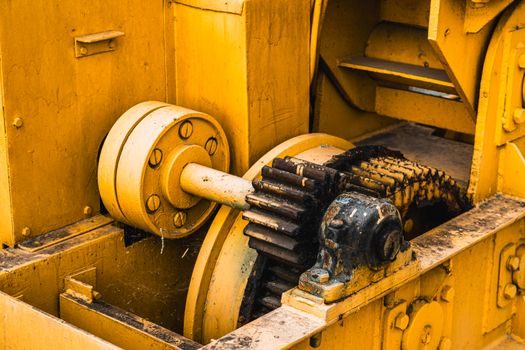
Three architectures dominate the 2026 catalog. Worm-gear (single-enveloping) units are the cheapest and self-locking — they hold position with no brake and dominate the small-tracker and small-platform market [S1]. Helical-worm (double-enveloping) units add a second worm thread that meshes with the gear teeth over a larger contact area, raising continuous torque capacity by 30–50% over single-enveloping at the same OD [S3]. Planetary gear sets (used in SE17 heavy-duty builds) reach the highest torque density but lose the self-locking trait, so an external holding brake is mandatory [S2][S3].
The decision comes down to duty cycle and whether the application is fail-safe. A solar tracker on a 25° slope needs self-locking — no power, no drift. A truck-mounted crane in continuous slewing needs the higher continuous torque of a helical-worm or planetary build and accepts the brake as a normal sub-assembly. Buyers who treat these three families as interchangeable pay the difference later in field failures.
For deeper bearing-side context that determines the gear architecture's envelope, the slewing ring bearing page walks through raceway hardening and tooth geometry in detail.
Gate 3 — Ratio, Backlash, and the Solar-Tracking Penalty
Ratios in standard export slewing drives run from 31:1 to 150:1, with 62:1 as the most-quoted solar-tracker figure [S1][S3]. Backlash in single-enveloping worm sets sits around 0.1–0.2°; helical-worm drops to 0.05–0.1°; planetary stages with anti-backlash gearing reach below 0.05° [S3].
For solar tracking, backlash is paid for twice — once in tracking accuracy (every degree of slop is a degree of kWh lost), and once in wind-induced oscillation that hammers the worm gear under gust loading. For radar and antenna mounts, anti-backlash is non-negotiable: a 0.2° slop translates directly to metres of beam-pointing error at long range.
The rule of thumb is straightforward: pick the lowest backlash your duty cycle will tolerate, then verify the holding torque still meets the tilt-moment requirement from Gate 1. Stepping down backlash without re-checking holding torque is how buyers end up with units that track accurately in still air and strip their teeth in a 30 km/h gust.
Gate 4 — IP Rating, Seal Design, and the Sand-Spray Test
IP66 is the floor for outdoor slewing drives in 2026, with IP67 offered on premium lines for marine and offshore service [S1][S2]. The difference matters more than it looks: IP66 survives powerful water jets, IP67 survives temporary immersion — and the seal stack inside a slewing bearing is what decides which one the unit will still meet after 24 months.
Three failure modes show up in the field: (1) sand ingress wearing the lip seal, (2) salt-spray corrosion attacking the raceway, and (3) thermal cycling pumping moisture past a static O-ring. Wuxi-based M6 suppliers have moved to double-lip nitrile seals with grease relief channels as the default, and offshore SKUs add an epoxy primer under the topcoat [S1].
For solar farms in desert zones, a buyer should request the sand-spray test certificate (typically 8 h of ASTM B117 salt-spray equivalent) and verify the seal stack before signing the PO. A 15% price premium for IP67 with a documented seal drawing is cheap insurance against a 5-year field replacement campaign.
Gate 5 — Mounting Interface, Gear Lubrication, and Sourcing Realities

Three interface patterns dominate: flange-mount with through-bolts, flange-mount with tapped holes, and shaft-output (no flange) for belt or pinion drives. Bolt circle, bolt count, and PCD tolerance are not standardized across the SE series — SE9 on supplier A and SE9 on supplier B do not share a bolt pattern, even when torque and ratio do match [S1][S2].
Lubrication is the second silent variable. Worm-gear units run on EP-2 grease packed at assembly and require re-grease intervals between 6 and 24 months depending on duty cycle. Helical-worm and planetary units more often run on oil bath with a sight glass, and that sight glass is a documented interface — if your mounting bracket hides it, you have bought a serviceability problem. M6 production capacity at the larger Wuxi hydraulic-component shops runs at roughly 1,500 pieces per month per line, so a confirmed PO for a 200-unit solar-farm order sits comfortably inside the lead-time window [S2].
For buyers building truck cranes or aerial work platforms, the aerial work platform 2026 selection guide walks through the same gate logic on a sister drivetrain. Helical gear reducer selection, covered in the helical gear reducer 2026 buying guide, is the right companion read for anyone mixing slewing drives with parallel-shaft gearboxes in the same driveline.
Comparison: Worm vs Helical-Worm vs Planetary on Four Buyer Criteria
On a 4-criteria decision matrix — holding torque, self-locking, backlash, and unit cost — the three architectures line up as follows. Worm-gear: lowest cost, built-in self-locking, 0.1–0.2° backlash, lowest continuous torque density. Helical-worm: mid-cost, self-locking retained, 0.05–0.1° backlash, 30–50% higher continuous torque than single-enveloping. Planetary: highest cost, no self-locking (brake required), sub-0.05° backlash with anti-backlash gearing, highest torque density in the smallest OD [S2][S3].
Buyers should pin the four criteria down in this order before contacting a supplier: required tilt-moment, self-locking yes/no, target backlash, and budget per unit. The right architecture usually falls out of those four answers without a 40-page datasheet review.
Who Slewing Drives Are For — and Who Should Walk Away
Slewing drives fit slow-rotation, high-load, intermittent-duty applications: solar trackers, small truck cranes, aerial work platforms, radar and antenna mounts, stage rigging, and small wind turbines. A buyer specifying continuous slewing at 10+ rpm, or sub-arc-minute positioning under reversing load, is outside the economic envelope of a worm-gear slewing drive and should be looking at a turntable bearing paired with a servo drive or a purpose-built slewing ring with an external gearset. [S1]
For high-speed, low-torque positioning the stepper drive reference page lays out the alternative drivetrain. And for applications where the rotation is continuous and the fluid being moved must not leak, the magnetic drive pump page covers the alternative sealed-rotation architecture for a different class of equipment.
Field Failure Modes Buyers Rarely Spec Against
Three failure modes show up across supplier service data: (1) bolt-loosening under cyclic tilt, almost always traceable to missing or undersized mounting washers, (2) seal failure at the output flange from grease starvation when re-grease intervals are ignored, and (3) worm-gear wear from shock loads above the published peak torque — typically a 1.5× to 2× momentary spike from a wind gust or a hard stop [S1][S2].
All three are paper-spec problems. The bolt-loosening fix is a Nord-Lock or equivalent washer stack called out on the drawing. The seal-failure fix is a documented re-grease interval in the O&M manual. The shock-load fix is a published peak-torque curve and a buyer-side agreement not to operate outside it. A supplier that cannot supply all three documents is not yet a qualified source.
Trackable signals to watch over the next two quarters: M6 export suppliers in Wuxi and Hangzhou are expected to expand SE17 and SE25 planetary inventory as solar-tracker demand continues to scale, and the 25.4 mm (1-inch) shaft-output interface is becoming more common on the SE7–SE12 line for direct pinion-mount retrofits. Buyers with RFQs landing in late 2026 should confirm the supplier's current SE-family availability and the lead-time on double-enveloping (helical-worm) units, since these two data points move together with order book density [S1][S2].