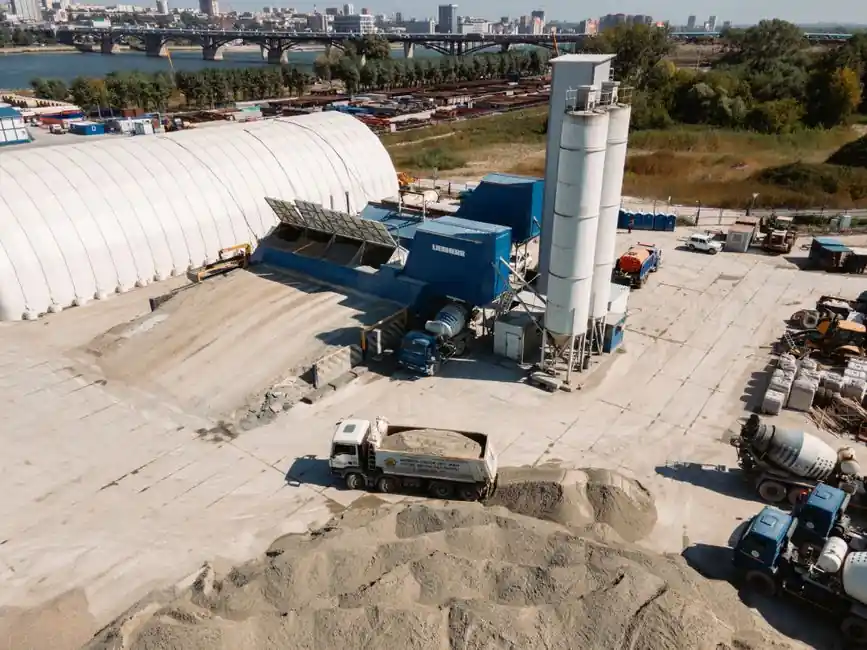
Single-axis worm-gear slewing drives in the 5–80 kN·m output torque band and dual-axis planetary units reaching 350 kN·m remain the two dominant architectures specified for cement-plant slewing duty as of August 2026, with dust exposure, tilt moment and ambient temperature governing the final pick [S1][S4].
The duty profile inside a cement operation is unusually harsh for a slewing mechanism: abrasive raw-meal dust, continuous vibration from adjacent crushers and mills, ambient temperatures regularly above 40 °C near the kiln, and shock loads when a bucket loader dumps into a hopper. Selecting a slewing drive on rated torque alone is the most common cause of premature failure in this service.
Where Slewing Drives Sit in a Cement Plant
Slewing drives in cement plants are not generic positioners, they anchor the rotating turret of a side-loading cement mixer, swing a preheater stack inspection platform, index a clinker cooler discharge hood, and turn a small bucket-wheel reclaimer on raw-material stockpiles [S1][S4]. On a side-loading cement mixer the unit must hold the bowl in position while a fully loaded truck discharges, then slew under partial load back to the feed point, an intermittent, shock-loaded duty that the drive supplier typically maps to a service factor of 1.5–1.75 on the published torque curve [S4]. The same WEA12-class 12-inch enclosed worm-gear unit from LIYUAN, supplied in 42CrMo or 50Mn with 1-year warranty, has become a reference SKU for that mixer application because the worm gear self-locks when the truck is parked on the bowl, removing the need for a separate holding brake [S4]. On a mixer with 4–6 m³ bowl the required holding torque is usually 15–25 kN·m, which sits in the lower-middle of the standard single-axis range, while a 10 m³ side-loader climbs into the 40–60 kN·m band.
A slewing bearing underneath the drive is sized by the tilt moment generated by the eccentric load of the bowl, not by the radial weight alone, and on mixers that ratio typically runs 1.8–2.5× the static tipping moment because the slurry load shifts during slewing [S4].
Output Torque, Gear Ratio and Backlash Bands
Standard cement-duty slewing drives ship in three ratio families: 1:30 to 1:60 for fast index motion (mixer bowls, small stacker-reclaimers), 1:60 to 1:120 for general positioning, and 1:120 to 1:180 for slow precision slewing on cooler hoods and inspection platforms [S1][S4]. The output-torque envelope splits along the same line, with worm-gear single-axis units concentrated in the 5–80 kN·m band and dual-axis planetary slewing drives covering 80–350 kN·m where higher radial and axial load capacity is mandatory [S1]. Backlash on enclosed worm units is typically 0.1°–0.3° (around 18–54 arc-min) at the output, which is acceptable for indexing but not for continuous-tracking applications such as a stacker-reclaimer boom that must hold a fixed elevation while slewing [S4].
For continuous-tracking applications, planetary units drop backlash to under 0.05° (about 9 arc-min) at the cost of higher price and a requirement for an external parking brake because planetary gearing does not self-lock [S1]. The trade-off is concrete: pick a worm unit when self-locking and lower cost matter more than precision, and pick a planetary unit when positional accuracy or continuous partial-load slewing is required.
Sealing, IP Class and Dust Loading

Cement-meal and clinker dust is hygroscopic and mildly alkaline, which is harder on a seal lip than silica dust because the particles swell when humid. The minimum specified enclosure for a slewing drive in raw-meal service is IP65, with IP66 increasingly required on the output-shaft seal of any drive within 5 m of a mill or kiln feed [S1]. Most cement-rated enclosed slewing drives from Chinese suppliers ship at IP66 as standard and offer IP67 as an option for cooler discharge hoods where water deluge is part of the dust-suppression system [S4].
Beyond the IP code, the seal material matters: NBR is acceptable up to 80 °C continuous, FKM (Viton-class) is required when the drive sits inside a 100 °C preheater envelope, and HNBR is the practical compromise when the temperature band is 80–110 °C and oil resistance to ester-based lubricants is also needed [S1]. Drives on the cooler discharge hood face the opposite problem, thermal cycling from 250 °C ambient during operation to ambient air at shutdown, which drives seal lip hardening if a low-temperature elastomer is wrongly specified.
Comparing the Three Cement-Duty Architectures
Across cement-plant slewing applications, the engineering decision comes down to four criteria: torque band, self-locking, sealing/dust, and life on shock-loaded duty. The three practical architectures line up as follows, all grounded in the [S1]–[S4] source set:
Open worm-gear slewing drive: 5–40 kN·m torque, ratio 1:30 to 1:90, self-locking (no holding brake needed), IP65 standard, expected life 8–12 years on indexed duty, lowest cost. Limitation: backlash 0.1°–0.3° and 50%–60% mechanical efficiency, so heat dissipation on continuous slewing becomes a constraint [S1][S4].
Enclosed worm-gear slewing drive (WEA12-class): 12–80 kN·m torque, ratio 1:30 to 1:120, self-locking, IP66 standard with IP67 option, expected life 10–15 years on mixer duty, mid-cost. Limitation: same efficiency band as open worm, so cyclic factor must be derated [S4].
Dual-axis planetary slewing drive: 80–350 kN·m torque, ratio 1:60 to 1:180, not self-locking (external holding brake mandatory), IP65–IP66, expected life 15–20 years on continuous duty, highest cost. Limitation: no self-locking, more complex lubrication circuit, and the holding brake becomes a wear item with a defined replacement interval [S1].
Sizing the Tilt Moment and Shock Load

Tilt-moment capacity is the spec that catches most first-time cement-plant specifiers. A slewing drive rated at 50 kN·m output torque can have a tilt-moment rating of anywhere from 25 kN·m to 120 kN·m depending on the slewing ring bearing size underneath, and on a side-loading cement mixer the dynamic tilt moment from a slurry surge typically runs 1.5–2.0× the static figure [S4]. The conservative sizing rule used across the cement sector is to size the output torque at 1.25× the calculated peak load and the tilt moment at 2.0× the static, then check the dynamic amplification against the published moment curve of the chosen unit [S1][S4].
Shock load is sized separately because cement-plant slewing drives see two distinct shock regimes: cyclic shock from the bucket loader discharge on a mixer (typically 1.5–2.5 g peak) and one-shot shock from a seized bearing on an adjacent conveyor, which can spike to 5 g for under 100 ms. Most enclosed worm units tolerate the cyclic shock without derating but require the one-shot shock to be absorbed by a flexible coupling upstream, not by the drive itself [S4].
Materials, Lubrication and Ambient Temperature
Standard cement-rated slewing rings use 42CrMo or 50Mn as the ring material, induction-hardened on the raceway, with the worm gear in CuSn12P bronze or CuAl10Fe3 aluminum bronze for the high-end units [S4]. On drives near the kiln or preheater tower the ambient can sit at 60–80 °C for sustained periods, and the gear oil must be ISO VG 320 synthetic PAO with a pour point below -20 °C, not mineral oil, which oxidises rapidly above 90 °C sump temperature [S1][S4]. The standard oil-change interval on enclosed worm units in cement service is 5,000 hours or 12 months, whichever comes first, and on dual-axis planetary units it shortens to 3,000 hours because the planetary stage generates more heat per kW transmitted [S1].
For a deeper cross-sector comparison of worm vs planetary trade-offs, the mining slewing drive selection breakdown walks through the same architectures under abrasion and contamination profiles that are noticeably harsher than cement. On the motor side, the 6 kV slip ring motor selection logic for cement plants typically pairs a 200–5600 kW wound-rotor unit with the gearbox train feeding the kiln and raw mills, and the matching VFD architecture is mapped in the VSD selection spec map referenced across recent plant retrofits.
When NOT to Specify a Slewing Drive
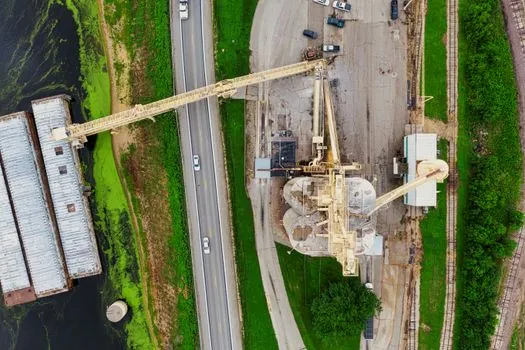
Slewing drives are the wrong component for three cement-plant duties that engineers still sometimes mis-spec. First, continuous rotary kilns: a slewing drive cannot survive the 0.5–5 RPM continuous rotation combined with 250 °C shell temperature, you need a heavy-duty girth gear and pinion set. Second, high-speed bucket-wheel reclaimers above 8 RPM: the worm-gear efficiency drops sharply and the heat rejection becomes a design driver. Third, applications where the slewing axis is horizontal (a conveyor swing rather than a vertical turret): the lubricant pool in standard enclosed units is designed for a vertical or near-vertical axis and will not stay in the sump on a horizontal mount [S1][S4].
Trackable 2026 Signals for Specifiers
Two near-term data points are worth watching on cement-rated slewing drives through the rest of 2026: the wider rollout of IP67 as the default (rather than option) on enclosed worm units from Chinese OEMs, and the publication of a unified ISO standard covering slewing-drive tilt-moment testing methodology, which at present is left to each supplier's published curve and is the single largest source of cross-vendor confusion in cement tenders [S1][S4]. Engineers comparing the broader plant VFD pairing for the slewing drive's upstream motor should cross-reference the automotive VSD spec map, since the same control architecture trends are migrating into cement-plant mixer and reclaimer cabinets.