
Submersible sludge pumps span a 7-370 gpm flow window with 9-40 m head and up to 80 mm spherical solid passage in 2026 OEM catalogues, making the solid-handling diameter the single most important selection gate [S1][S4].
Atlas Copco's WEDA S30, S50N, and S60N dewatering models cover 250-420 gpm at 2.0" (≈50 mm) solid handling, with dry weights from 56 to 144 lbs and 4.0-9.3 hp input [S4]; Grindex separates sludge, slurry, drainage, and stainless-steel "Inox" lines into distinct catalogues rather than one stretched family [S1].
Solid-Handling Diameter and Spherical Passage
Spherical solid passage sets the floor on pump class: Grindex specifies up to 80 mm for its sludge line, 50 mm for slurry, and 12 mm for drainage pumps, with the three categories never overlapping in catalogue bands [S1].
Buyers should match the largest expected debris dimension, not the average, because a single oversized rag or stone will stall an impeller whose passage is rated below that dimension. The sludge pump class sits between a drainage pump and a true slurry pump in both head and abrasion resistance, and the spec sheet must show the passage value explicitly rather than a vague "handles sludge" claim [S1][S4].
Flow and Head Operating Window
Grindex sludge pumps cover 7-24 L/s (≈110-380 gpm) at 9-40 m head, while the broader WEDA submersible sludge family hits 250-420 gpm (15.8-26.5 L/s) at similar head, so the two catalogues are comparable in flow but not interchangeable in solids tolerance [S1][S4].
Selecting on the duty-point intersection of flow (Q) and head (H) is the only defensible method; running a pump far left of its BEP accelerates wear on the impeller eye, while running far right of BEP risks cavitation and seal damage. The wider flow window of the WEDA S60N (up to 420 gpm) is wasted on a digester feed duty that only needs 50 gpm at 15 m, where a smaller Grindex unit is a better mechanical and electrical match [S1][S3][S4].
Material Selection for Corrosive and Abrasive Sludge
Grindex Inox stainless-steel units are rated for pH 2-10 with abrasive particles, addressing chemical-plant and digester supernatant duty where cast-iron would pit inside one duty cycle [S1].
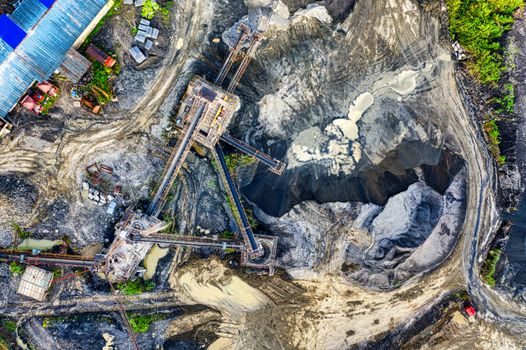
For mining and coal-washing slurries, high-chrome iron or hardened alloy impellers are the established choice; for municipal wastewater digester feed, ductile-iron or stainless bodies with hard-faced wear parts are typical. The decision rule: specify material after you have fixed the fluid chemistry, not before, because over-specifying stainless on a benign biosolids line wastes 2-4× the pump cost for no service-life gain [S1][S2].
Submersible vs Dry-Pit Configuration
Submersible units dominate the 4-10 hp sludge range because the sealed oil-chamber and mechanical seal arrangement removes the need for a dry well, and Atlas Copco explicitly markets the modular sealing system and built-in starter as the differentiator for this class [S3].
Dry-pit centrifugal or progressive-cavity pumps remain preferred for digester recirculation loops above 15 kW, where continuous-duty bearing life and gearbox service access outweigh the civils saving of a submersible. The selection gate is access: if the pump can be lifted by crane, submersible wins on installed cost; if the duty is 24/7 and mean-time-between-overhaul is measured in years, dry-pit with industrial valve isolation wins on maintainability [S2][S3].
Comparison: Grindex Sludge vs WEDA Sludge vs Drainage vs Slurry
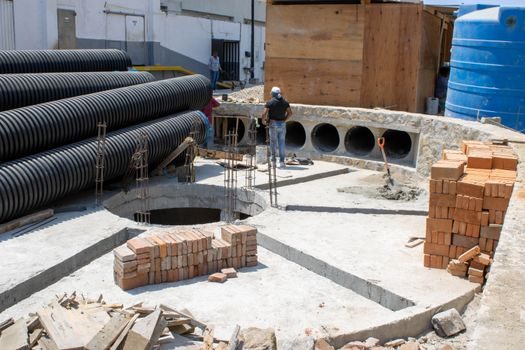
The four classes divide cleanly on three criteria: solid passage (12 / 50 / 80 mm), flow window (drainage widest, sludge narrowest), and head ceiling (drainage up to 200 m, sludge 40 m, slurry lower still) [S1][S4].
A drainage pump will move the most water per dollar but choke on a 30 mm clump; a slurry pump will pass an ore pebble but cannot deliver 200 m head economically. Within the sludge class, Atlas Copco's WEDA S50N at 7.0 hp and 131 lbs offers the best mid-range compromise, while the S30 at 4.0 hp and 56 lbs is the pick for portable site dewatering where two workers carry the unit [S4]. For a deeper side-by-side on positive-displacement alternatives, the diaphragm pump vs multistage centrifugal pump breakdown covers displacement-style options that some specifiers run in parallel with a centrifugal sludge unit for thick primary sludge.
Who Should NOT Pick a Stock Submersible Sludge Pump
Raw primary digester feed above 6% total solids, oil-laden separator sludge, and any fluid above 80 °C should be screened out of the submersible sludge category because the standard elastomer seals and Class F stator windings are not rated for those combinations [S1][S3].
The slip is specifying a general-purpose WEDA unit on a digester recirculation loop with 8% DS and 60 °C — the pump runs, the seal fails in weeks, and the OEM warranty is void. A positive-displacement or dry-pit configured unit is the correct pick in that envelope, and the selection should route through a flow meter on the return line to verify that actual duty matches the original spec within ±10% before any pump is ordered [S2][S3].
Drive, Controls, and Site Integration
Atlas Copco highlights optional built-in starters and motor protection as a "plug and play" feature, which removes the panel-builder step on construction-site duty and shortens commissioning to a cable connection [S3].
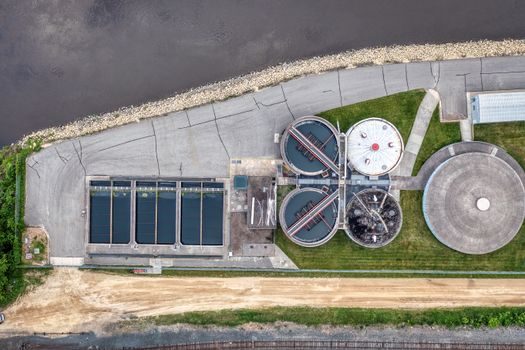
For permanent municipal or industrial installation, VFD control is increasingly specified to soft-start against a closed discharge PLC and to trim the pump to seasonal inflow variation, but the VFD adds harmonic filtering and motor bearing-insulation requirements that a basic starter avoids. A VFD is justified when the duty cycle varies by more than 30% across the week, not as a default [S3][S4].
Selection Shortlist Logic
Run this three-step filter in order: (1) confirm the largest solid dimension and set the passage floor; (2) plot the operating point on the Q-H curve and reject any pump whose BEP sits more than 20% away from that point; (3) match material to fluid pH and temperature before considering brand [S1][S3][S4].
Shortlist output for a typical 200 gpm at 20 m biosolids transfer duty: Grindex sludge line or WEDA S50N both clear the 50 mm passage gate and sit near BEP, with the decision tipping on whether stainless (Inox) is needed for the pH. Track as a leading signal whether any pressure transmitter on the suction leg shows recurring vacuum spikes; that single measurement is the earliest indicator that the next pump should move up one size class [S1][S3][S4].