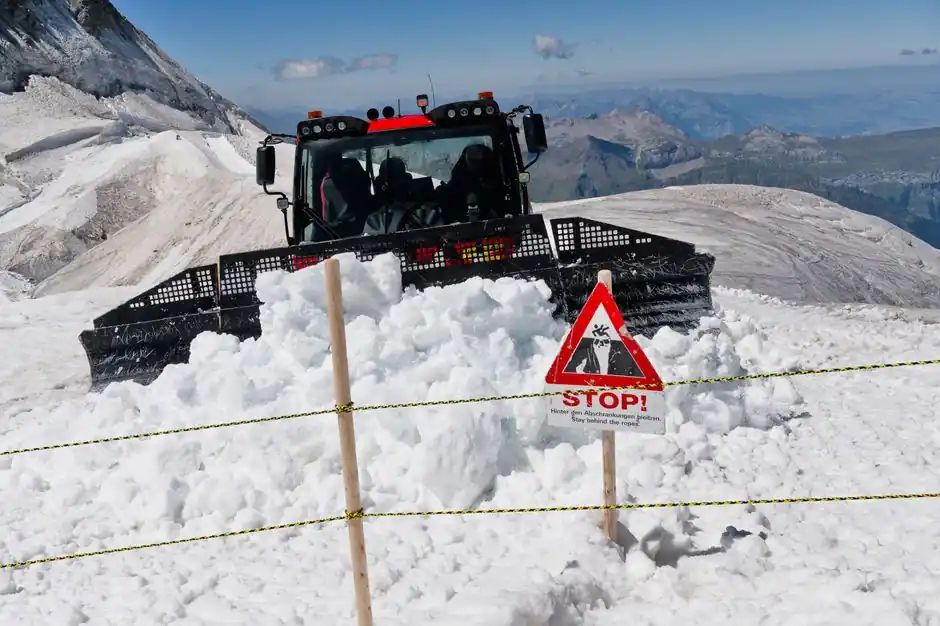
Rough-terrain boom lifts and tracked spider lifts are the two aerial work platform families that hold up on icy, snow-packed ground; electric-drive scissor lifts and wheeled personnel lifts are indoor tools that should be kept off frozen ground unless the surface is cleared and mats are laid [S1][S3].
Snow removal is one of the harder duty cycles an aerial work platform sees: cold-soak hydraulic fluid, wind loads on extended booms, low sun angles, and ground that alternates between frozen hardpan and soft slush inside a single shift. The selection error that kills the most jobs is choosing the wrong chassis, not the wrong reach.
Why winter ground conditions decide the chassis
Standard wheeled platforms are suited to indoor or finished-surface work, while crawler (tracked) platforms are the outdoor default, including on uneven, muddy, or frozen terrain [S1]. On snow, a wheeled electric scissor lift will lose tractive effort the moment compacted snow gives way to glare ice, and a frozen rut will twist a small caster hard enough to throw the platform out of level. Crawler lifts distribute ground pressure across a longer track footprint, which keeps the machine on top of soft snow instead of plowing into it.
Two crawler variants dominate winter roof and tree work: compact articulating crawler boom lifts (sometimes called spider lifts) with non-marking tracks, and straight/telescopic rough-terrain boom lifts. Spider lifts typically top out between 10–15 m of platform height, while straight rough-terrain booms span 12–64 m (39'6" to 210'6") of platform height and are the only option when the roofline is above four storeys [S3].
Ground-bearing pressure matters as much as reach. On a frozen but unfractured lawn or plaza deck, a tracked spider lift exerts roughly 30–50 kPa ground bearing, low enough to sit on most rooftops with a structural review. A rough-terrain wheeled boom with outrigger pads concentrates 200 kPa+ under each pad, so frozen soil heave or a hidden ice lens can punch a pad through and tip the machine. Always probe the outrigger point: hardpan frozen soil behaves like concrete for the first 50 mm, then turns to waterlogged muck at the frost line.
Platform height vs working height vs outreach
Working height is the single most important selection criterion because it constrains which lifting mechanism can be considered at all [S1]. Snow removal on residential and small commercial roofs sits in the 8–14 m working height band, which is the sweet spot for 10 m class articulating booms and 12 m scissor lifts with rough-terrain packages. Anything taller, including clear-span warehouse roofs and steep-slope commercial roofs, is straight-boom territory.
Articulating boom lifts reach vertical platform heights of roughly 29'2" to 150' (about 8.9–45.7 m), straight booms 39'6" to 210'6" (about 12.0–64.2 m), and towable / spider lifts 34' to 50' (about 10.4–15.2 m) of platform height [S3]. Outreach is the second axis: a straight boom gives long horizontal reach for clearing snow off a long eave without repositioning, while an articulating boom's joint lets the operator reach up-and-over a parapet or dormer without driving the chassis closer to the building edge.
For snow work specifically, treat the platform's rated capacity as a moving target. Two workers in cold-weather PPE, a powered shovel, and a containment tarp can easily push the basket to 80% of nameplate capacity before the worker steps in. Strip the platform to one worker plus tools, or step up one size class, before you commit.
Options lined up against winter-duty criteria
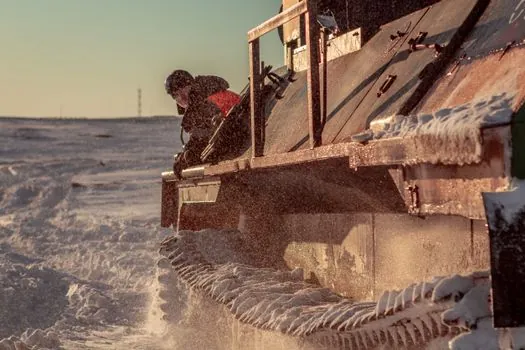
Four aerial work platform categories are realistically available for snow removal, and they sort cleanly on the criteria that matter in freezing conditions [S1][S3][S4]:
1. Rough-terrain straight boom lift: platform height 12–64 m, rough-terrain tires, four-wheel drive, diesel or hybrid power. Pros: highest reach and outreach, best wind performance. Cons: heaviest ground pressure, needs firm outrigger bearing, poor on soft snow without mats.
2. Articulating boom lift on tracks (spider lift): platform height 10–15 m typical, four outrigger legs, narrow stowed width. Pros: lightest ground bearing, fits through a personnel door, sets up on frozen lawns and rooftop decks. Cons: limited reach, slower to reposition.
3. Rough-terrain scissor lift: platform height 8–18 m, extendable deck, diesel power. Pros: large platform for multiple workers and bulk tools, stable. Cons: zero lateral outreach, so the chassis must drive right under the snow target, which rarely works beside a building.
4. Vehicle-mounted boom (aerial work truck): platform on a truck chassis with outriggers. Pros: road-legal, fast inter-site transit, can carry a heated cab. Cons: needs a clear hardstand for outriggers, and frozen curb lines often prevent setup on narrow urban streets.
For most winter roof snow loads and tree work the answer is a tracked articulating boom in the 12–16 m working height band, because it balances reach, ground pressure, and the ability to fold up for transport. Straight booms only earn their keep above 18 m of working height or on long outreach clears like commercial awnings.
Use cases that actually justify a winter lift rental
Snow removal from a roof is the headline use, but it is not the only one. Common winter lift applications include removing snow that threatens to collapse a roof or fence, clearing gutters and eaves troughs before ice damming forms, repairing utility lines and transformer boxes compromised by ice, post-storm roof and chimney inspections, and hanging or taking down commercial holiday lighting on tall facades [S4]. Each of these pushes a different criterion: roof snow removal needs outreach and stable ground, gutter work needs a narrow tracked chassis that can straddle a flower bed, and utility line work needs the long horizontal reach only a straight boom gives.
Cherry pickers and personnel lifts are the simplest one- to two-worker buckets, useful for light residential jobs like clearing a porch roof, but they offer limited reach and positioning flexibility compared with an articulating or telescopic boom [S4]. Towable boom lifts fill the same residential niche and hitch to a pickup, but their 34' to 50' platform-height envelope caps them to single-storey work [S3].
Cold-weather specifications that change the math
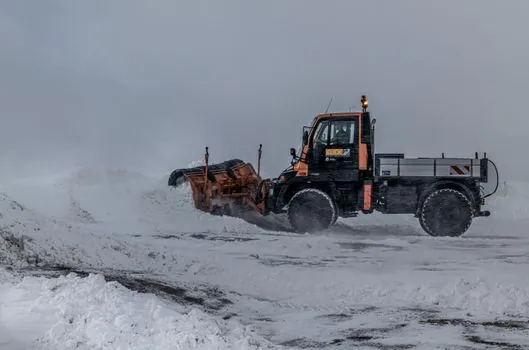
Hydraulic fluid viscosity at -20 °C is the first spec to verify, because ISO VG 32 oil in a standard machine will not flow through a proportional valve in deep cold. Manufacturers publish arctic or low-temp hydraulic packages that drop the cold-start pour point by 10–15 °C; without that package, the lift will fault out on boot in anything colder than about -10 °C. Battery capacity on electric-drive lifts falls 30–50% at -20 °C versus the 20 °C rating, so a diesel or hybrid is the safer spec for sub-freezing single shifts. [S3]
Outrigger pads must be larger than the summer rating suggests, because frozen ground can fracture under a point load in a way summer soil never does. A 600 mm square pad is a sensible minimum for any rough-terrain boom on snow. Tire chains or non-marking rubber tracks with embedded steel cleats are the next decision: chains bite ice, but they mark finished surfaces, so the choice is governed by whether you are on a construction site or a finished plaza.
Limitations, failure modes, and what not to do
The hard limit on a winter aerial job is wind, not cold. Most boom lifts derate or stop work above 12.5 m/s (about 28 mph) platform-height wind, and that limit drops further when the basket is loaded with a tarp acting as a sail. Pull the anemometer reading at platform height, not at ground level, because ground-level wind in a built-up area is routinely half the rooftop wind. Frost on the boom glass and joystick is a secondary failure mode: cold-soak electronics fog up and the operator cannot see the load chart on the display, so a pre-shift cabin warm-up is non-negotiable. [S3]
Operator certification and ground-condition assessment are the two items most often skipped in a rush. Operators must be trained on the specific machine class, and the ground under each outrigger or track must be assessed before every setup because ice heave and frost line depth are invisible until the pad punches through [S8]. On a frozen roof deck, get a structural sign-off before setting any tracked machine; snow load plus machine weight can easily exceed 5 kPa, which is above the live load rating of many light commercial roofs.
Sourcing, rental, and standards notes
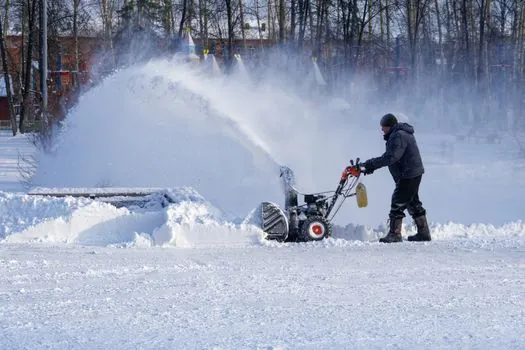
For Chicago-area and Northern Illinois winter work, regional rental yards stock rough-terrain scissor lifts, articulating booms, and straight booms on a daily-weekly basis, with larger machines commonly on weekly or monthly terms for storm-response contracts [S2]. Plan the rental order at least 72 hours ahead of a forecast storm: articulated crawlers and rough-terrain straight booms are the first categories to sell out, and substitution to a smaller machine is the usual cause of mid-storm stoppages.
Compliance falls under OSHA 29 CFR 1926.453 for aerial lifts and ANSI A92.6 for self-propelled elevating work platforms in the US, with operator training documented per ANSI A92.24. In Europe, EN 280 governs the same family. The standard reference numbers are not optional citation shorthand: insurance carriers will void a winter claim if the operator card, the daily inspection checklist, and the ground-condition sign-off are not on file before the lift goes up. For an overview of how a wheeled aerial work truck variant compares against a self-propelled boom on winter road duty, the truck-mounted option remains the better fit where inter-site road transit dominates the shift.
Two trackable signals for the next planning cycle: first, watch for arctic hydraulic package availability expanding on 10–12 m electric articulating booms, because battery cold-soak is the single biggest reason mid-shift derating shows up in winter telematics; second, watch whether rental fleets in the Great Lakes and Northeast regions shift their default winter stock from diesel rough-terrain scissors to tracked articulating booms, which would confirm crawler chassis as the new winter default rather than the exception. For a parallel specification exercise on the ground-clearance side of the same winter job, the wheel loader selection map for snow removal covers the chassis and traction choices that sit one level below the aerial platform on a typical plow-and-lift package.
Component reference pages worth checking: platform scale.