EAST Group (stock code 300376) released four catalog lines in June 2026 covering UPS modules, stationary cabinets, and 12V automotive start-stop packs built on NaFePO4 cathodes, signalling that sodium-ion is moving from lab demo to commercial SKU at the same time lithium carbonate pricing remains volatile [S1][S2][S4][S5].
The Intel-Na UPS module ECN5150R16S1PA1 ships with a 50Ah / 2280W rating, 53V nominal output adjustable from 43-58 VDC, 4800W max output, 100A max discharge, and a 3000-cycle life at 1C/80% DOD/25°C, backed by a 5-year warranty and MTBF ≥500,000 hours [S1]. Automotive 12V packs in the NaQTP and NaQTP-Alpine families list 50-60Ah capacity, 660-1000A cold-cranking amps, >3000 cycles at 1C/70% DOD, <3% monthly self-discharge, and 96-99% discharge efficiency at 1C [S2][S4].
What "Supply Shortage" Actually Means in 2026
Sodium-ion's risk profile is not a single commodity squeeze; it is a capacity-allocation squeeze layered on top of shared upstream inputs. The 12V start-stop SKUs (50-60Ah, 660-1000A CCA) [S2][S4] and the 53V/50Ah UPS module [S1] all use the same NaFePO4 cathode chemistry, the same hard-carbon anode family, and the same aluminum current collectors, so any automotive over-order directly starves UPS and stationary cabinet programs [S1][S2][S4][S5].
Stationary demand is structurally larger: the cabinet product line is explicitly modular, with faulty modules auto-exiting and PACK-level fire suppression shipped standard plus cabinet-level suppression optional, which only works if the cell supplier can sustain 19-inch rack volumes in the 45-50kg weight class [S1][S5]. When a single new gigafactory line switches between UPS and EV pack formats, the second program in line sees lead-times stretch from 8-12 weeks into the 20-30 week range typical of constrained lithium SKUs in 2022-2023.
Selection Criteria: Cathode, Format and Operating Envelope
EAST's published data isolates three decision variables a buyer can verify on the datasheet without trusting marketing claims: cathode chemistry, format, and operating envelope. The UPS and cabinet SKUs use NaFePO4 cathodes at 50Ah/2280W with 3000 cycles at 1C/80% DOD [S1][S5], which trades raw energy density for cycle count and thermal stability. The 12V start-stop SKUs use the same chemistry but in 50-60Ah single-block format with 660-1000A CCA bursts at 1C/70% DOD, sacrificing some cycle headroom for cranking power [S2][S4].
Operating envelope is where the alpine variant earns its premium: the NaQTG series targets cold cranking at 660-1000A while the conventional NaQTP is rated across a "wide temperature range" without the sub-zero claim [S2][S4]. For UPS buyers, the Intel-Na module's charge window is locked to 0-40°C and discharge to -20 to +50°C with altitude derating of 1% per 100m above 2000m, which rules out unconditioned outdoor enclosures in hot climates without active cooling [S1].
Cathode Chemistry Trade-Off: NaFePO4 vs Prussian Blue vs Layered Oxides
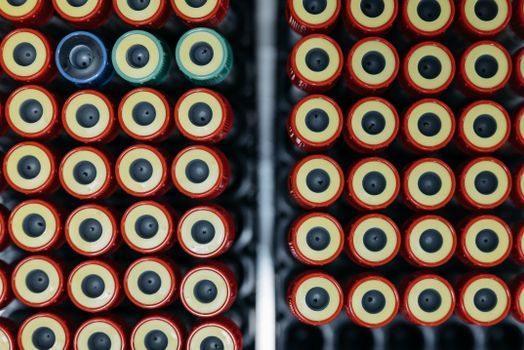
Three cathode families are competing for the same sodium cell lines. EAST has standardised on NaFePO4 (sodium iron phosphate), which trades lower nominal voltage and energy density for iron's low cost, supply-chain simplicity, and thermal stability - values that align with UPS and stationary use where weight is secondary to cycle life and fire safety [S1][S5].
Prussian-blue analogues (Na2FeFe(CN)6, Na2MnFe(CN)6) offer higher voltage and sodium abundance but suffer from water-content control issues that compress factory yield. Layered oxides (NaNi1/3Mn1/3Co1/3O2 and NaNi1/2Mn1/2O2 variants) push energy density higher but reintroduce nickel and cobalt exposure - the very supply-chain risk sodium-ion is supposed to bypass; see Cobalt Demand 2026-2030 for the upstream exposure that sodium layered chemistries import.
For an industrial UPS buyer, NaFePO4 is the rational default: the 3000-cycle/80% DOD/25°C rating matches the 10-year design life of the Intel-Na module [S1], and EAST's 5-year warranty [S1] is the only commercial commitment of its kind in the catalog. For an EV pack buyer chasing range, layered oxides remain the only path - and that is exactly the allocation pressure point.
Anode Side: Hard Carbon vs MoTe2 and Other TMDs
On the anode side, sodium-ion cells overwhelmingly use hard carbon, with molybdenum ditelluride (MoTe2) as a research-stage alternative. Hydrothermally synthesised MoTe2 delivered 380 mAh g-1 initial capacity stabilising at 277 mAh g-1 after 50 cycles (72.8% retention), while electrodeposited MoTe2 reached 425 mAh g-1 stabilising at 355 mAh g-1 (84.5% retention) with 78% initial Coulombic efficiency [S3].
That 277-355 mAh g-1 envelope is competitive with hard carbon's 250-320 mAh g-1 typical range, but MoTe2 remains at lab scale with no announced gigawatt-hour roadmap. For procurement in 2026, hard carbon is the only bankable anode; if a vendor pitches MoTe2 or Bi2MoO6-graphene composites, treat it as a research sample, not a deliverable SKU [S3][S8].
Who Sodium-Ion Is For (and Who It Is Not For)
Sodium-ion is a fit for stationary UPS, telecom backup, automotive 12V start-stop (especially sub-zero markets), and short-range urban EV programs where energy density per kilogram is secondary to cost-per-kWh and supply-chain resilience. The EAST catalog is built for these cases: a 12V 45-54Ah pack at 660-1000A CCA replaces lead-acid with 3000-cycle life [S2][S4], and a 53V/50Ah UPS module replaces LiFePO4 in a standard 19-inch rack at 45kg [S1].
It is not a fit for long-range EVs, aviation, marine propulsion, or grid-scale long-duration storage where $/kWh-cycle economics still favour lithium iron phosphate and vanadium flow. A buyer who specs sodium-ion for a 500km passenger car or a 200MWh grid plant in 2026 is buying into a constrained cell pool that the existing product lines are not designed to serve.
Limitations, Failure Modes and Verification
Three failure modes dominate the field. First, thermal runaway: sodium-ion does not smoke, catch fire, or explode under the conditions the EAST cabinet was designed for, but that claim is anchored to PACK-level fire suppression and modular isolation - remove those subsystems and the safety case weakens [S5]. Second, cold-charge plating: at sub-zero charging, sodium plating on hard carbon is more aggressive than lithium plating on graphite, so a buyer using the Intel-Na module below 0°C must respect the 0-40°C charge window [S1].
Third, supply chain verification: NaFePO4 cell datasheets at the 50Ah/3000-cycle level are now coming from multiple Chinese vendors, and the only durable signal is warranty terms, MTBF disclosures, and cycle-life test conditions (1C, 80% DOD, 25°C with explicit discharge depth) - the EAST Intel-Na module publishes all three [S1]. For buyers mapping exposure, the same constraint pattern shows up in adjacent raw-material markets - see Nickel Procurement Strategy for a parallel methodology that applies to sodium-ion precursor contracts.
Sourcing Signals to Track Into Q3-Q4 2026
Three signals will confirm whether the 2026 squeeze tightens or breaks. First, whether any tier-1 cell maker (CATL, BYD, HiNa, Faradion) publishes a 50Ah/3000-cycle NaFePO4 datasheet with cycle-life test conditions matching the EAST Intel-Na module [S1] - that is the proof point for sustainable supply. Second, whether 12V automotive start-stop contracts shift from lead-acid to NaQTP-class packs at the 660-1000A CCA level [S2][S4], which would consume the same cell pool as UPS modules.
Third, whether all-solid-state sodium-ion work based on sodium alginate biopolymer electrolytes [S6] or sulfide/oxide composite electrolytes advances from coin-cell to single-layer pouch by year-end - a yes would relieve but not solve the 2026 allocation issue, because solid-state lines take 18-30 months to ramp. For buyers evaluating alternatives, the same diligence loop applies to Solar Panel Demand 2026-2030, where storage pairing drives the same upstream constraints.
For component-level specifications, see dc power supply, switching power supply, and pressure transmitter.