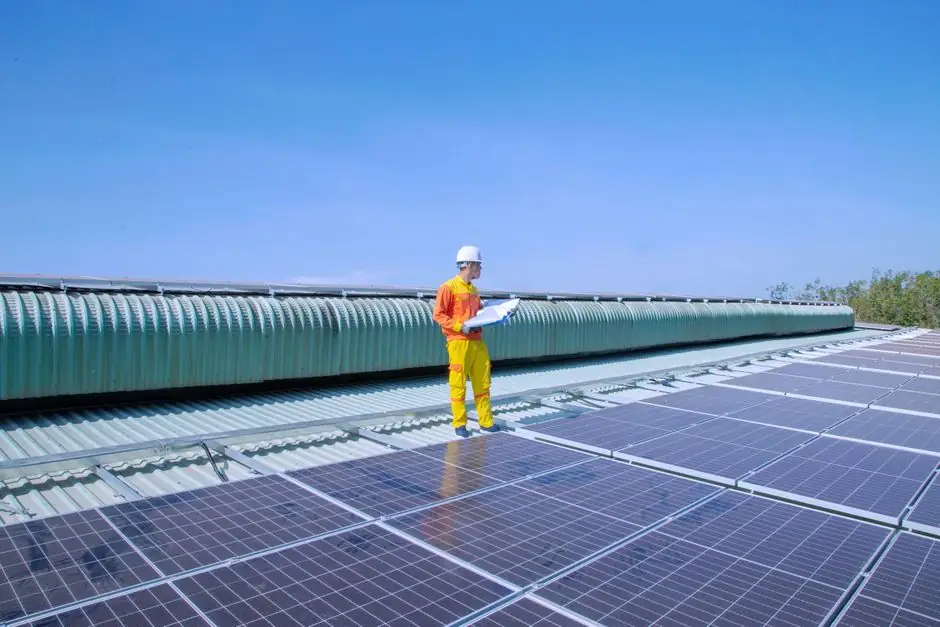
Solar cell manufacturing equipment for 2026 module assembly covers a 22-station turnkey line from glass loading to palletizing, with a baseline 25 s/pcs cycle time, 98% uptime over a 3-month rolling window, and throughput scales from 5 MW to 1 GW annual capacity per OEM spec sheet [S2].
The mainstream cell formats handled on a single line are G1 (156.75 mm), M6 (166 mm), M10 (182 mm), and M12 (210 mm), and the cell technologies span mono/poly, MBB, PERC, TOPCon, IBC, HPBC, and shingled, with module footprints from 1640 × 992 mm to 2500 × 1400 mm and frame heights of 30–40 mm [S2][S4].
Line Architecture and Station Count
A modern full-automatic solar panel line is composed of 22 process stations in fixed sequence, beginning with Automatic Glass Loading and ending with Automatic Sorting and Palletizing, with the laminator flanked by a 90-degree flip inspection station and a 180-degree flip machine [S2]. MES data interface and a unified PLC network link every station, and the line supports one-to-one mode and mixed-flow dual-mode operation depending on scheduling [S2]. Module weight on the conveyor tops out at 40 kg/pcs and noise is held to 60 dBA, with main power 380 VAC ±10% at 50 Hz ±1% and control at 220 VAC with DC 24V logic [S2].
Conveyor specifications are tightly bounded: speed 10–25 m/min variable-frequency on both pre- and post-laminator sections, height 950 ±50 mm, transport error under 10 mm in both axes, and inter-section height difference capped at 2 mm with vibration below 1.5 g, all on a 500 kg/m² floor load [S2]. Compressed air is specified at 6–8 kg/cm² (0.6–0.8 MPa) at approximately 200 L/min per cell-loading station, which matches ARGUS SOLAR's lay-up machine requirement of 0.6–0.8 MPa gas source [S1][S2].
Cell-Format and Technology Compatibility
Cell technology coverage in 2026 spec sheets is wide, with PERC at 22–23.5% efficiency, TOPCon at 23.5–25%+, HJT at 24–25.5%+, and IBC/ABC/HPBC at 24–26%, all on a single multi-technology production line [S4]. Busbar counts have moved up: G1 supports 5–12BB/MBB, M10 supports 9–16BB/MBB, and M12 supports 11–18BB/MBB, with MBB-optimized tabber-stringers rated for accuracy of ±0.3 mm and yield above 99.8% [S4].
Module types now default to bifacial double-glass and half-cell framed (C-face frame required), with non-destructive thermal laser cutting used to halve 156–230 mm cells at ±0.1 mm accuracy and throughput up to 8000 cells/hr, and breakage held under 0.2% [S3][S4]. Lay-up equipment in the same class achieves ±0.5 mm positioning at 120 modules/hr and yield above 99.9%, with ARGUS SOLAR's SGL-2500 robot lay-up station claiming ±0.5 mm accuracy and ≤1‰ breakage on A-class cells at 12 s/string (6 s/string on faster models) [S1][S4].
Throughput, Uptime, and Capacity Tiers

OEMs publish three capacity tiers for module lines: 100–600 MW for standard full-automatic lines, 120 MW as a mid-market turnkey, and up to 1 GW as the upper bound of modular design, with solar panel factory footprint referenced at 8000 m² for a full shift-3 24 h operation [S2][S3][S8]. Argus Solar's tabber-stringer platform cites single-string cycle time of 5 s and string length up to 2300 mm on the SJPG-300V18/ER10-2000 configuration, with lay-up beat time dropping from 12 s/string to 6 s/string when the line is reconfigured for shorter strings [S1][S3].
Per-station uptime targets run 99% on glass loading, EVA cut-and-lay, and EL inspection stations, with the bottleneck at the laminator typically holding line uptime at 98% on a 3-month average [S2]. Compressed air demand, floor loading, and conveyor height stability are the three utility gates that most often force a redesign late in plant build-out, since a 2 mm inter-section step or a 60 dBA noise ceiling will fail acceptance testing in EU and Korea audits [S2].
Selection Criteria: Cell Type, Module Type, Throughput, Footprint
Buyers should match four criteria against the OEM spec: (1) cell technology and busbar count, (2) module type (framed, bifacial double-glass, half-cell), (3) throughput class (100 MW / 120 MW / 600 MW / 1 GW), and (4) factory footprint and utility envelope. Argus Solar's wavelength-1064 nm / 30 W average-power laser scribing station pairs with chalcogenide thin-film lines, so a buyer building CIGS needs a different upstream than a PERC/TOPCon/HPBC crystalline-silicon buyer [S1].
For PERC/TOPCon, MBB stringer accuracy of ±0.3 mm and lay-up precision of ±0.5 mm are the floor; for HJT, low-temperature handling and dedicated cure profiles are required because HJT cells degrade above 200°C, and Ooitech's published 24–25.5%+ HJT band confirms the line must run at lower lamination setpoints [S4]. For bifacial double-glass, the bifacial edge-sealing station and 90-degree flip are mandatory, since frameless double-glass modules require perimeter sealant instead of an aluminum frame [S2]. For 1 GW capacity, the modular PLC/MES network and 500 kg/m² floor load are non-negotiable; anything below that floor load will require a structural retrofit [S2].
Quality and Test Stations

Inline EL testers are now standard on every full-automatic line, with testing cycle under 24 s, four-camera upward perpendicular projection, barcode recognition, and MES interfacing, and final EL check is repeated after framing to catch handling-induced micro-cracks [S2][S3]. IV testers and insulation/hi-pot testers are placed after the 180-degree flip and before sorting, with sun-simulator IV recording the final electrical performance [S2][S3].
Ooitech's published EL tester spec of 0.1 MP resolution and 100% inspection at 60–120 modules/hr is the de facto floor for buyers in tier-1 markets, and the published yield above 99.5% on laser cutting and above 99.8% on tabber-stringer is the reference benchmark to grade competing bids [S4]. Argus Solar's lay-up breakage ceiling of ≤1‰ on positive A-class cells is the most aggressive published claim in the lay-up category and should be treated as a hard spec line in any RFQ [S1].
Comparison of Mainline Equipment Options
Buyers evaluating the four most common equipment classes should compare them on throughput, accuracy, footprint, and uptime: laser cutting machines deliver up to 8000 cells/hr at ±0.1 mm and 99.5% yield; tabber-stringers deliver up to 3600 cells/hr at ±0.3 mm and 99.8% yield; layup machines deliver up to 120 modules/hr at ±0.5 mm and 99.9% yield; EL testers run 60–120 modules/hr with 100% inline coverage [S4]. A buyer chasing 600 MW annual output on a 25 s/pcs line cycle will see the laminator as the throughput ceiling, while a buyer chasing 100 MW on a single shift can drop the lay-up beat-time to 6 s/string by re-spec'ing to Argus's high-speed model [S1][S2][S4].
For thin-film chalcogenide lines the laser-scribing station at 1064 nm / 30 W average power is the critical path, and the cell-technology equipment compatibility in [S4] does not apply since CIGS uses different upstream wet-chemistry tools [S1]. For shingled cells, precision cutting and string assembly are mandatory because laser-cut shingles cannot be tabber-stringer welded in the conventional way, and the OEM line must include dedicated shingle handling [S4].
Limitations, Failure Modes, and Standards

Three failure modes dominate 2026 line-acceptance disputes: (1) lamination delamination caused by conveyor height mismatch greater than the 2 mm inter-section tolerance, (2) cell micro-cracking from lay-up beat time exceeding 12 s/string, and (3) EL false-negatives when four-camera calibration drifts on a 24 s cycle [S2][S3][S4]. Each of these is captured in published uptime metrics: a 1.5 g conveyor vibration reading will show up as a sudden rise in EL-rejected modules within 72 hours, and a 0.1 mm loss in laser-cutting accuracy will drop tabber-stringer yield below 99% within a shift [S2][S4].
Buyers should lock acceptance tests to four published numbers: line uptime of 98% measured over 3 months, EL cycle of 24 s maximum, lay-up breakage at 1‰ on A-class cells, and conveyor vibration below 1.5 g, all of which are present in OEM literature and serve as a defensible spec gate [S1][S2][S3][S4]. The relevant industry standard HS code 8486209000 is published for the equipment class, and CE/UL conformity on the 380 VAC main power panel is the typical EU/US acceptance gate [S3].
Use Cases and Buyer Profiles
A greenfield 1 GW bifacial double-glass line in India, the Middle East, or North Africa should spec the Ooitech full-automatic architecture with M10/M12 cells, 9–18BB/MBB stringers, ±0.3 mm accuracy, and a 25 s/pcs line cycle on a 500 kg/m² floor [S2][S4]. A 100–600 MW brownfield upgrade in Southeast Asia typically keeps existing lay-up stations and replaces the stringer, EL, and IV stations to step from PERC to TOPCon, and here the lay-up beat-time and EL cycle become the acceptance test rather than raw throughput [S3][S4]. A thin-film CIGS line is a different procurement track entirely, requiring chalcogenide laser scribing at 1064 nm and dedicated wet-chemistry upstream that is not part of a crystalline-silicon turnkey package [S1].
For buyers integrating smart-factory data, the unified PLC network with MES data interface on Ooitech-class lines is a hard requirement, and the line must support one-to-one mode and mixed-flow dual-mode operation to survive a product-mix change mid-shift [S2]. For European and Korean buyers, the 60 dBA noise ceiling and 500 kg/m² floor load should be raised as explicit acceptance criteria in the RFQ, since retrofit cost is high once the slab is poured [S2].
Trackable next signals: the 1 GW capacity ceiling, currently the published upper bound for modular turnkey lines, is the most likely number to move upward in the next product refresh cycle, and the lay-up beat-time floor of 6 s/string on Argus's high-speed model is the throughput benchmark to watch [S1][S2][S4]. For broader industrial spec context relevant to factory floor planning, see the linear guide selection guide for agriculture machinery and the spec-driven overview of solar inverter process control instrumentation, which complement the manufacturing-equipment picture for downstream inverter integration. Plant engineers selecting adjacent automation hardware can cross-reference the CNC controller sourcing tier map for spindle/PLC pairing decisions on the same factory floor.
For the relevant spec sheets and selection criteria, see additive manufacturing material, linear guide, and load cell.