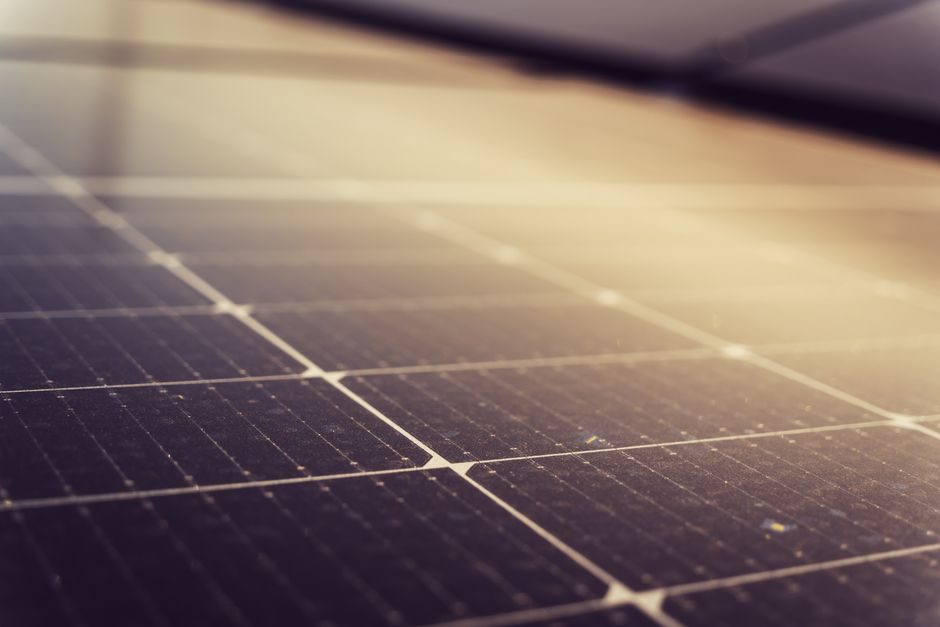
A crystalline-silicon PV module line is built around seven core stations: cell tabber-stringer, strings bussing machine, full-auto layup, full-auto EL tester, laminator, framing machine, and junction-box welder, which together turn soldered cell strings into a framed, IEC-certified module [S5].
Current line layouts cover wafer formats from 166 mm through 182 mm and 210 mm half-cut cells up to 800 W panels, plus 1/3-cut and 1/8-cut shingled-cell architectures, with full factory-layout engineering offered alongside the equipment package [S5].
Process Station Breakdown and Where Each Machine Sits
The cell tabber-stringer is the front end: it solders interconnect ribbons onto cells and lays the strings, while the busser joins strings into a matrix that becomes the electrical backbone of the panel [S5].
After stringing, a full-automatic layup station stacks the string matrix with EVA encapsulant, backsheet and front glass; a full-auto EL tester then runs electroluminescence imaging to catch microcracks before lamination locks defects inside the module [S5].
The laminator is the thermal bottleneck of any PV line, and Zenith Solar lists multiple configurations including a BIPV dual-chamber online laminator, a fully automatic online/offline dual-chamber BIPV laminating machine, and a 2742 dual-heating automatic PV module laminator, with EVA encapsulant-film testing integrated into the station [S2].
Downstream, the framing machine mounts the aluminum alloy border, and a junction-box welding station attaches the IP-rated output box; for engineered facility design, HMI panel interfaces at each station are the practical way to expose recipe, fault and throughput data to line operators.
Turnkey Suppliers and What Each One Actually Ships
Horad positions itself as a turnkey PV-module-line builder, offering complete solar panel production lines plus the full machine set covering every process step, with a stated focus on intelligent PV panel production lines since founding [S4].
Zenith Solar concentrates on the lamination step, with a product family that includes the BIPV Dual-Chamber Online Laminator, the Fully Automatic Online/Offline Dual Chamber BIPV Laminating Machine, the 2742 Dual Heating Automatic PV Module Laminator, and a Premium Quality BIPV variant [S2].
Atsco Solar Panel Manufacturing, based in Izmir, Turkey, lists 1 year on the platform with main categories of solar panel, solar project, and PV panel, indicating a regional module-assembly profile rather than equipment supply [S3].
For upstream mechanical handling, a Made-in-China factory in Zhejiang supplies solar-panel-related fastener grades including A194-2H, A325/A325M and A490/A490M, plus U-bolts, spring washers and DIN912 socket screws used in mounting brackets — relevant when a turnkey line ships its own racking and framing fixtures [S1].
Specialty Stations: Glass Washing, EL Test and BIPV Variants
Front-glass cleanliness directly controls lamination yield, and the Techwin Solar Panel Toughened Glass Washing Machine is listed at US$27,600-28,000 per set with a 1-set MOQ on the China supplier portal, branded Techwin and manufactured in Guangdong [S9].
BIPV (building-integrated PV) modules need a different lamination cycle than standard glass-backsheet panels, which is why the Zenith catalogue splits BIPV laminators into their own dual-chamber online and online/offline sub-family rather than reusing a standard PV recipe [S2].
On the upstream silicon value chain, Applied Materials (USA) supplies manufacturing solutions for glass, thin-film and crystalline-Si processes, and Schiller (Germany) supplies FAB end-to-end solutions, illustrating that fab-side equipment and module-assembly equipment are supplied by largely disjoint vendor pools [S7].
Spec Selection: Format, Wattage, and Throughput Gates
Cell format is the first hard gate: 166 mm, 182 mm and 210 mm half-cut lines require different stringer jigs, busser layouts and layup tables, and a 1/3-cut or 1/8-cut shingled-cell line additionally needs a different cell-cutting and stringing arrangement than a mainstream half-cut line [S5].
Output wattage is the second gate: a line rated up to 800 W panels implies a larger layup table, longer laminator heating plates and a heavier framing station than a line rated only to 400-450 W PERC modules [S5].
Comparing the main equipment options on four criteria:
• Tabber-stringer + busser: required for every c-Si line; vendor choice is Horad (turnkey) vs. the OEM/ODM route via solarpanelproductionline.com; throughput scales with strings/hour.
• Laminator: Zenith dual-chamber online (continuous), Zenith online/offline dual-chamber (batch + continuous), Zenith 2742 dual-heating (high-speed), and Horad turnkey — the trade-off is footprint vs. cycle time [S2][S4][S5].
• Glass washer: Techwin at US$27,600-28,000/set; alternatives from general industrial-washer OEMs, often Chinese, sit in a similar band for a 2 m glass width [S9].
• Mounting fastener set: A194-2H, A325/A325M, A490/A490M hex bolts, U-bolts, DIN912 socket screws from Zhejiang suppliers, used for racking and framing jigs rather than the module itself [S1].
Who a Turnkey Line Is For — and Who Should Buy Stations Instead
A turnkey Horad-style line is the right fit for a new entrant building a greenfield module factory of 500 MW to multi-GW scale, where one vendor carries interface responsibility across the seven core stations [S4][S5].
Buying single stations — for example, adding a Zenith laminator to an existing stringing line, or a Techwin glass washer to upgrade yield — fits contract manufacturers and Tier-2 module makers who already run a stable process and want to debottleneck one step [S2][S9].
The OEM/ODM route through suppliers like solarpanelproductionline.com fits buyers who want the machine set shipped directly from the factory with custom jigs for their cell format, while still owning the line integration themselves [S5].
For process engineers evaluating factory-floor control retrofits, CNC controller market 2026 is a useful parallel read because the same axis-count, embedded-Linux and EtherCAT questions now show up on PV stringer and layup stations.
Standards, Sourcing Constraints and Failure Modes
Module-side equipment does not eliminate the underlying IEC 61215 and IEC 61730 design and type-approval burden on the finished panel; the laminator and layup stations only control how consistently a cell string is encapsulated, not whether the cell and module design itself passes the type tests. [S5]
One practical failure mode is lamination yield drop caused by contaminated front glass; this is exactly why a dedicated toughened-glass washer station (Techwin, US$27,600-28,000/set) is sold as a standalone upgrade rather than integrated into the laminator [S9].
A second failure mode is microcrack propagation under the cell matrix: a full-auto EL tester is placed after stringing and again post-lamination so that cracks induced at layup are caught before the module is framed, not after [S5].
On sourcing, listings for fastener sets tied to shipyard and structural-steel grades (A194-2H, A325/A325M, A490/A490M) show up on the same supplier pages as solar-panel mounting hardware, because the mounting-bracket screw is mechanically a structural bolt regardless of whether it carries a PV clamp [S1].
Trackable Signals to Watch Through 2026
Two signals to monitor: whether Horad or Zenith publish cycle-time and uptime data for the 2742-class dual-heating laminator family, because that is the most useful single number for a buyer modelling throughput per square metre of cleanroom floor [S2][S4].
Second, watch the OEM/ODM factory-layout offerings for 210 mm half-cut and 1/8-cut shingled lines, since cell-format and shingle-cut choice are the two specs most likely to lock a buyer into a single stringer and busser vendor for the next 5-7 years [S5].
For the relevant spec sheets and selection criteria, see additive manufacturing material, and anti static equipment.