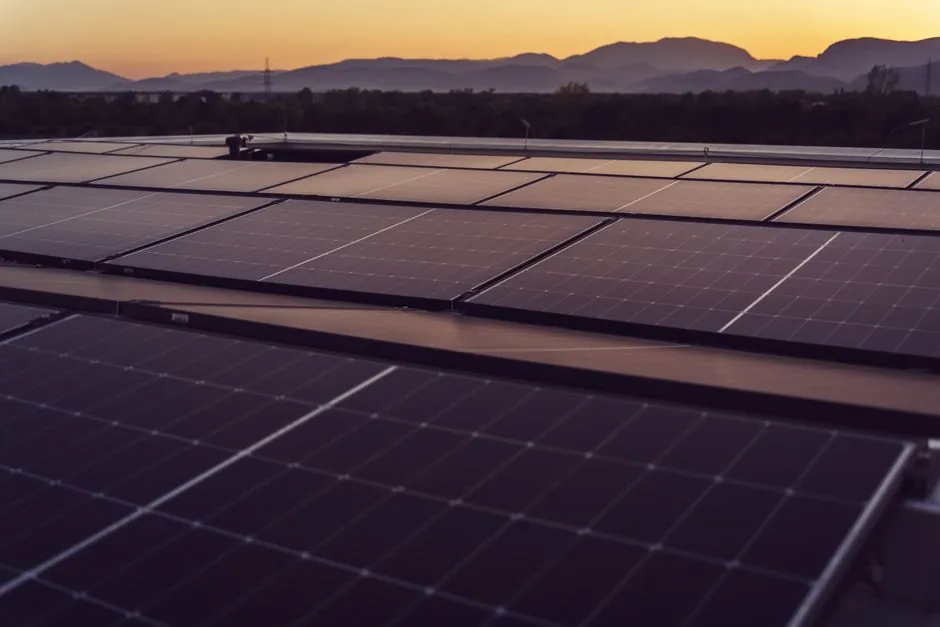
ASLAN Solar, a Shenzhen-headquartered PV manufacturer active since 2009, lists annual capacity above 1.2 GW with ISO 9001 and TUV certifications and ships TopCon cell modules from 2 Wp to 670 Wp in both mono-crystalline and poly-crystalline form factors as of August 2026 [S2].
Chinese PV factories now segment output across rigid mono PERC 410-700 W utility panels, mid-range 100-300 W mono residential modules, and a parallel portable/flexible sub-segment in 50-200 W ratings with IP65 foldable form factors for off-grid kits [S2][S4]. Sourcing decisions turn on watt class, cell chemistry, certifications, and whether the bill-of-materials is open or locked.
Cell chemistry and watt-class segmentation across Chinese PV factories
ASLAN Solar's catalog splits into mono-crystalline (PERC Mono 410 W, 545 W, 600 W, 660 W, 700 W), poly-crystalline 2 W epoxy/PCB, plus PET-based low-wattage epoxy panels, covering a 2 Wp to 670 Wp range as displayed on its homepage in mid-2026 [S2]. The mono PERC line uses TopCon cells per the company description, while poly and epoxy/PCB lines target small-format and consumer goods buyers [S2].
Buyers should map watt class to deployment: rigid mono 660-700 W PERC for utility/ground-mount, rigid mono 410-545 W for rooftop residential, poly or epoxy 2-100 W for IoT/consumer products [S2][S4].
Portable and flexible modules: a separate sourcing lane
Future Tech Solar runs a separate product line dedicated to portable and flexible PV, with categories including Foldable Solar Blanket (FT60 60 W IP65), Flexible Solar Panel, Folding Solar Panel, Rigid Solar Panel, Balcony Solar Panels, and portable solar charger 5000 mAh class units [S4]. The FT60 foldable blanket is rated 60 W with an IP65 waterproof enclosure and a black PET/ETFE top sheet typical for the form factor [S4].
This portable sub-segment uses a different BOM than rigid utility panels: ETFE or PET lamination instead of tempered glass, PCB- or fabric-backed substrates, and PWM or basic MPPT charge controllers rather than string inverters [S3][S4]. Wattage typically caps at 200 W for foldable and 100-400 W for balcony microinverter kits, and the buyer pool is OEM/ODM consumer brands, RV and marine distributors, and EU balcony-solar resellers rather than EPC contractors [S4]. For process engineers specifying plant rooftop or ground-mount arrays, the portable lane is largely irrelevant; for product buyers building a private-label solar charger, it is the entire spec map.
Inverter pairing and balance-of-system compatibility
Chinese suppliers list Aurora-class string inverters, micro-inverters, and MPPT off-grid units in 400 W to 9000 W ratings, with model codes such as Solar Power Inverter 600 Watt, Solar Inverter GW4000D-JP, High Frequency 4000 W / 5000 W home-use units, and 9 kW three-phase models [S3]. Off-grid MPPT inverter categories appear as standalone SKUs in the Future Tech Solar catalog [S4].
Match inverter DC input window to panel Voc at the coldest expected cell temperature: for a 660 W mono PERC panel with Voc around 41-46 V, a string of 2 in series lands around 90 V, well inside 600 W class single-MPPT inverters, while 9 kW three-phase units handle 8-12 panels per string [S2][S3]. HART-style analog signalling does not apply to PV inverter communication; grid-tied units use Modbus RTU/TCP, Sunspec, or proprietary cloud APIs, and any plant requiring integration with a control panel component should specify the supported protocol stack before locking the inverter SKU.
Certifications, supplier vetting, and what ISO 9001 + TUV actually cover
ASLAN Solar displays ISO 9001 and TUV certification badges on its homepage and states it serves "more than 50 countries and regions" with 1.2 GW+ capacity, a footprint consistent with mid-tier Chinese PV exporters rather than the top-three tier-1 cell producers [S2]. TUV product certification typically covers IEC 61215 (design qualification) and IEC 61730 (safety) for crystalline silicon modules, and ISO 9001 covers the factory QMS, not the panel's electrical performance per se [S2].
Buyers should request the certificate numbers, issuing TUV/Intertek/CGC body, and the IEC standards explicitly listed on the certificate scope, since factory-level ISO 9001 does not by itself guarantee any specific panel model has passed IEC 61215 or IEC 61730 type approval [S2]. For utility-scale procurement a bill-of-materials lock (glass supplier, encapsulant, junction box brand, cell origin) is non-negotiable, and third-party EL testing on a per-batch basis is the standard hedge against tier-2 factory variance. For consumer/OEM portable panels the same logic applies in lighter form: confirm cell origin (PRC cell vs Southeast Asian cell), lamination type, and IP rating test report [S4].
Pricing mechanics, MOQ, and Incoterm realities for 2026
Direct-from-factory pricing on Alibaba-style B2B platforms (Amax Solar, everychina.com) typically applies at 1 pallet to 1 container MOQ, with Amax Solar listing 1 product category page and 8 new-product SKUs alongside 5000 mAh portable solar chargers, keychain power banks, and 2600 mAh folding units aimed at consumer buyers [S1]. Watt-class and cell chemistry are the dominant price drivers: a 670 W mono TopCon module is roughly an order of magnitude higher per unit than a 100 W poly panel, and 2 W epoxy/PCB panels sit two orders of magnitude below a 660 W PERC module on per-unit basis [S2].
Standard Incoterms for Chinese PV exports remain FOB Shenzhen/Ningbo for sea freight and EXW for small parcels, with 30% T/T deposit + 70% against B/L the default payment term on platform-mediated orders [S1][S2]. Lead time on stock SKUs is 7-15 days; on custom OEM portable panels 30-45 days; on rigid mono 660-700 W PERC modules, 20-35 days depending on cell supply. For plant-scale procurement a more rigorous sourcing play is covered in this Solar Panel Procurement Strategy: Factory, Installer, After-Sales walkthrough, which aligns the same factory-vetting logic to installer and after-sales selection.
Failure modes, warranty traps, and what to track post-shipment
Tier-2 factories commonly exclude PID from warranty scope or limit it to the first 5 years, so warranty document language matters as much as the warranty headline.
For portable/balcony products the failure modes shift to lamination delamination under thermal cycling, IP65 connector water ingress, and charge-controller MOSFET failure, and these are typically covered 12-24 months [S4]. Pre-shipment inspection (PSI) by a third party such as SGS or Bureau Veritas, plus a per-batch flash test report and EL image set, is the standard practice for orders above 1 container. Buyers integrating PV into an HMI panel or SCADA stack should also verify inverter data export format (Modbus registers, Sunspec model IDs) before accepting any inverter SKU on the BOM.
The two trackable signals worth monitoring through the rest of 2026: (1) any update to China's polysilicon export tax or VAT rebate policy, which directly shifts FOB unit pricing on mono TopCon panels; (2) any expansion announcement from tier-1 cell producers (LONGi, JinkoSolar, Trina, JA Solar) that pulls capacity away from tier-2 lines like ASLAN, since that historically tightens MOQ and lead time on 410-545 W residential mono modules. Buyers locking 2027 rooftop or ground-mount arrays should pin pricing and cell origin in writing before either variable moves.
Spec-level background on the components involved: linear guide.