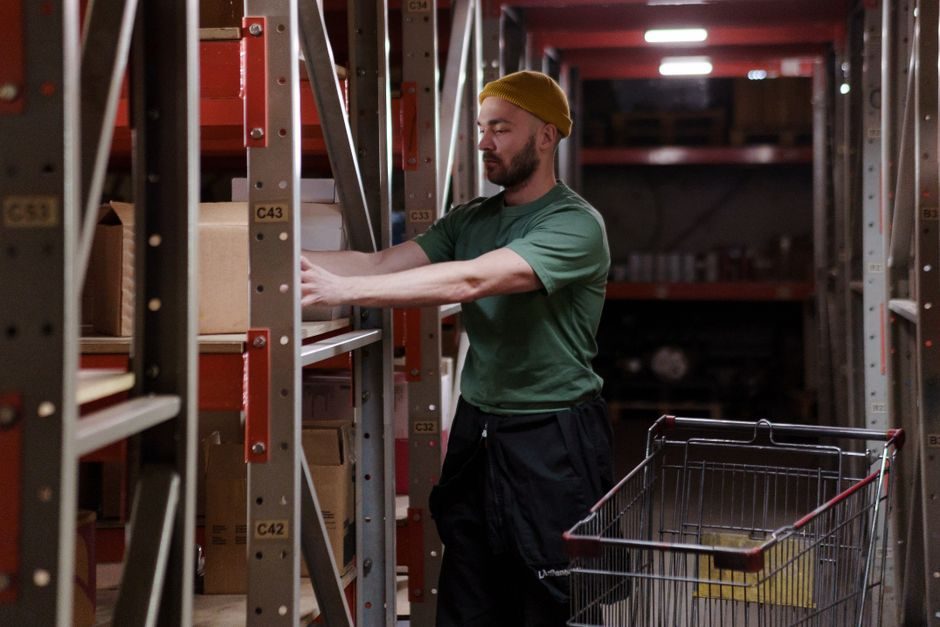
Sorting system specification in 2026 resolves into six engineering gates — item profile, throughput, sortation accuracy, footprint, WCS/WMS integration, and lifecycle cost — with each gate disqualifying a measurable share of conveyor sorter, AS/RS shuttle, and cross-belt options before the RFQ is even issued [S1][S2].
For mid-volume distribution centres (5,000–25,000 units/hr), the practical decision is usually between a linear cross-belt sorter and a tilt-tray or shoe sorter on a common loop, while parcel and e-commerce flows above 15,000 pcs/hr are increasingly served by cross-belt or double-belt overhead sorters with induction lengths tuned to 600–1,200 mm [S3].
Item profile and dimensional envelope
The first measurable gate is the physical envelope: length 100–1,500 mm, width 80–800 mm, height 10–600 mm, and weight 0.05–50 kg cover roughly 90% of typical DC parcel and case mixes handled by loop sorters [S1].
Items outside this window — for example soft polybags below 5 mm thickness, or steel totes above 50 kg — force a sorter change: polybags need a narrow-belt or Bombay-door induction with 25–50 mm gap control, while heavy totes push the spec toward a sliding-shoe or heavy-duty AS/RS shuttle coupled with a downstream recirculation loop rather than a cross-belt [S2][S3].
Throughput and induction math
Peak throughput is not the same as nameplate throughput: a cross-belt sorter advertised at 20,000 pph typically sustains 15,000–17,000 pph under real-mix parcel distributions because the limiting factor is the induction gap, not the loop speed, and the empirical rule of thumb is 250–400 mm minimum centre-to-centre spacing at the induct [S1][S3].
Tilt-tray and tray-sorter loops run at 1.0–2.0 m/s with 600–1,200 mm tray pitch, giving a per-loop ceiling of 9,000–15,000 trays/hr, which is why multi-loop configurations (two or three parallel loops) are the standard answer for sites needing more than 18,000 pph without resorting to a wide-belt shoe sorter [S2].
Sortation accuracy and divert technology
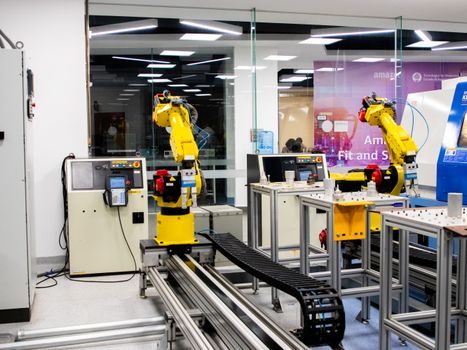
Sortation accuracy targets in pharmaceutical, retail-fulfilment, and postal hubs cluster around 99.95–99.99% for unit-level cross-belt and tilt-tray, with first-pass mis-sorts typically held under 0.05% on well-tuned lines; shoe sorters on flat cartons routinely sit at 99.5–99.9% because the divert relies on friction rather than a positive push [S1][S3].
For high-friction or shrink-wrapped loads, sliding-shoe sorters with servo-driven divert arms handle 2–5 kg cartons at 99.9% accuracy and switch-over times under 300 ms, which is the same order of magnitude as cross-belt arm actuation (typically 150–250 ms) but with different load-handling characteristics [S2].
Footprint, height and civil constraints
A loop sorter's footprint is geometrically fixed: a 30 m × 8 m oval with 4 m overhead clearance accommodates roughly a 12 m × 6 m induction zone plus 18 m of return loop, and any deviation from a 4:1 length-to-width ratio starts to penalise divert dwell time [S1].
Where ceiling height is below 3.5 m, the practical answer is a floor-level sliding-shoe sorter or a linear belt cross-belt deck on a low-profile conveyor sorting line running at 0.6–1.2 m/s, which trades throughput for a 1.8–2.2 m vertical envelope [S3].
Controls integration and WCS handshake
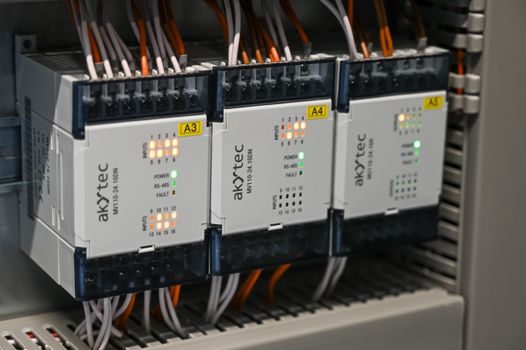
Modern sorters expose a flat-file or PLC tag interface (typically OPC UA Pub/Sub over Ethernet/IP or PROFINET) and a sorter-level throughput API that the WCS polls at 100–500 ms intervals, with divert-confirm feedback closing the control loop within one cell pitch [S1][S2].
The 2026 baseline is dual-redundancy: a primary WCS plus a hot-standby sorter PLC, with item-tracking data flowing from the induction scanner through a 1D/2D imager bar at 3,000–6,000 reads/min, and the sortation database retention is now routinely specified at 90–180 days for traceability against mis-sort claims [S3].
Lifecycle cost, energy and maintenance gates
Total cost of ownership over a 12-year horizon is dominated by energy, drive replacement, and divert-bearing service: a 20,000 pph cross-belt loop draws 35–55 kW under load, while a comparable tilt-tray loop draws 25–40 kW, and a 30–40% delta in kWh/1,000 sorts is common between the two at equal throughput [S1].
Selection frame summary: who the option is for, and who it is not

Cross-belt loop sorters fit e-commerce, postal, and pharmaceutical unit flows at 8,000–18,000 pph where divert speed and a 99.95%+ accuracy target dominate; they are not the answer for heavy-case flows above 30 kg or for very low-height buildings [S1][S3].
Tilt-tray and tray sorters suit fragile, oddly shaped, or high-value items (glass, cosmetics, electronics) at 6,000–12,000 pph with positive tray containment; they lose on footprint per pph and on initial capex. Sliding-shoe sorters carry 2–10 kg cartons at 99.9% accuracy and are the workhorse for retail DC and apparel, while shuttle-system and AS/RS totes are the right tool for bin-level storage rather than for high-speed sortation [S2].
For engineers weighing broader material-handling stacks, the AMR price and cost guide 2026 breaks the same six-gate logic across payload, navigation, and battery, and the VLM vs pallet rack spec cut applies a comparable frame to unit-load storage; both reinforce that selection gates, not vendor preference, drive a defensible 2026 spec.
Trackable signal: a verifiable next node is the WCS-to-sorter handshake latency requirement (sub-200 ms is the 2026 RFQ baseline for greenfield loops), and a 1- to 2-quarter watchpoint is the emergence of OPC UA over 5G as a brownfield retrofit interface for legacy loop sorters whose original fieldbus is now a maintenance liability.