A sorting system and an autonomous mobile robot (AMR) are often conflated in warehouse marketing material, but they execute different physical operations: a sorting system identifies, classifies and diverts individual items at fixed induction and discharge points, while an autonomous mobile robot carries a payload between waypoints on a dynamically updated map.
The decision is not "which is better" but "which bottleneck you are actually relieving." A 2026 DirectIndustry listing indexes 16 manufacturers offering 28 transfer-AMR products, including Hikrobot (9 part numbers), NORCAN (4), and QENVI Robotics (2), which signals that the AMR supply base is now broad enough for multi-vendor fleets [S1]. Sorting system vendors, by contrast, integrate tightly with parcel or unit-handling conveyor OEMs and rarely expose a standalone picking API.
Functional Scope and Core Operating Envelope
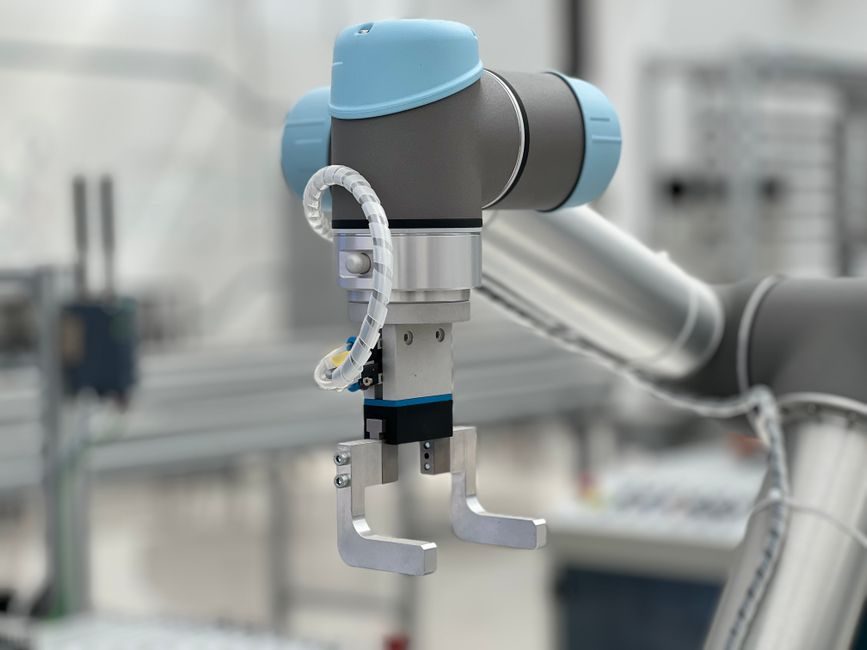
A sorting system reads an identifier (barcode, 2D code, or 3D vision features), executes a divert decision within 200-800 ms, and physically routes the unit to one of N chutes or zones; throughput is measured in units per hour per induction lane, with conveyor-belt sorters commonly running 5,000-15,000 units/h and cross-belt or shoe sorters scaling to 25,000+ units/h on large hubs. The Turin Robotics 3D vision-guided autonomous sorting cell, released for industrial order-fulfilment trials, combines structured-light cameras with an inline conveyor loop and a six-axis articulated robot for pick-and-place into destination totes [S5].
An AMR is a self-guided wheeled platform that carries totes, racks or bins from point A to point B; payload typically ranges from 50 kg (small fleet units) to 1,500 kg (heavy-pallet AMRs), with navigation done through 2D SLAM laser scanners, 3D obstacle cameras, or magnetic/QR fiducials. A representative 2026 listing, the Robotnik RB-SUMMIT, is classed as a mobile autonomous robot in the indoor-mobile-robotics category with manipulator-ready top mounts [S6]. Power architecture has been surveyed extensively: battery chemistries split between LiFePO4 (3,000-6,000 cycle life, lower energy density ~90-160 Wh/kg) and NMC (1,500-3,000 cycles, ~150-220 Wh/kg), with charging windows of 10-30 min opportunity charge common in 2022-2026 designs [S4].
Selection Criteria: Throughput, Footprint, Item Mix and IT Layer
Use a sorting system when the work is item-level identification plus divert: parcels, e-commerce units, returned goods, pharma totes, or discrete-parts kitting. Use an AMR when the work is load-level transport: full totes, raw-material reels, WIP racks, or finished pallets moving between cells. The two are not mutually exclusive — many 2026 fulfilment cells use AMRs to feed induct conveyors on a conveyor sorting line, and the AMR fleet manager (e.g. Hikrobot, OTTO Motors, Geek+) hands off totes at the induction scan tunnel. [S1]
Decision criteria that separate them cleanly: (1) fixed vs flexible routing — sorters require bolted chutes and steel structure, AMRs require only mapped floor; (2) unit vs load granularity — sorters move one parcel per decision, AMRs move a tote holding 5-30 units; (3) capex profile — sorters of 10,000+ units/h cost USD 1-5 M installed, while a 10-vehicle AMR fleet for similar throughput lands near USD 0.8-1.5 M, but the AMR has a 3-5 year depreciation curve that adapts to layout changes; (4) control integration — sorters typically expose PLC and OPC-UA tags, AMRs expose REST or MQTT fleet APIs and require a WMS/WCS bridge [S1].
Comparison: Sorting System vs AMR on Engineering Criteria

Lining them up on the four criteria a process engineer will actually weigh: [S2]
- Throughput unit: sorter = items/h at the divert point (5,000-25,000 typical); AMR = moves/h per vehicle (40-120 typical, scaled by fleet size). High-volume parcel hubs cannot be built from AMRs alone because vehicle count, battery cycling and traffic management cap effective throughput well below a single cross-belt sorter line.
- Footprint and infrastructure: sorter needs a fixed steel mezzanine, induction belt, and chute matrix (typical 200-600 m² for a mid-volume unit sorter); AMR needs only a mapped floor with no embedded guides, allowing redeployment in days rather than months. If you anticipate 2+ layout changes per year, the AMR's lower sunk cost wins.
- Item variability: sorter's vision system handles a declared SKU/feature set (new SKU = model retraining, typically 1-7 days); AMR is item-agnostic because it never reads the contents, only the destination. For mixed-SKU 3PL operations, vision-guided sorting cells now use deep-learning classifiers that re-train in hours, narrowing the historical gap [S5].
- Failure mode and recovery: a sorter stop halts the entire induction-to-chute flow (mean time to repair often dominated by belt tracking and divert actuator wear, with typical MTBR 500-2,000 h between jams); an AMR failure removes one vehicle from a fleet of N, with traffic manager rerouting in seconds. The fleet model is inherently more resilient at the cost of per-vehicle complexity (LiDAR, SLAM, battery management) [S4].
Who Each System Is For — And Who It Is Not For
A sorting system is the right answer for: e-commerce fulfilment centres above 3,000 orders/day, parcel hubs above 50,000 pieces/day, pharma distribution with strict serialised track-and-trace, and discrete-parts kitting cells where each unit must reach a unique order. It is the wrong answer for low-volume (<500 units/day) operations, sites with no fixed conveyor ceiling, or workcells where totes — not individual items — are the actual handling unit. [S3]
An AMR is the right answer for: assembly-line side-feed, work-in-progress transport between cells, finished-goods put-away, and order-fulfilment picking where the totes are the granularity being moved. It is the wrong answer for sortation itself (vehicles do not divert parcels to chutes) or for ultra-high-density storage where a mobile crane or unit-load ASRS will out-cycle a wheeled robot on vertical storage density.
Standards, Sourcing and Integration Constraints

No single IEC or ISO standard governs the sorting-system/AMR boundary. Sorter safety typically falls under ISO 13849-1 (safety-related control systems, PL d or PL e on divert actuators) and ISO 13855 (safety distance for safeguards), with emergency-stop and muting logic following ISO 13850. Navigation perception literature continues to use sonar and ultrasonic-vision fusion as reference baselines, although 2D/3D LiDAR has displaced both in commercial units since roughly 2018. [S4]
On the sourcing side, the 2026 vendor pool is wide enough to run competitive tenders for either class: DirectIndustry indexes 16 transfer-AMR manufacturers with 28 products across DAIFUKU, ek robotics, Hikrobot, OTTO Motors, Raymond, Robotnik and others [S1]; sorting-system integration is dominated by four-firm global players (Beumer, Siemens, Vanderlande, Honeywell Intelligrated) with regional integrators filling mid-market slots. For mixed-technology cells, the AGV robot category still overlaps with AMR on function but differs in guidance infrastructure and fleet protocol — a point procurement teams often miss until integration phase.
Limits, Failure Modes and 2026 Watch Items
Sorting systems fail in three dominant modes: (1) vision miss on novel SKUs (mitigated by deep-learning classifiers, but training-data drift remains the top cause of mis-sort rates climbing from 0.5% to 3% over 12 months), (2) divert actuator wear (typical MTBR 500-2,000 h for cross-belt, longer for shoe sorters), and (3) induction congestion when upstream pick rates exceed sorter capacity. AMRs fail in different modes: (1) LiDAR/SLAM drift in dynamic environments with high pedestrian density, (2) battery degradation in fleets running 3-shift opportunity charge (LiFePO4 retains ~80% capacity at 3,000 cycles, NMC at ~70% by 2,000 cycles [S4]), and (3) traffic-management deadlocks when fleet density exceeds roughly 1 vehicle per 200 m² in narrow-aisle layouts.
Cooperative multi-robot research, in the literature since the late 1990s, established the architectural patterns modern fleet managers use (centralised vs decentralised, behaviour-based vs plan-based). The two-wheeled self-balancing AMR literature addresses a different stability-control problem relevant to compact human-following robots but not to warehouse-class platforms [S2]. Open-source simulators such as sobot-rimulator [S3] and the ROS-based rs-lidar-16 perception stack are the de-facto teaching baselines, but they are not a substitute for vendor-validated fleet software in production.
Buyers evaluating either class in 2026 should anchor the decision on three trackable signals: (a) the per-unit throughput actually demonstrated at 90 days post-install, not vendor brochure rates; (b) the WMS/WCS integration interface list and version compatibility, because most 2024-2025 fleet managers switched REST endpoints at least once; and (c) the safety-certification trail against ISO 3691-4 (AMR) and ISO 13849-1 (sorter) — both must be cross-referenced to the installed CE/UL file, not the generic corporate certificate. For adjacent selection frames on heavy material handling, the forklift jib vs truck-mounted crane 2026 spec cut applies a similar fixed-vs-flexible routing logic to lifting attachments.