
SPC rigid-core flooring is a calcium-carbonate-filled PVC composite (typically 60–70% limestone filler, 25–30% PVC binder, with a 0.3–0.7 mm wear layer and UV topcoat) — useful for dry office and corridor zones inside chemical plants, but unsafe as the primary floor of a process hall, bunded storage area, or battery room [S1].
China-origin SPC exports from Jiangsu and Shandong supply the bulk of mid-range rigid-core stock at landed prices around US$3.60–11.00 per m² (1,000 m² MOQ) [S4]. That price point is what draws EPC contractors, but it is the chemistry — not the cost — that decides whether SPC belongs in a given plant zone [S4].
What SPC Actually Is — and What It Is Not
The rigid core is a co-extruded mix of CaCO₃ and PVC; clicking planks run 4–8 mm thick with a 0.3–0.7 mm transparent wear layer, a printed décor film, and a 1.0–1.5 mm IXPE or EVA acoustic underlay [S1]. Manufacturers such as DECNO, Bofei and GKBM publicly position the product as waterproof, formaldehyde-controlled, and dimensionally stable, with a click-lock system aimed at residential and light-commercial fit-out [S3][S6].
Manufacturers do not, and cannot, claim chemical resistance beyond a narrow list — household detergents, oils, weak acids in food-contact settings. SPC is not a chemical-resistant floor; it is a waterproof decorative floor. Conflating the two is the most common engineering mistake seen in greenfield process-hall fit-outs [S2].
Selection Criteria Inside a Chemical Plant
Zone the building first, then pick the floor: (1) dry offices, control rooms, corridors, electrical rooms — SPC is a fit-for-purpose, low-cost option; (2) laboratories, dispensing rooms, cleanrooms — choose a chemically-rated vinyl tile or resin with documented resistance to the specific reagent list; (3) process halls, drum storage, battery rooms, bunded areas — specify resin-based screeds (PU, vinyl-ester, epoxy novolac) installed by specialist applicators, not rigid planks [S1][S5].
Verifiable decision rules worth pinning to the drawing: SPC's upper continuous-service temperature sits near 60 °C — pour one bucket of hot solvent over a 60 °C plank and the core softens. SPC also has no resistance to strong acids, ketones, chlorinated solvents or aromatic hydrocarbons; the printed film and PVC binder swell, stain, or detach within hours of contact [S1].
Options Compared: SPC vs Epoxy vs PU vs Vinyl Ester
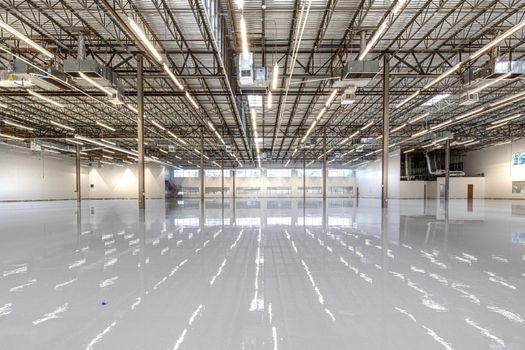
On a 1–5 engineering scale for chemical-processing floors: SPC scores high on cost (5/5), install speed (5/5) and slip resistance when dry (4/5), but low on temperature limit (1/5, ~60 °C continuous), chemical resistance (1/5, narrow reagent list) and impact under fork-truck traffic (2/5) [S1][S2].
Epoxy screeds with novolac resin score 4/5 on chemical and temperature resistance (often rated to 90–120 °C short-term), 3/5 on cost, 4/5 on cleanability, but 2/5 on installation speed (7–14 day cure) and crack-bridging. PU cement screeds hit 4/5 on thermal-shock and organic-acid resistance, 3/5 on cost, and 4/5 on impact. Vinyl-ester screeds push chemical resistance to 5/5 against strong oxidising acids but cost 2/5 and demand skilled applicators [S2]. Use the rule: if the floor will see anything stronger than household detergent, do not specify SPC.
Use Cases Where SPC Is the Right Pick
SPC belongs in dry back-of-house zones inside a chemical site: admin offices, conference rooms, locker rooms, IT server rooms, cafeterias, and corridor walkways away from liquid handling. The value is speed — a 1,000 m² office floor can be floated in 2–3 days with no adhesive cure time, and the click profile tolerates the slab movement common in new industrial builds [S1][S2].
SPC also works in temporary modular offices, containerised control rooms, and contractor cabins where the floor will be decommissioned within 5–7 years. Factory-direct MOQs of 1,000 m² and per-m² pricing near US$3.60 make it attractive for fast-track EPC schedules, particularly when paired with raised-access underfloor cable trays [S4].
Use Cases Where SPC Must Be Rejected

Anywhere the floor will see free liquids of unknown chemistry, hot spills above 60 °C, or steam cleaning — reject SPC. That covers process halls, pump skids, drum-filling bays, IBC storage, battery charging rooms (spilled electrolyte is HF or H₂SO₄), CIP rooms in food or pharma, and any zone with an open bund or secondary containment drain [S1].
Verbatim from a regulatory note on a New Zealand flooring project: "If consent drawings specify tiles, vinyl, or similar materials, any substitution with laminate, SPC, wood, or other flooring requires a Minor Variation approved by Council before installation… Council may reject the product at inspection regardless of compliance documents" [S5]. Treat that as a standing rule for any audited or code-controlled facility — substitution without re-spec is a documented non-conformance.
Limits, Failure Modes and Cost Traps
SPC's two silent failure modes in industrial settings: (1) UV and chemical attack on the wear layer dull the surface within 6–12 months in semi-outdoor or solvent-exposed zones, eroding the slip rating; (2) click-profile separation at temperature swings, especially when the plank approaches its softening point and forklifts turn on the joint [S1][S6].
The cost trap is that "waterproof" is not the same as "chemical-proof." Buying cheap SPC for a process zone forces a full rip-out within 18–36 months; a properly specified resin screed at 3–5× the install cost is amortised over 10–15 years. Treat any price quote under US$5/m² for a chemical-zone floor as a red flag, not a bargain [S4].
Standards and Documentation to Demand
For dry zones where SPC is acceptable, ask the supplier for: EN 16511 (resilient floor covering — semi-rigid multilayer modular panels) compliance, a low-formaldehyde declaration aligned to E0/E1 or FloorScore, EN 13501-1 reaction-to-fire class at least Bfl-s1, and a wear-layer abrasion rating in AC4/AC5 for commercial traffic [S1][S3][S6]. For chemical-process floors, the spec list runs to ASTM C722, ASTM D1308, ISO 2812 chemical-resistance test data, and slip rating per DIN 51130 / EN 13893 — none of which SPC will pass for reagent duty [S2].
Cross-reference the broader flooring decision against the industrial flooring engineering reference when matching zone, traffic, and reagent class, and use the SPC flooring category page to vet supplier claims on wear-layer thickness and acoustic underlay. For reagent-spill compatibility, validate against the chemical reagent database before any substitution is signed off.
Trackable signals to watch: (1) any new EN 16511 amendment covering chemical-exposed commercial zones, expected to clarify SPC's permitted scope; (2) Shandong and Jiangsu OEM announcements of AC6-grade, 0.7 mm wear-layer planks priced under US$6/m², which would extend SPC's reach into heavier light-commercial traffic [S4]. Neither signal is yet confirmed; both are worth a quarterly check.
For related coverage, see Self-Aligning Bearing Selection: Bore, Misalignment, Material and Housing.