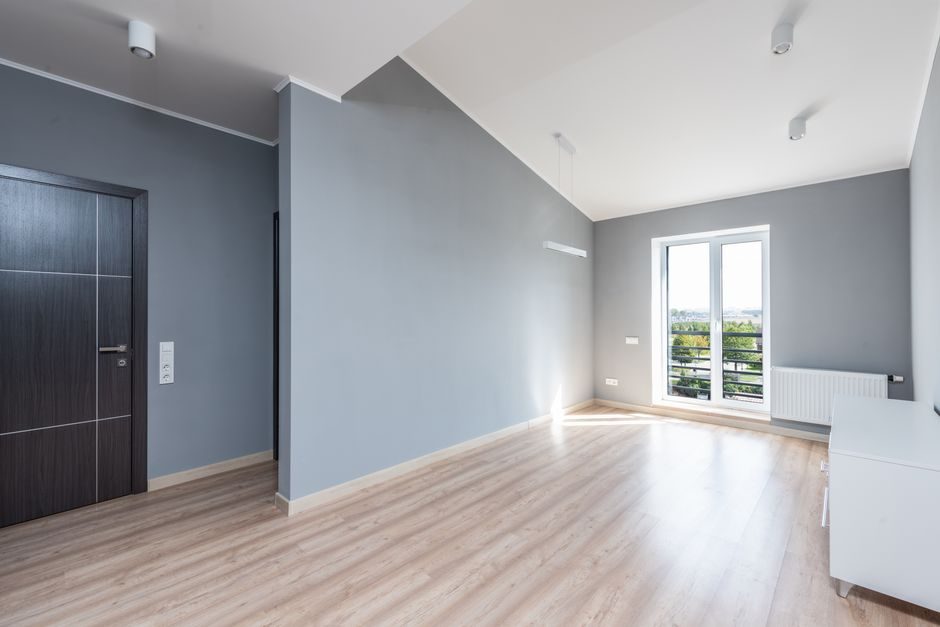
SPC (Stone Plastic Composite) flooring is a rigid click-lock plank built around a calcium-carbonate-filled PVC core, with the spec window for most commercial and residential buyers running from 4.5 mm to 8 mm total thickness and a wear layer of 0.3 mm to 0.7 mm [S1].
Entry-tier export SPC out of Qingdao clears at roughly US$1.00–2.00 per square metre FOB at 500 m² MOQ, and full-container 20 GP orders are the standard commercial break point for cross-border buyers [S1]. Flooring selection sits inside a wider building-products sourcing flow that also covers dry-mix mortar vs cement and block and brick, so the same spec-first logic applies: nail the material parameters first, then negotiate commercial terms.
What SPC Actually Is: Core Composition and Thickness Stack-Up
SPC planks are a sandwich: a UV-cured wear layer on top, a printed PVC decor film, the rigid SPC core (typically 60–80% natural limestone powder bound in PVC), and a backing layer of IXPE or EVA foam for acoustic comfort and underfoot feel [S1]. Total thickness of 4.5–8 mm is the commercial norm, with 5 mm and 6 mm being the highest-volume export SKUs out of Chinese and Mexican plants [S1][S2].
The rigid core is what separates SPC from flexible LVT: it will not telegraph subfloor imperfections the same way, and click-lock integrity is preserved across temperature swings where soft vinyl would gap. Buyers comparing SPC against alternative floor builds should also weigh how the plank sits next to architectural hardware thresholds and skirting transitions, because the rigid core's 4.5–8 mm stack changes the reducer profile you need at doorways. Reference pages on industrial flooring and SPC flooring cover the broader category comparison.
The Four Spec Levers That Actually Drive Price
Total thickness, wear-layer thickness, core density, and backing foam density are the four parameters that move price more than any other variable on the spec sheet [S1].
Wear layer is the single most important spec for commercial traffic: 0.3 mm is residential-grade, 0.5 mm is light commercial, and 0.7 mm is the entry point for heavy retail and office corridors. Foam backing thickness — 1.0 mm, 1.5 mm, or 2.0 mm IXPE — drives acoustic performance (ΔLw impact sound reduction) but does not affect wear life. Buyers who only optimise on price/m² routinely under-spec the wear layer and end up with visible scuffing inside 18 months on anything beyond residential foot traffic.
Wear Layer, Thickness, Backing, and Price: Side-by-Side
For a spec-first buyer, the comparison below lines up the main SPC build options against the four criteria that govern lifecycle cost, based on export-grade SKUs currently shipping out of Qingdao and the local-Mexico model that Zenith Flooring runs for North American accounts [S1][S2].
Residential 4.5 mm / 0.3 mm wear layer / no foam: US$1.00–1.30/m² FOB, 6–10 year residential life, suitable for bedrooms and low-traffic apartments [S1]. Light commercial 5 mm / 0.5 mm wear layer / 1.0 mm IXPE: US$1.40–1.70/m² FOB, 10–15 year life, default spec for hotel rooms and small offices [S1][S2]. Heavy commercial 6 mm / 0.7 mm wear layer / 1.5 mm IXPE: US$1.80–2.20/m² FOB, 15–20 year life, retail and corridor grade [S1]. Premium 8 mm / 0.7 mm wear layer / 2.0 mm IXPE: pushes above the US$2/m² floor band, used where acoustic performance is the design driver [S1].
Who SPC Is For — and Where It Loses
SPC is for buyers who need a waterproof, click-lock floor with a rigid feel, installed over concrete or existing hard subfloors in residential, multi-family, retail, and light-commercial settings [S1][S2]. It is the default pick for projects with tight timelines because planks install as a floating floor with no adhesive and no acclimation week, and the click profile tolerates minor subfloor variation that would defeat glued LVT [S1].
SPC is NOT for outdoor use (UV and thermal cycling will warp the rigid core), NOT for areas with prolonged direct sunlight through unfiltered glass (fading and expansion), and NOT for heavy industrial loads from forklifts or steel-wheeled traffic — the industrial flooring category covers those use cases with epoxy, polyurethane screed, or polished concrete instead. SPC also struggles on uneven subfloors with more than 3 mm deviation over 2 m: the rigid core will rock and the click will eventually shear.
Certifications, Acoustics, and Real Use Cases
FloorScore certification is the standard VOC/emissions label for SPC shipped into the US, and formaldehyde emissions below the FloorScore threshold are the typical minimum bar for residential sales [S1]. Buyers heading into European projects should also check CE/EN 16511 compliance for resilient flooring; Mexican-local SPC production cuts US-bound lead times because trucks, not containers, handle the last-mile leg [S2].
Typical real-world deployments include: multi-family apartment renovations (5 mm / 0.5 mm, US$1.40–1.70/m² band), retail fit-outs on tight 4–6 week schedules (6 mm / 0.7 mm, US$1.80–2.20/m² band), and hotel guest rooms where 1.0–1.5 mm IXPE backing delivers the ΔLw impact-sound numbers that property managers need to hit. SPC's 100% waterproof core also makes it a default for kitchens, bathrooms, and basement conversions where engineered wood and laminate would swell [S1].
Sourcing and Lead Time: China vs Local Production
Cross-border buyers default to Qingdao and Shandong for lowest FOB price, with 20 GP being the entry MOQ band and 500 m² being the per-SKU MOQ inside a mixed container [S1]. Lead time is 25–35 days production plus 18–25 days ocean transit to US West Coast, so plan a 60-day door-to-door window for first orders.
Local Mexican production — Zenith Flooring being one named example — quotes faster US delivery by cutting ocean transit entirely, which makes sense for time-sensitive retail rollouts even when per-square-metre price runs higher than Qingdao FOB [S2]. Payment terms on the China side are typically L/C, T/T, D/P, or Western Union at order confirmation, with balance against copy of B/L [S1]. Buyers should always request a pre-shipment sample plank, a wear-layer thickness micrometer reading, and a FloorScore or CE certificate copy before releasing the deposit, because sub-spec wear layers and unbranded cores are the two most common downgrade tactics in this product category.
Trackable signals to watch next: the 0.5 mm and 0.7 mm wear-layer SKUs continuing to absorb share from 0.3 mm stock as commercial retrofits run, and Mexican-local capacity expanding to take share from Qingdao on US-bound orders under 5,000 m².
For component-level specifications, see pressure transmitter.