
A specialty chemicals plant runs against a written process specification that fixes the unit-operation route, equipment, parameters, and inspection steps before any batch is released, per the standard definition of 工艺规范 / process specification [S3].
The document is a controlled technical file: process route per part or per SKU, per-step work content, cutting/dosing rates, man-hour quotas, equipment and tooling lists, and inspection methods must all appear, then be approved before production [S3]. It functions as the master reference for production preparation, scheduling, shop-floor execution, and quality verification, which is why specialty plants in Europe tend to anchor their operation around a logistics-and-formulation cluster rather than a single asset [S1][S3].
What a process specification must contain on a specialty-chem line
A compliant process specification lists, at minimum, six blocks: (1) the unit-operation route and which shop/section each step runs in, (2) per-step work content including the reactor, centrifuge, dryer, or packaging machine used, (3) the process parameters — temperature, pressure, residence time, agitation, pH — for each step, (4) inspection items and methods (in-process and release), (5) dosing or machining rates and man-hour quotas, and (6) the required operator skill grade [S3]. The file is approved and then treated as binding; deviations require re-issue, not annotation.
For a specialty-chemical batch plant the equivalent of "machining route" is the recipe: charge order, addition rates, hold times, transfer set-points, and CIP/SIP steps. Because SKUs change frequently and runs are short, the same specification template is reused across dozens of products, with parameter tables swapped per material — which is the practical reason specialty plants invest in configurable process control rather than hard-wired sequences [S3].
Plant-layout reality: clustered, multi-client, feedstock-adjacent
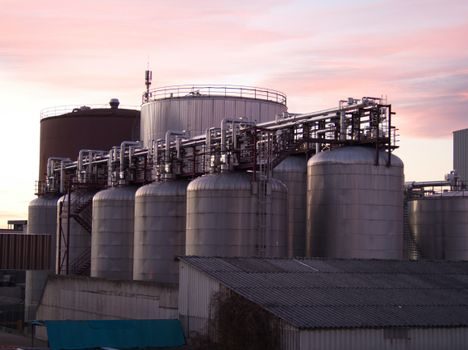
Specialty-chemicals manufacturing in Europe is structurally clustered. Katoen Natie's French flagship at Saint-Martin-de-Crau grew from 30,000 m² to 350,000 m² over 16 years by stacking multiple customers on one permitted site, and the same operator runs a 30,000 m² Seingbouse (Moselle) tank-farm-style site near a petrochemical complex for consumer-goods liquids [S1]. The pattern — anchor with one petrochemical tenant, then add adjacent FMCG, retail, and DIY accounts — repeats from Antwerp outward [S1].
Three layout rules follow from that model. First, sit within reach of a port or pipeline-fed petrochemical cluster so bulk feedstocks arrive by tank rather than drum, cutting unit cost. Second, design the tank farm and bunding for multi-tenant segregation so a single site's HSE envelope covers several unrelated chemistries. Third, keep the warehouse, drumming hall, and QC lab on the same cadastral plot so a 25–30 t batch can move from reactor to test certificate to outbound truck in under one shift, which is the throughput assumption built into the operator's site-selection logic [S1].
Vendor service model: chemistries plus on-site technical reps

Independent specialty-chemical suppliers sell programs, not just drums. Wesmar's published offering bundles cleaning and sanitation chemistries, boiler/cooling/wastewater treatment programs, agriculture and post-harvest chemistries, and process additives, then backs each line with an on-site technical representative who handles dosing-system engineering, bulk-tank monitoring, and audit support against FSIS, USDA, GFSI, and SQF schemes [S2].
The economic mechanism is the same as a process specification: the supplier writes the dosing set-points, the CIP frequencies, and the lab-test cadence, and the plant executes against that document, which is the only way a 50-customer food processor keeps a single sanitation plan defensible to a third-party auditor [S2][S3]. Bulk and mini-bulk delivery with automated inventory telemetry removes the manual drum reconciliation step that otherwise burns a sanitation shift per week, so the service fee is typically recouped in labour and chemical overuse reduction rather than priced as a per-kilogram margin [S2].
Decision criteria: which specialty plant model fits which buyer
Buyers fall into two camps and the right vendor shape is different for each. A contract manufacturer running 5–20 kt/yr of proprietary actives for one brand owner needs a process specification with full parameter tables, validated cleaning, and a captive QC lab, and the right site is a single-tenant permitted plot inside a feedstock cluster [S1][S3]. A food processor or industrial plant buying functional chemistries (CIP, boiler, wastewater) does not need to own the process specification at all; it needs a supplier who writes and owns that spec on the buyer's behalf and signs the audit paperwork [S2].
Four selection criteria separate the options: (1) ownership of the process specification (in-house vs supplier-owned), (2) scale of the site (single-tenant 10,000–30,000 m² vs multi-tenant 100,000–350,000 m² cluster), (3) feedstock logistics (pipeline/tank vs drum/ISO), and (4) regulatory scope (REACH/CLP for chemicals vs FSMA/GFSI/SQF for food plants). Specialty-chemical toll manufacturers sit on the first three rows; service-oriented chemical distributors sit on rows two through four [S1][S2][S3].
Operating limits and failure modes practitioners plan for
Three failure modes dominate. First, specification drift: when a parameter table is edited in the shop floor's local copy and never re-issued through the approval loop, the audit trail breaks and the batch cannot be released, which is why the process specification is treated as a controlled document rather than a working draft [S3]. Second, tank and dosing cross-contamination in a multi-tenant cluster, mitigated by dedicated lines, dedicated CIP skids, and sequenced product-rotor-valve logic on the industrial valve manifold. Third, utility failure during an exotherm, where the flow meter signal on the cooling-water return is the only credible proof that the recipe stayed inside its thermal envelope.
Instrumentation choices for these plants are conservative. Corrosive-service pressure transmitter bodies are usually specified with Hastelloy or PTFE diaphragms on reactors carrying HCl, hypochlorite, or strong solvents, while dosing-pump skids are routinely audited against the multifunction process calibrator that proves both the 4–20 mA loop and the HART variables at the same time. In a multi-tenant cluster the same calibrator doubles as the document of record for the customer's audit pack, which is the practical link between the process specification on paper and the working reactor in the field [S3].
Where specialty-chemicals manufacturing is heading in 2026
Two structural moves are visible. European chemical logistics operators are continuing to grow multi-tenant clusters at 200,000–400,000 m² scale to absorb overflow capacity from single-tenant sites that cannot expand inland, and the bottleneck is no longer land but HSE permitting and segregated utility headers [S1]. On the service side, independent chemical suppliers are pushing deeper into on-site technical representation, audit-ready documentation, and bulk-tank telemetry so that the buyer's plant can be defended against FSMA, GFSI, and SQF audits without owning a full QC function [S2].
Trackable signals for the next 12 months: announcements of new multi-tenant specialty-chemicals clusters in the Antwerp–Rotterdam range or in southern France, and published extensions of FSMA-aligned service programs by specialty chemicals suppliers into new commodity chemistries such as peracetic-acid CIP or membrane antiscalants for the TFC RO membrane lines that an increasing number of food and pharma sites are installing. A separate near-term signal is consolidation among mid-sized service-oriented chemical distributors, since the on-site-rep cost base only amortises above roughly 200 active accounts per region [S2]. Buyers specifying a new site in 2026 should require that the contract manufacturer holds an approved process specification per product family before any commercial commitment is signed, and that the process specification template itself is delivered as a controlled document under change-control rather than as a quotation attachment [S3].