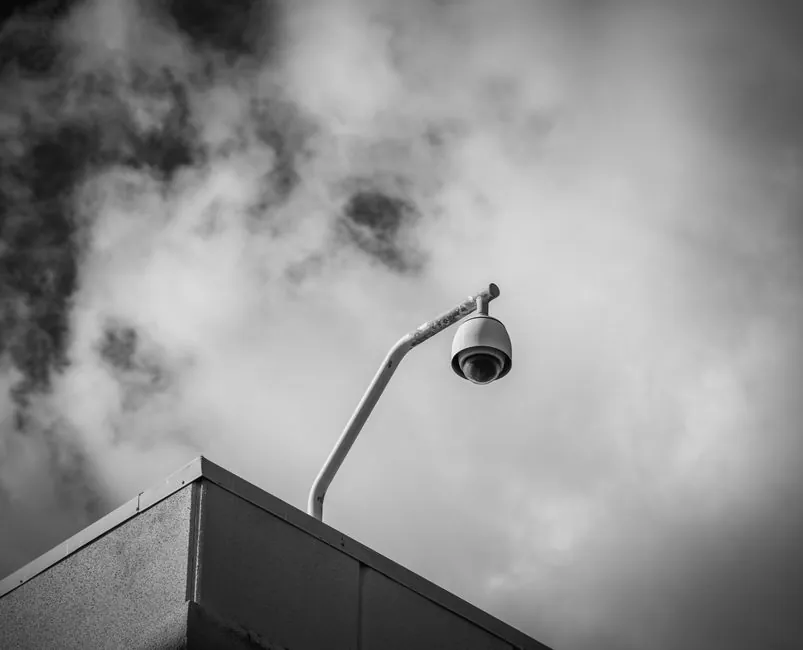
Laboratory surveillance cameras must be specified to IP66/IK10 minimum, with 4K resolution and PoE as the default, and must shift to certified explosion-proof housings where flammable vapors or dust are present [S2][S4][S5].
The lab is a hybrid space: part clean office, part chemical plant, part data-handling room. Cameras that work in a corridor or a warehouse often fail inside a fume hood, a BSL-2 suite, or a cold room, so the spec sheet has to be built around room-by-room hazards, not around a single "industrial" label [S1][S2].
What a Lab Camera Specification Has to Cover
A lab security camera spec must include at least four building blocks: ingress protection, impact rating, low-light sensor performance, and network/power topology, because each one is tied to a documented failure mode in lab environments [S2][S4]. IP66 is the floor for dust and water-jet resistance; IP67 is preferred where wash-down or condensation is routine; IK10 is the standard impact-rating target for vandal and bump resistance on reachable housings [S2][S4]. Resolution is now set at 4K (8 MP) as the baseline for entrance, stockroom, and evidence-grade coverage, with H.265 or Ultra H.265 compression to keep storage within sane NVR sizing [S4].
On the protocol side, ONVIF compliance is non-negotiable for any lab tying surveillance into an existing access-control or VMS stack, while PoE (Power over Ethernet) collapses power and data into a single Cat5e/Cat6 run and simplifies UPS-backed redundancy [S4]. For a primer on how these cameras fit into the broader physical-security stack, the surveillance camera technology overview lays out the sensor, lens, and codec vocabulary a spec writer needs before writing the BOM.
Choosing Housing Class by Room Type
Room zoning drives housing class, and the rule is straightforward: standard IP66/IK10 dome or bullet bodies in offices, write-up areas, and corridors; stainless or corrosion-resistant housings in wet chemistry or autoclave rooms; ATEX/IECEx-rated explosion-proof bodies inside solvent storage, butane extraction, or any area where flammable vapors can reach the camera body [S2][S5]. Explosion-proof network IP cameras on the market in 2025 ship at 8.0 MP with built-in infrared, 15 FPS, and IP66 housings, which is the resolution/frame-rate envelope to use as a reference when validating vendor datasheets [S5].
PTZ bodies are reserved for large multi-bench labs, shared instrument rooms, and atrium-style atriums where one camera must cover a 180-360 degree arc; fixed bullet or mini-dome bodies are preferred for choke-point coverage at doors, pass-throughs, and stockrooms [S4]. The rule of thumb from facility-security practice: video is most useful at entries and exits, and least useful as a substitute for access control, so place fixed bodies at every controlled door and put PTZ only where a human operator will actively drive it [S1].
Low-Light, Infrared, and 24/7 Operation
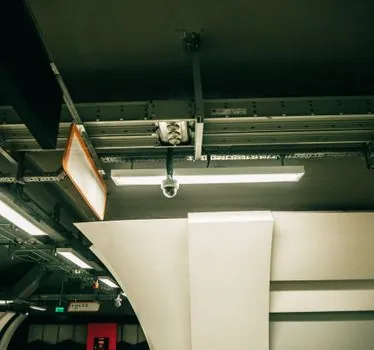
Laboratories routinely run unattended experiments and cold-storage cycles overnight, so a camera that drops to useless footage at 5 lux is a false economy; spec writers should require explicit minimum illumination figures (e.g., 0.001-0.01 lux in color, 0 lux with IR on) and confirm IR range covers the full room diagonal [S2][S4]. Full-color night vision (starlight sensors) is now the default in 2025-spec commercial and industrial lines and avoids the blown-out foreheads and black backgrounds typical of older IR illuminators [S4].
For the deeper environment-control context, including how cameras interact with HVAC, lighting, and vibration from benchtop equipment, the industrial surveillance systems overview is the right adjacent reference for EHS and facility teams writing a unified spec.
Resolution, Codec, and Storage Sizing
For 4K (8 MP) streams, Ultra H.265 (also called H.265+) typically cuts bitrate 50-70% against H.264 at the same perceptual quality, which directly shrinks the NVR disk budget and extends retention windows for chain-of-custody review [S4]. A practical sizing anchor: a single 4K Ultra H.265 stream at 15 FPS can land in the 2-4 Mbps range, so a 16-camera lab over 30-day retention fits in roughly 2.5-5 TB of usable storage after RAID overhead [S4]. Where retention is regulated (for example, controlled-substance or select-agent areas), spec writers should set retention to 90 days minimum and verify the NVR supports hot-swap drives and RAID 5/6 [S1][S4].
Local SD card slots up to 256 GB give per-camera redundancy if the NVR drops, which is a real failure mode in legacy buildings where network switches get rebooted during HVAC or electrical work [S4].
Integration with Lab Access Control and Data Systems
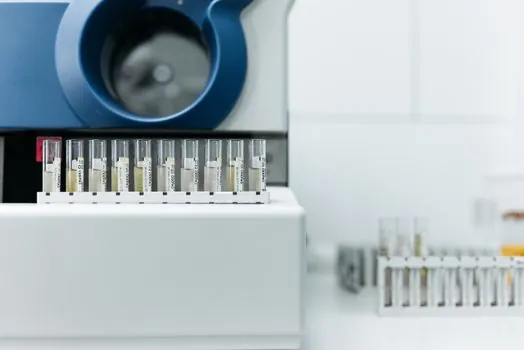
Camera placement in a lab is part of a four-domain security model: physical, electronic, operational, and information, and the camera by itself only addresses the detect function; delay and response still come from locks, access control readers, and procedural controls [S1]. ONVIF Profile S/T compliance is the practical contract that lets a lab VMS pull events from door controllers and lets access-control software pop up the nearest camera on badge read, which is the workflow that actually catches tailgating and prop-door events [S4].
For labs handling proprietary chemistry or biological materials, audit trails on video access matter as much as the footage itself, so NDAA-compliant product lines and tamper-detect logging on the NVR are increasingly part of the procurement checklist [S3]. Information-security rules also apply: cameras on the lab network should live on a segmented VLAN with no inbound routing from the open internet, and admin credentials must be enrolled in the institutional password manager, not left on the default [S1].
Options Compared: Dome vs. Bullet vs. PTZ vs. Explosion-Proof
Across the four dominant form factors used in labs, the selection trade looks like this. Fixed dome cameras win on aesthetics, IK10 vandal resistance, and ceiling-mount coverage of benches and aisles, but lose on long-throw identification at doorways beyond roughly 15 m [S4]. Fixed bullet cameras win on long-range license-plate and face ID at entries, on visible-deterrent presence, and on easy IR alignment, but lose on discreet corridors where a dome is less obtrusive [S4]. PTZ cameras win on coverage area per camera and on operator-driven zoom for incident review, but lose on per-camera cost, on mechanical wear, and on the need for an active operator to be useful [S4]. Explosion-proof cameras win on regulatory compliance and on survivability in flammable atmospheres, but cost roughly 5-10x a standard IP66 dome and require classified-area electrical installation, so they are over-spec for ordinary labs and under-spec for solvent rooms [S2][S5].
Failure Modes and Spec Pitfalls
The most common lab-camera spec failures are predictable: IP65 specified where IP66 was needed, so wash-down destroys the seal; IR range specified without checking the room's reflectivity, so corners go black; PoE budget undersized on a 16-port switch, so 4 cameras reboot on pan-tilt; and NVR storage sized for H.264 when the cameras ship as H.265, so retention silently halves [S2][S4]. Vibration from centrifuges, freezers, and HVAC blowers is a second failure source and is the reason commercial-grade bodies fail in lab service; look for bodies rated for sustained vibration, not just impact [S2]. Cold rooms (-20 to -80 degrees C) require low-temperature-rated housings and often heated windows to prevent condensation on the lens, which is a spec line that gets missed until the first defrost cycle [S2][S4].
Applicable Standards and Procurement Checks
Specifiers should anchor the procurement check on a short list of verifiable marks: an IP code per IEC 60529, an IK code per IEC 62262, ATEX 2014/34/EU or IECEx certification for any body in a classified area, ONVIF conformance for VMS interoperability, and NDAA compliance for any lab with U.S. federal funding or procurement links [S2][S3][S4][S5]. For hazardous-location bodies, confirm the exact zone rating on the datasheet (Zone 1 vs. Zone 2, gas group, temperature class) against the lab's own area classification drawing before issuing a PO, because a Zone 2 camera in a Zone 1 room is a documented audit finding [S5].
Two trackable signals to watch over the next 12 months: ONVIF Profile M (metadata for AI analytics) adoption in lab VMS stacks, which will let analytics events like PPE detection or unattended-bag alerts write directly into the access log; and the migration of explosion-proof lines from 2 MP/15 FPS bodies to 8 MP/30 FPS bodies, which is the resolution gap currently between general industrial and hazardous-location cameras [S4][S5]. For a related read on explosion-proof and remote surveillance bodies in oil and gas, see the explosion-proof camera spec map for oil and gas sites; for the construction-site counterpart, the DORI/IP/power spec map applies the same selection logic in a more mobile setting.
Component reference pages worth checking: industrial camera.