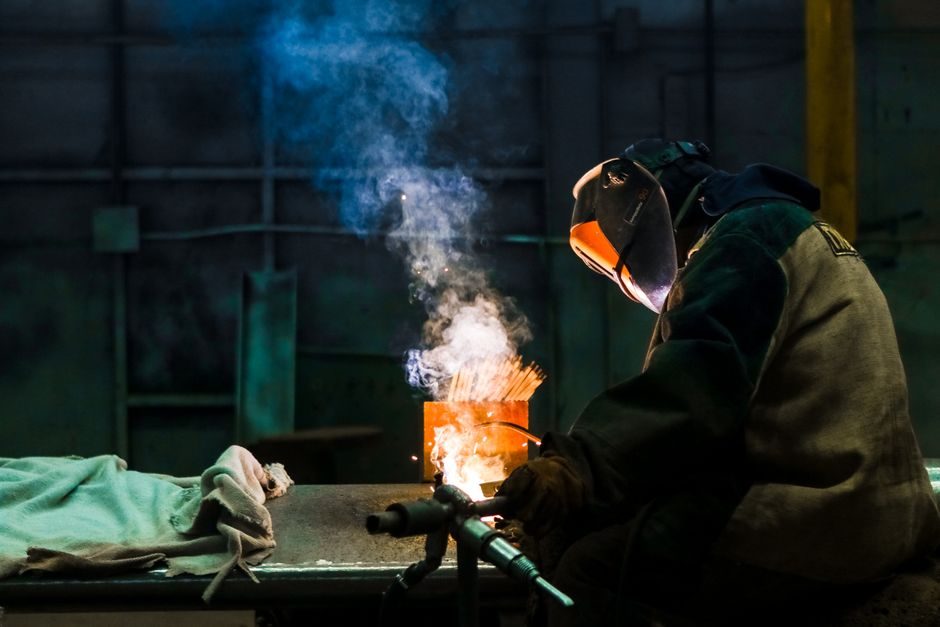
A 2026 sourcing scan of three DirectIndustry OEM listings and Made-in-China wholesale catalogs places entry-level manual spot welders at US$415–633 per piece with a 1-piece MOQ, while 380V three-phase full-automatic resistance welding lines list at US$10540–25100 per set with 1-set MOQ [S4]. Capacitor-discharge and MF (medium-frequency) inverter units used in battery pack assembly sit in a separate band, with cylinder-cell pack welders (18650/21700/26650) quoted at US$2160–8820 per set.
On the heavy-industrial end, a Turkish OEM's automatic standalone/online fence-mesh line (Galata Makina Automesh) is rated at 600 kW minimum and 1.5 MW maximum welding power, with weld thickness 3–6 mm and a published line speed of 50 panels/min at 380 V three-phase [S1]. A semi-automatic Spanish bench unit (Serra Soldadura Alfa 314) occupies the mid-power class at 200 kVA AC or 170 kVA / 2×170 kVA MF, 1400 daN electrode force, with throat-depth options of 400/600/750 mm and electrode stroke of 120/140 mm [S3]. A Taiwanese precision automatic (WPI Taiwan SPM-Multi Spot) handles 0.5–1.4 mm steel sheet at 50/60 Hz output frequency with servo-driven multi-axis shifting [S2].
Four cost drivers that move spot welder price by 10x
Across the 2026 listings, price variation is driven by four spec axes: (1) kVA/MF power class, where 200 kVA AC semi-auto units are an order of magnitude cheaper than 1500 kW-rated mesh lines; (2) weld-thickness capacity, with 0.5–1.4 mm precision sheet-metal machines [S2] priced below 3–6 mm heavy mesh lines [S1]; (3) automation class (manual pedal vs semi-auto vs full-automatic standalone/online, the last adding programmable logic, servo shifting and touch-screen HMI); and (4) supply voltage — 380 V three-phase is the standard for full-auto resistance welders, while 220 V single-phase appears on compact ultrasonic and small bench units [S3]. Reference designs for related automated production can be reviewed in this coding machine overview, and the structural mechanics of precision sheet positioning share architecture with crossed-roller guide slides used in weld-gun gantries.
Manual and bench-top tier: US$415–8,820
Entry-level manual spot welders, typically capacitor-discharge (CD) pedal-operated units for small workshops, list at US$415–633 per piece, 1-piece MOQ, water-cooled, vertical electrode stroke, fixed style and ISO 9001 / QC 080000 factory certification [S4]. The mid-tier manual/auto lithium-battery-pack spot welder band covers 18650/21700/26650/32700 cylindrical cells at US$2160–8820 per set, 1-set MOQ, from Xiamen-based suppliers. CENS-listed condenser spot welders, used for electronic-component and small-assembly work, occupy a similar specialty tier and are typically quoted per configuration rather than at flat catalog pricing. The cost logic of these compact welders parallels small-batch cutting machine sourcing, where controller, frame rigidity and electrode dressing determine lifetime cost more than headline kVA.
Semi-automatic industrial tier: kVA 170–200, force 1400 daN
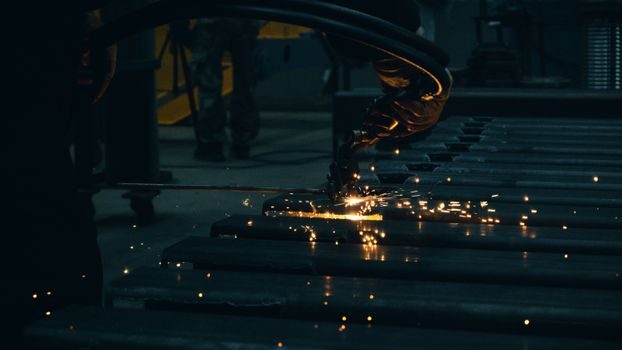
Mid-power semi-automatic pedestal welders (e.g. Serra Soldadura Alfa 314) are characterized by 200 kVA AC or 170 / 2×170 kVA MF rating, 1400 daN electrode force, 400/600/750 mm throat depth and 120/140 mm electrode stroke [S3]. Comparable Japanese semi-auto inverter units (Koyo Giken NK-03 / NK-08 / NK-21 / NK-71 series) are listed in the same OEM category, indicating that semi-auto remains a stable global product class. Pricing for this class is generally not published on the OEM site and is quote-only; based on parallel 2026 Made-in-China quotes for full-automatic three-phase resistance welders in the 100–200 kVA class, expect US$7000–20000 per set before installation, electrodes and water-chiller adders [S6].
Full-automatic and mesh-line tier: US$10,540–25,100 per set
380 V three-phase full-automatic resistance welding lines list at US$10540–25100 per set, 1-set MOQ, with a 1-year warranty and CE marking, classed as a three-phase resistance welder in fixed style [S4]. Anping Wanzhong's CE-certified construction-mesh multi-spot wire-mesh welding line is quoted at US$20300–21500 per set, 1-set MOQ. The Galata Makina Automesh fence-mesh line, with 600 kW–1.5 MW power, 3–6 mm weld thickness, 50 pcs/min throughput, and integration of servo motors, touch-screen HMI, water cooling and CE certification, sits at the upper end of this class [S1]. For context on high-throughput integrated production architecture, see this core machine overview and this filling machine reference, which share the same programmable-logic + servo + multi-axis recipe used in modern weld cells.
Selection criteria: match kVA, force and stroke to the joint
For steel sheet metal 0.5–1.4 mm, servo-shifting multi-axis automatic with sliding table (SPM-Multi Spot class) is the typical match [S2]. For fence/mesh/cage production at 3–6 mm wire or plate, a 380 V three-phase full-automatic standalone/online line with multi-head water-cooled transformer and 50 pcs/min throughput is the working point [S1]. For job-shop repair and low-volume production, a 200 kVA AC or 170 kVA MF semi-auto with 1400 daN electrode force and 400–750 mm throat depth covers most generic work [S3]. For 18650/21700/26650/32700 lithium battery pack assembly, a CD or pulse-heat manual/auto welder at US$2160–8820 per set is the dominant 2026 sourcing pattern.
Limitations, constraints and sourcing signals
Published OEM prices on DirectIndustry are pre-tax, exclude delivery, customs duties, installation and commissioning, and "may vary by country, with changes to the cost of raw materials and exchange rates" — a critical footnote for any cross-border RFQ [S1][S2]. Battery-pack and CE-certified construction-mesh listings carry a "contact issuer for current status" disclaimer on CE certificates, meaning EU plant acceptance still requires the buyer to re-verify the declaration of conformity. Made-in-China reports 2000+ spot-welding-machine manufacturers and 6000+ products on its index, with supplier R&D capacity frequently labelled OEM, 1-year warranty standard, and fast-delivery commitments of within 15 workdays from Xiamen-based vendors. For comparable welding-process decision criteria beyond spot, this MIG welder selection guide lays out process, power-class and wire-feed architecture in the same spec-vs-cost structure.
Trackable next signals for procurement teams: (1) confirm CE DoC validity directly with the issuing factory before PO, since the 2026 listings openly flag the disclaimer; (2) request electrode and water-chiller line items separately, because DirectIndustry RFQs exclude installation and consumables [S1]; (3) benchmark any quote above US$20000 per set against the Anping Wanzhong US$20300–21500 mesh-line and the US$10540–25100 380 V three-phase full-auto band, both explicitly listed with 1-set MOQ [S4].