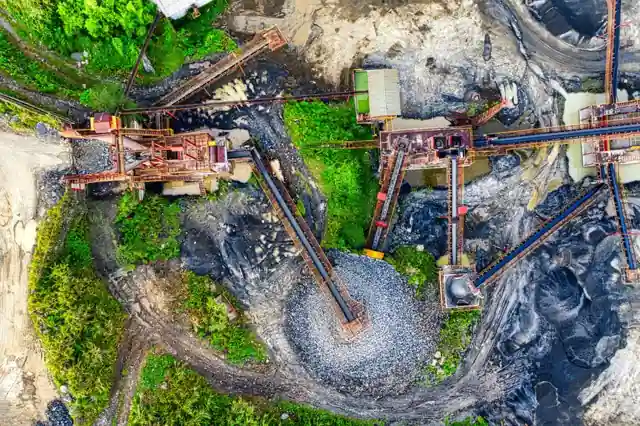
Spring washer choice in mining bolted joints is governed by four engineering constraints: dynamic load class, working range under vibration, corrosion exposure from water and process chemicals, and axial space inside the joint stack [S3][S7].
Field loads on crusher, conveyor, and haul-truck fasteners commonly reach 55,600 N per bolt, with split-ring and low-grade wave washers failing by bending or cracking inside months when substituted for a properly specified Belleville or heavy curved washer [S7].
Washer Geometry Comparison for Mining Duty
Belleville (disc spring) washers convert small axial deflection into high reaction force inside a compact stack, which makes them the default pick for high-load, space-constrained joints such as bolted flanges, valve assemblies, and crusher frames [S2][S3]. Wave washers carry a lighter spring rate, deflect further, and absorb shock, which suits them to bearing-preload and motor-housing joints where the load is moderate but the deflection budget is generous [S3]. Curved (single-arc) washers run in material thicknesses from a few thousandths of an inch up to about 0.100" and are typically stamped from tempered spring steel, with stainless options where corrosion rules [S3]. Split lock (helical) washers resist back-off mainly through friction and edge bite, so they remain a low-cost general-purpose option for lighter vibration environments only [S3]. A useful decision rule: if the joint is flange-class with preload loss risk, specify Belleville in a stacked or series arrangement; if the joint is a gearbox or motor cover with light vibration, wave or curved is more efficient [S2][S3]. The spring washer reference page lists the full geometry matrix and standard DIN 6796 / DIN 2093 designations.
Material Selection by Mining Environment
Material choice drives spring rate, corrosion resistance, and operating temperature range, and is therefore the first filter after geometry is fixed [S3][S6]. Carbon steel is the most common washer material and the lowest cost, but needs plating or coating to survive mine-site humidity, slurry splash, and acidic water [S1][S3]. Stainless grades 301, 302, and 17-7PH add corrosion resistance and hold elastic properties at elevated temperature, which suits them to wash-down zones, underground pump stations, and any joint near chemical reagent lines [S3]. For high-temperature crusher or kiln structures, high-temperature spring washer variants are specified separately, with the supplier confirming the upper limit per grade rather than assuming it [S2]. Operating-environment rule of thumb: underground wet / acidic, specify 301 or 302 stainless; dry above-ground structural, plated carbon steel is acceptable; high-temperature or fire-risk zones, confirm the high-temperature washer line with the maker [S2][S3].
Load, Working Range, and Stacking Math
Spring washer sizing is driven by the working range the joint actually needs, not the catalogue static load. Laboratory work on hold-down fasteners defined a usable working range between 4.5 kN minimum and 22.2 kN maximum installation load, with a baseline Fe6 washer proving inadequate to hold that band over service life [S4]. Two non-commercial washers in the same study, an Fe19 design and a polyurethane unit, expanded that working range by 69% and 93% respectively, while cutting timber stress 68% versus the Fe6 baseline [S4]. In a mining context that translates directly to joint relaxation: the washer must keep its reaction force inside the operating band through thermal cycling, vibration, and bolt embedment, otherwise preload decays and the joint walks loose [S2][S7]. Practical stacking options to widen the working range are parallel stacks (add spring rate at the same deflection) and series stacks (add deflection at the same load), with most OEMs publishing free washer calculators to size the stack for a given bolt class and clamp load [S2]. For heavy-mining loads around 55,600 N, double-coil or stacked Belleville arrangements are the documented recommendation over single-wave units [S7].
Failure Modes and Field Symptoms
Wrong selection in mining service shows up as three repeatable failure modes: premature loosening under vibration, fatigue cracking at the spring edge, and wasted axial space from over-stacked wave washers [S3]. On haul-truck and chute fasteners, the immediate symptom is bolt back-off within weeks, followed by elongation of the bolt hole and eventual joint separation if the washer is not upgraded [S5][S7]. A split lock washer used in a high-vibration crusher joint typically loses its bite edges inside 2–6 months because the friction path degrades under slurry ingress, whereas a Belleville in the same joint keeps preload by spring reaction rather than friction [S3][S5]. The third mode, axial-space waste, is common when wave washers are specified to do a Belleville's job: a stack of three or four waves fills the gap without delivering the load, so the joint goes tight on torque but loose in service [S3].
Selection Criteria and When NOT to Use a Spring Washer
A spring washer is the right call when at least one of four conditions is present in the joint: sustained vibration, thermal cycling across more than about 50 °C, measurable gasket creep or embedment, or shock loading from process events [S2][S3]. It is the wrong call on soft-material joints (thin aluminium flanges, GRP liners) where a Belleville's concentrated reaction force will crush the surface, in which case a flat washer should be used alone or paired with a Belleville to spread the load [S5]. It is also the wrong call as a substitute for proper torque control: a spring washer cannot compensate for an under-torqued bolt, and torque-and-angle tightening plus a calibrated washer stack is the correct procedure on critical mining joints [S2][S7]. For joints in the 4.5–22.2 kN hold-down band where a baseline Fe6-class washer has failed, upgrading to a Fe19-class or polyurethane unit has been shown to roughly double the working range and cut substrate stress by about two-thirds [S4]. Where the joint is a sealing washer interface under a live-loaded flange, the spring washer selection should be solved jointly with the gasket choice, not in isolation.
Specification Checklist for Procurement
A 2026 specification for a mining spring washer should lock down, in order: washer type and standard (DIN 6796 split lock, DIN 2093 Belleville, or equivalent), material grade and finish (carbon steel with zinc flake, 301/302 stainless, or high-temperature alloy), required working load band in kN, calculated stack arrangement (parallel, series, or mixed) with the resulting spring rate, and any plating or coating statement for the service environment [S2][S3][S6]. The specification should also name the bolt class, the joint target preload, and the verification method, since washer performance is only meaningful inside a defined bolt-and-nut system [S2][S7]. Where a Belleville is paired with a flat washer to spread the reaction on a soft flange, both items must appear on the drawing with their order in the stack, not as separate "washer as required" notes [S5].
Trackable signals for the next sourcing cycle: published updates to DIN 2093 dimensional tables for large-diameter Belleville units used on crusher frames, and any new high-temperature washer grades targeting kiln and smelter bolting above 400 °C service. For adjacent equipment decisions on the same site, the mining dump truck reference covers the suspension and chassis fastener stack where these washer choices also apply.
See also our earlier report, Apparel checkweigher selection: spec map for garment distribution.