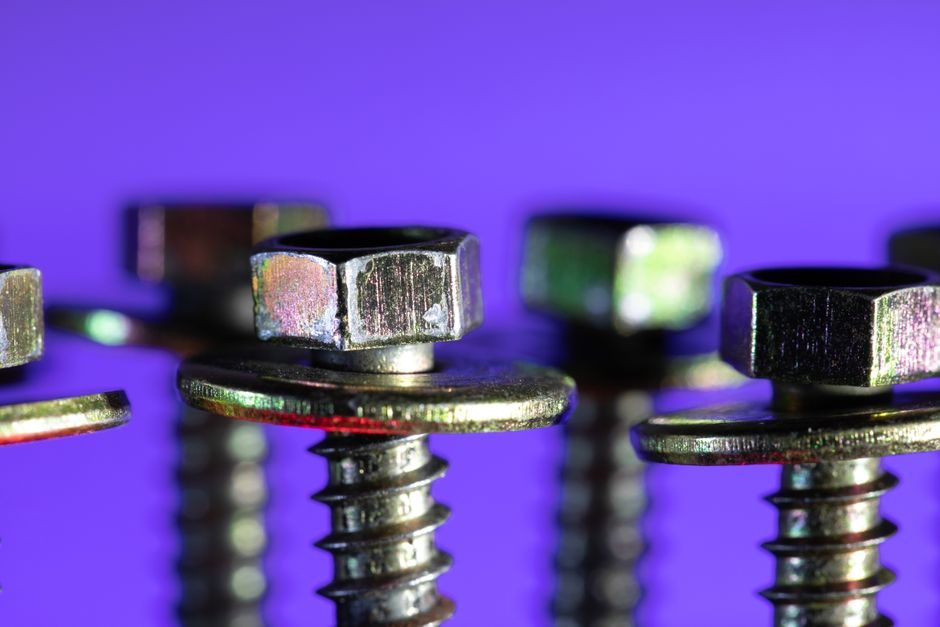
Spring washers are a small-line, high-mix fastener that engineers specify by joint duty rather than part number, with conical (Belleville), split-lock, wave, and disc-spring geometries covering four distinct retention regimes on a bolted assembly.
Conical spring washer pricing on Chinese export portals clusters around US$ 0.001–0.10 per piece at 1,000-piece MOQ, with audited mill pricing from US$ 0.10–0.50 at 500-piece MOQ — a range that confirms the part is treated as a commodity-grade consumable, not a precision component, in most procurement catalogs [S1].
Match the profile to the retention job
A conical / Belleville spring washer acts as a single-disc spring and is the default pick when the bolted joint must hold a high pre-load against settling, thermal expansion, or external vibration — the geometry deflects axially and returns the stored energy as a sustained clamping force. Split-lock washers (DIN 127 form) suit light-vibration, low-cost assemblies where the goal is simply to prevent nut loosening on a standard hex bolt; wave washers cover electrical contact and ultra-light axial cushioning; and stacked disc-spring arrangements (per DIN 2093) replace single Bellevilles when the load envelope exceeds a single disc's force/deflection window or when a progressive load curve is required. For a working primer on the general spring washer family and how each profile behaves under bolt preload, the catalog taxonomy is the fastest reference. Where the joint also needs fluid or gas sealing, the spring element is paired with a flat or sealing washer — the spring holds pre-load, the seal contains the media. [S1]
Standards and dimensional fit
Specifying a spring washer by part number is the only way to keep procurement repeatable: DIN 6796 covers conical spring washers for bolted connections (with the 100HV / 130HV hardness classes tied to property classes 8.8 and 10.9 bolts respectively), DIN 127 covers the traditional split-lock form, and DIN 2093 covers the underlying disc-spring geometry that Belleville washers are cut from. For metric structural bolts at property class 8.8 the minimum matching washer hardness is typically 100 HV; for 10.9 bolts it steps to 130 HV, and mismatched hardness is the single most common cause of washer flattening in service. Inner diameter must clear the bolt shank, outer diameter must fit the wrench clearance on the mating part, and thickness under load must be calculated against the bolt's elastic elongation budget — get any of these wrong and the washer becomes a static spacer rather than a spring. [S1]
Material, finish, and environment
Standard spring washers ship in carbon steel (C75S / 65Mn spring-steel grades) with zinc, zinc-flake, or black-phosphate finishes; stainless variants use 301/304/316 for corrosive atmospheres but sacrifice roughly 15–20% of the spring's load capacity at the same geometry. Hot-dip galvanizing is acceptable for outdoor structural use but raises hydrogen-embrittlement risk on hardness-class 130HV parts — bake-out or substitution with a 100HV washer plus mechanical locking is the usual mitigation. For sour-service or marine exposure, 316 stainless or Inconel disc springs are specified and matched to NACE MR0175 environments only after the full bolt/washer/gasket system is reviewed, never on the washer alone. Temperature is a second hard limit: standard carbon-steel spring washers lose preload above roughly 200 °C, and 301 stainless pushes that to about 250 °C; beyond those points a disc-spring stack in a higher-grade alloy is the only credible option. [S1]
Load calculation, not catalog habit
Selection by catalog habit is the most common engineering error with conical washers: a Belleville that is too soft flattens under bolt preload and provides no anti-loosening function, while a Belleville that is too stiff transmits the full vibration load to the bolt threads and can accelerate fatigue failure. The correct sizing path is to take the target bolt preload (typically 70% of proof load for non-safety joints, 60% for fatigue-sensitive joints), subtract the design external axial load, and solve for a washer deflection and force at working height that closes the residual preload gap. DIN 2093 publishes load/deflection curves for every standard disc geometry — use them, do not estimate. For procurement, the single-bag conical-washer price band of roughly US$ 0.001–0.10 at 1,000-piece MOQ means the engineering hour spent sizing correctly costs more than the part itself [S1]; spend the hour.
Comparison: four profiles against four decision criteria
Stacked against (a) anti-loosen performance under vibration, (b) space claim under the bolt head, (c) preload retention under thermal cycling, and (d) unit cost at volume, the four common profiles line up predictably. Conical / Belleville scores high on (a) and (c), neutral on (b) — a single disc is 1–3 mm thick — and low on (d) at small MOQs, though volume pricing closes the gap [S1]. Split-lock scores medium on (a), thin on (b), poor on (c), and lowest on (d). Wave washers score low on (a) and (c), thin on (b), and lowest on (d) for industrial quantities. Stacked disc-spring arrangements score highest on (a) and (c) but worst on (b) and (d) — they are the right answer only when the engineering calculation says a single disc cannot deliver the required force/deflection curve. For a related trade-off where a spring element sits next to a seal, the sealing washer versus oil seal matrix walks through the same profile-vs-duty logic.
Who should not pick the cheapest option
Buyers defaulting to the lowest-cost split-lock or generic conical washer on a 1,000-piece MOQ quote are fine for general industrial enclosures, consumer-grade electrical bonding, and non-safety furniture joints — anywhere a loose fastener is an inconvenience rather than a hazard. They are the wrong pick on three classes of joint: (1) any bolted connection above property class 8.8 where DIN 6796 mandates a matched hardness washer, (2) any joint on a rotating or reciprocating machine where fatigue of the bolt, not cost, drives the failure mode, and (3) any subsea, sour-service, or >200 °C service where the washer material and finish are the controlling variables. In each of those cases the unit-cost saving of US$ 0.01–0.40 per washer is dwarfed by the cost of a re-torque campaign or an unscheduled shutdown, and a spring washer hardness call-out is the cheapest insurance available. [S1]
Sourcing, MOQ reality, and what to verify on the PO
On Chinese export catalogs the conical spring washer category sits under Industrial Equipment & Components > Fastener & Fitting > Circlip > External Retaining Ring, with the "conical spring washer" tag appearing in the related-search widget alongside Spring Washer, Flat Washers, Lock Washer, and Zinc Plated Washer — useful when confirming that the supplier has classified the part under the correct HS code and not mis-tagged it as a circlip [S1]. Audit the supplier (Diamond Member / Audited Supplier status is the platform's main trust signal), pin the standard (DIN 127 / DIN 6796 / DIN 2093 / ISO 6930) and the hardness class on the PO, and request a mill test certificate for any batch above 10,000 pieces. For a complementary view of small-line consumables where spec discipline at the PO matters more than headline price, the RFQ spec for food-contact basket strainers walkthrough applies the same logic to a different part. The next signal worth tracking is whether 2026–2027 catalog listings start publishing DIN 6796 130HV parts with declared test reports rather than generic "spring steel" descriptions — that shift would mark the export market moving from commodity to engineered-fastener status.
Spec-level background on the components involved: pressure transmitter.