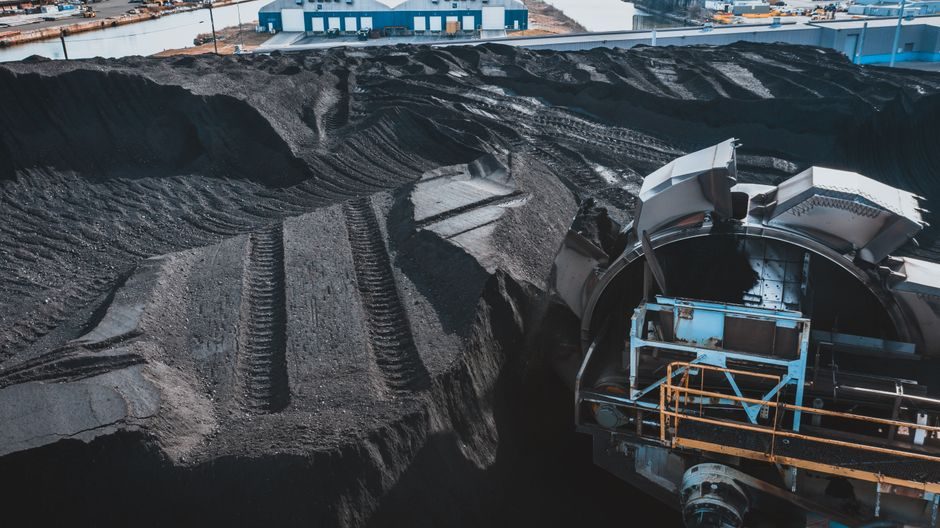
A vibrating conveyor is a materials-handling machine that uses controlled mechanical oscillation — typically from dual synchronized vibrator motors or eccentric exciters running in opposite rotation — to drive bulk solids along a trough in a series of micro-throws, classifying it as a forced-vibration linear conveyor rather than a continuous-pull machine [S1][S2].
The category spans three working geometries (horizontal, inclined, and tubular/closed-circuit) and serves food, mining, pharmaceutical, recycling, and metallurgical duties, with ATEX-rated hygienic builds available for European powder and dairy plants [S1][S2]. For engineers comparing it against other continuous transport options, the vibrating conveyor family is structurally distinct from a belt conveyor (which relies on friction between belt and idlers) and from a chain conveyor (which uses positive pull through slats or flights).
Classification by Trough Geometry: Horizontal, Inclined, and Tubular
The ZDS series from Xinxiang Weiliang Sieving Machinery explicitly markets three form-factors — horizontal, inclined, and tubular — within a single product line, confirming that geometry, not drive type, is the primary differentiator at the catalogue level [S1].
Horizontal troughs are the most common configuration and run at near-level elevation to move material the shortest practical distance, typically 1–6 m, with trough widths from roughly 200 mm to 1200 mm in standard OEM builds. Inclined troughs add 5°–15° elevation to lift material between process stages, sacrificing some throughput for a vertical rise that a level belt conveyor cannot deliver without a cleat or steep-angle belt. Tubular (closed-circuit) designs wrap the trough around itself to form an enclosed tube, which suits dusty, hygienic, or sanitary applications where product must not contact the surrounding air — the ZDS tube type vibrating conveyor is described as a linear inertia conveying equipment built around two matched vibrator motors, a feeding trough, a vibration-isolation device, a group of isolation springs, and a bearing base, all mounted on a steel-structure bracket or fabricated platform [S1].
Drive Mechanism: Vibrator Motor vs. Eccentric Exciter
The drive on a vibrating conveyor is, by definition, the source of the oscillation, and the two dominant architectures are matched-pair vibrator motors and mechanical eccentric exciters, with synchronous reverse rotation being the operating rule for both [S1].
In a vibrator-motor design, two identical specification motors are mounted on the trough body and wired for counter-rotation; their combined unbalanced forces cancel horizontally and add vertically, producing a straight-line linear throw. In an exciter design, a single motor drives a pair of eccentric weights through a timing belt or gear set, achieving the same synchronous counter-rotation with finer control over amplitude. The amplitude of vibration — typically 3–8 mm peak-to-peak for a linear trough, and 8–15 mm for a tubular feeder — directly sets conveying speed, since each micro-throw advances the material a fraction of the stroke length. Operating frequency is normally 25 Hz (1500 rpm) on 50 Hz mains or 30 Hz (1800 rpm) on 60 Hz mains, with 50/60 Hz dual-rated motors widely available for global plants. The vibrating conveyor drive arrangement, with its matched vibrators, contrasts with a positive-displacement conveyor chain, where motion is imparted by sprocket engagement rather than inertial throw.
Selection Criteria: Capacity, Material, Hygiene, and Hazardous-Area Rating
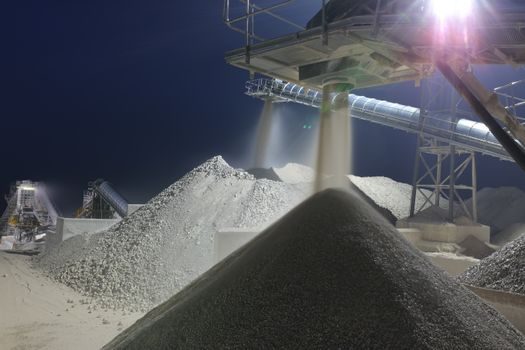
Vibrating conveyors are specified when the duty calls for gentle handling, dust-tight transport, or sanitary construction, and four criteria — bulk density, particle size, hygiene class, and hazardous-area zone — narrow the catalogue quickly [S1][S2].
For bulk density, light powders (300–600 kg/m³) such as milk powder, starch, and pharmaceutical excipients are typical of the Alvibra dairy and pharma product lines, while dense ores and aggregates (1500–2500 kg/m³) drive the heavier mining builds [S2]. For particle size, the rule of thumb is that material must be dry, free-flowing, and below roughly 100 mm lump, since oversized particles break the micro-throw pattern and stall the trough. For hygiene, the Danish manufacturer Alvibra notes that food-safety requirements are increasing continuously, holds certification from the Danish Veterinary and Food Administration, and offers full material traceability and recyclable packaging [S2]. For hazardous-area duties, ATEX-rated builds are available on request for powder lines where dust-explosion risk is classified under ATEX 2014/34/EU zone categories [S2]. Compared to a pneumatic conveyor moving the same dairy powder, a vibrating tubular conveyor delivers lower air-handling energy, no filter loading, and gentler particle handling, at the cost of a fixed, non-routed geometry.
Construction Materials and Surface Finish
Stainless-steel construction and custom-fabricated troughs are explicitly listed in the Weiliang ZDS options, reflecting the food and pharmaceutical end of the market where 304 and 316L grades dominate the bill of materials [S1].
For mining, metallurgical, and recycling duties, mild steel with rubber-lined or polyurethane-lined troughs is the common build, and trough liners are replaceable wear items rated for abrasive service. Surface finish matters as much as alloy: dairy and pharma troughs are specified to Ra ≤ 0.8 µm in product-contact zones to support CIP (clean-in-place) wash-down, while industrial troughs ship as-welded and painted. Alvibra’s full material traceability and certificate pack — referenced on its hygienic machine line — is the kind of documentation a pharmaceutical auditor expects to see in the dossier, and is not standard on every industrial-grade vibrating conveyor [S2].
Industries and Real Use Cases
Five end-markets account for the bulk of vibrating-conveyor installations: food, dairy, pharma, mining/metallurgy, and recycling, with the food-pharma segment demanding the tightest documentation and surface-finish controls [S1][S2].
Food-industry duties include handling of nuts, cereals, dried vegetables and fruits, and confectionery — Alvibra lists dry-food as a core sector alongside fresh and frozen foods [S2]. Dairy duties cover infant formula, starch, creamers, and milk and whey protein powders, all of which are low-density, cohesive, and dust-prone, and which benefit from the closed tubular trough geometry [S2]. Pharma duties cover pharmaceutical salts and powders, where traceability and hygienic design are non-negotiable [S2]. Mining and metallurgical duties include ores, sinter feed, and clinker, where the robust trough liner and heavy-duty exciter handle abrasive lump at higher amplitudes [S1]. Recycling duties include shredded plastics and sorted MSW fractions, where the gentle handling preserves particle shape and reduces fines generation. Where the vibrating conveyor is compared to a pneumatic conveyor for the same powder-handling duty, the vibrating unit typically wins on energy-per-tonne and on particle-degradation, while the pneumatic unit wins on routing flexibility over long distances and multiple changes of direction.
Vibration Isolation, Mounting, and Structural Support
Every vibrating conveyor is mounted on a vibration-isolation system — typically coil steel springs or rubber isolators — sized to absorb 80–95 % of the dynamic reaction force so the support structure does not resonate [S1].
The Weiliang ZDS bill of materials lists, in order: two matched vibrator motors (or exciters), the feeding trough, the vibration-isolation device, a group of isolation springs, a bearing base, and a steel-structure bracket or fabricated platform with related accessories [S1]. This ordering is not arbitrary: the isolation springs sit between the vibrating mass (trough plus motors) and the static mass (bracket or floor frame), and their natural frequency is tuned to roughly one-third of the operating frequency so the system stays in the isolation regime rather than the amplification regime. A common specification error is undersizing the support steel — a 5 m trough running at 25 Hz with a 100 kg trough mass and a 5 mm amplitude generates a reaction force in the order of 5–8 kN, which must be carried by the bracket without resonance. Alvibra’s 30-plus years of vibration-technology focus is positioned around this kind of application engineering as much as around the conveyor itself [S2].
Limitations, Failure Modes, and Sourcing Signals
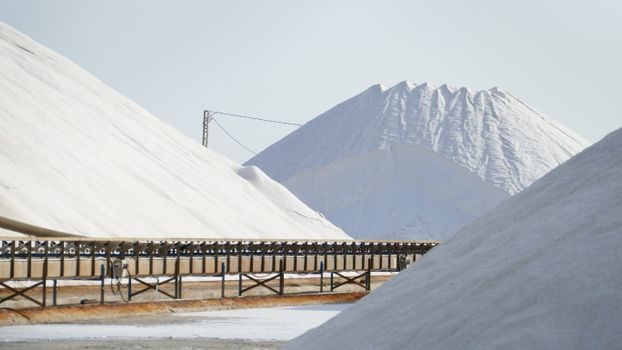
Vibrating conveyors are not universal, and three constraints define the operating envelope: distance, material stickiness, and the practical ceiling on trough length [S1].
Distance is the first constraint: linear-stroke conveyors are economical to about 8–10 m per unit, and longer runs are usually built as a chain of synchronized sections rather than a single long trough. Material stickiness is the second: wet, oily, or cohesive materials damp the micro-throw and stall the trough, which is why vibrating conveyors are almost exclusively specified for dry, free-flowing bulk solids. Trough-length resonance is the third: as trough length grows, the structural mode shapes of the trough itself begin to interfere with the drive frequency, and the practical ceiling is reached when the first bending mode of the trough drops into the operating-frequency band. Failure modes to watch in service are spring fatigue (typically 20,000–40,000 hours before replacement), vibrator-motor bearing failure (sealed-for-life units are now common), and trough-liner wear in abrasive service. Sourcing signals worth tracking are the publication of new ATEX and IECEx zone-22 dust certifications from European OEMs, the appearance of dual 50/60 Hz rated vibrator motors as standard catalogue items rather than specials, and the move toward 316L stainless as the default food-grade build rather than an upcharge option.
For related coverage, see Polyethylene Resin Manufacturing: Process Routes, Reactor Choices and Spec Gates.