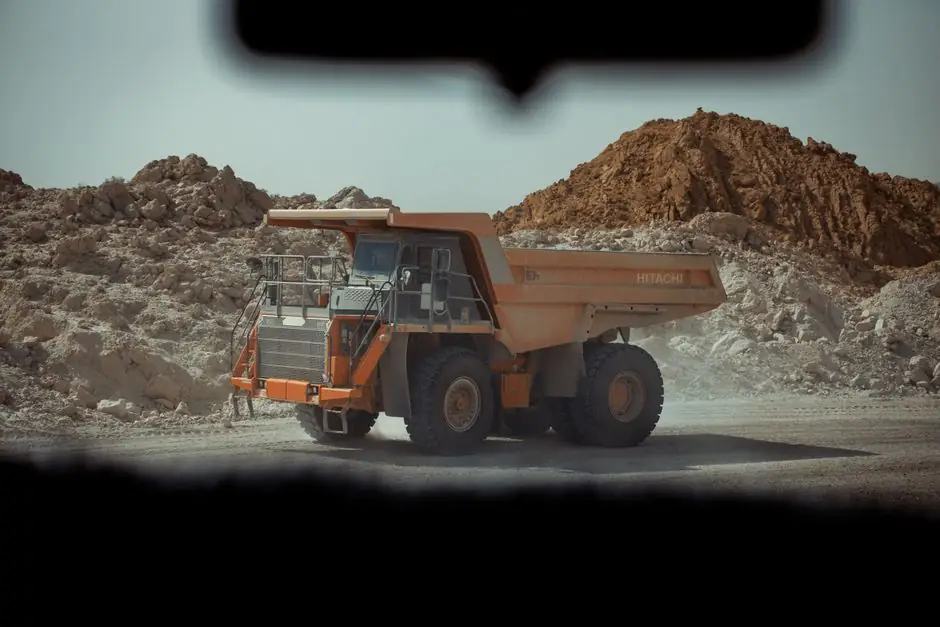
An articulated dump truck pivots on a hydraulic articulation joint between the tractor and the trailer, keeping all six wheels on the ground across soft, steep, uneven terrain; a standard (rigid-frame) dump truck sits on one fixed chassis and is built for hard-packed haul roads and high-volume cycles [S1][S2].
Payload splits roughly into 25–60 t for ADTs and 40–700 t for mechanical-drive mining trucks, with heaped-body volumes commonly 20–46 yd³ in the ADT class, and the ADT rental market runs around USD 1,600/day or USD 12,600/month versus roughly USD 25,000/month for a comparable rigid hauler [S1].
Frame, Drivetrain, and Off-Road Geometry
ADTs use two chassis sections joined by an oscillating pivot with hydraulic rams; steering is done by swinging the front unit relative to the rear, so all wheels track a single path and the truck can place all six tires on the ground over ruts and side slopes [S3]. Permanent all-wheel drive (6×6) and suspended oscillating axles are the design pattern across the major ADT lines, which is what gives them traction in mud, snow, and on steep grades where a rear-wheel-drive rigid truck would lose the hill [S1][S5].
A rigid dump truck bolts cab and body to a single ladder frame and typically uses two-axle rear-wheel drive, with the larger mechanical-drive mining trucks sized for the 100–400 t class running a single rear axle under a giant box [S2][S4]. The trade is ground pressure and manoeuvrability: a rigid hauler needs a built, drained, well-maintained haul road to hit its cycle time, while an ADT can climb a soft cut bench with 1:2 grade at 8 km/h loaded [S4][S5].
Payload, Volume, and Cycle Economics
ADT payload bands are 25–60 t with heaped-body capacity 20–46 yd³, depending on the model line, with Volvo, Caterpillar, John Deere/Bell, Doosan, Astra, and Komatsu all in the field; Volvo holds roughly half the global ADT volume since launching the Gravel Charlie in 1966 [S1][S3].
Rigid mining and quarry trucks move 40–700 t per load; cost-per-ton on a maintained haul road is much lower than an ADT, but the operator carries the capital and ongoing maintenance cost of the road itself, plus tyre wear and downtime in rain or thaw [S1][S4]. For a soft-ground or short-cycle job, the ADT’s lower per-trip payload is offset by shorter road-building civil work and the option to outsource the fleet outright [S4].
Selection Criteria by Site Conditions
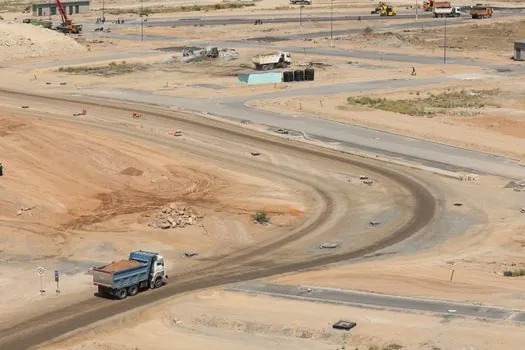
Pick an ADT when the ground is muddy, soft, or slippery, when the bench is steep, when the cut is short, or when turning room is tight: the pivot and 6×6 let a 40-tonne hauler work a footprint a rigid truck cannot enter [S1][S5]. An articulated hauler also serves as a multi-purpose tool for site development, drainage, and road base outside the peak overburden window, raising annual utilisation [S4].
Pick a rigid (standard on-road or off-road mining) truck when the project has firm, well-maintained haul roads, long straight hauls, high annual tonnage, and a willingness to fund road capital and tyre programs; rigid trucks also take higher-impact loads from a dragline or large shovel without frame flex damage [S4][S5]. Standard on-highway dump trucks, the short-wheelbase units you see on street paving jobs, sit below both off-road classes in payload and are not a substitute on rough terrain [S2].
Comparison Matrix: ADT vs Rigid Off-Road vs Standard On-Road
On drive configuration the ADT runs 6×6 permanent all-wheel drive, the rigid off-road mining truck typically 4×2 rear-wheel drive, and the standard on-road dump truck is rear-drive on a single fixed chassis [S1][S2]. Ground-contact behaviour gives the ADT continuous wheel contact via the articulation joint, the rigid class needs a built road, and the standard class needs pavement or a sealed surface [S2][S5].
Payload ranges are 25–60 t for the ADT, 40–700 t for rigid off-road, and roughly 10–20 t for a tandem-axle on-road dump; heaped volume is 20–46 yd³ for ADTs and scales up with rigid body length; rental bands are around USD 1,600/day for ADT versus USD 25,000/month for the rigid class, with the standard on-highway unit below both [S1][S2]. Best-fit site is soft/steep/short for the ADT, firm/long/high-volume for rigid off-road, and urban or short-paved hauls for the standard unit [S4][S6].
Operating Costs, Safety, and Outsourcing Considerations

Owning a rigid off-road truck means a continuous capital line for road grading, drainage, and tyre replacement; the cost-per-ton advantage only materialises when the road is genuinely maintained to design grade and cross-fall [S4]. An outsourced ADT contract removes the capital line but adds exposure to contractor safety performance, unfamiliar mixed fleets, and seasonal crew availability, a pattern documented for overburden-removal programs in North America [S4].
Both ADT and rigid platforms now ship with payload monitoring, traction control, radar, and cameras, so the operator-assist gap that used to favour rigid fleets on long hauls has narrowed; the ADT keeps the edge where the machine must self-recover on a soft shoulder [S1]. Articulated haulers also see use as concrete mixer, water tanker, and hook-loader platforms because the chassis accepts bolt-on bodies, a flexibility a rigid mining chassis does not offer [S3].
Limits, Failure Modes, and Standards Touchpoints
ADTs cap out near 60 t payload and are not the right tool for a 200 t mining face; conversely, a rigid mechanical-drive truck on a 15% grade in clay will spin out, while the same truck on a 30 cm rutted bench will bottom its frame and crack a crossmember [S1][S4]. Standard on-highway dump trucks lose load stability and violate road-rules when run on unbuilt ground, and tyre sidewall failures rise sharply on rocky fill without a pad [S2].
For off-road haulers, the relevant industrial references are the OEM payload-monitoring and traction-control specs, mine-site road design guidance from the major OEMs, and on-road rules (gross vehicle weight, brake, lighting) where the truck transits public roads between pits; articulated haulers are occasionally road-registered but most are site-bound [S3]. The decision should be driven by haul-road class, annual tonnage, and crew model rather than by headline payload, because a 40-tonne ADT on a soft cut will out-produce a 100-tonne rigid truck whose road has been allowed to degrade [S4][S5]. For a related decision matrix on aggregate feed upstream of these haulers, see skip hoist vs belt conveyor aggregate feed; for the cobot-versus-palletizer choice when offloading at the plant end, see cobot vs industrial palletizing robot.
Trackable signals to watch through 2026: OEM 2026 buyer-guide updates, with Equipment World’s 2026 ADT guide already published on 21 January 2026, and Volvo CE’s 26 January 2026 overburden-truck guidance, both pointing at the same conclusion, that the choice is terrain-and-road driven, not brand driven [S4][S7]. Class reference pages for dump truck, mining dump truck, and articulated robot (used here for the joint analogy) cover the broader taxonomy.