
A cobot palletizer typically maxes out at 25 kg payload and 3-13 cycles/min, while a traditional industrial palletizing robot routinely handles 300+ kg and sustains 10-20 cycles/min inside a guarded cell [S3][S4]. The selection driver is throughput, payload, and the completed risk assessment, not the robot category label.
The global palletizing robot market reached $1.6 billion in 2025, with food and beverage accounting for an estimated 46 percent of demand, and U.S. industrial robot installations rose 11 percent to 38,000 units in the same year, per International Federation of Robotics preliminary results [S3]. For an engineering buyer, the choice between a collaborative robot cell and an industrial robot cell comes down to four variables: case weight, sustained cycle rate, available footprint, and how often the pattern changes.
Payload, Reach, and Cycle Rate: Where the Two Architectures Diverge
Cobots are force- and speed-limited, with payload ceilings that commonly land at 25 kg including the end-effector mass, while industrial palletizers are routinely specified at 300 kg and above for full-layer and bag-stack patterns [S4]. Cisco-Eagle's side-by-side test data places cobot throughput at roughly 13 cycles/min and around 28 lb (12.7 kg) per pick, against industrial systems that sustain heavier loads at higher rates [S5]. PASCO reports a 10 cycles/min cobot ceiling in non-collaborative palletizing mode, which is the realistic operating point once throughput matters [S6].
The architecture gap is structural: cobots use joint torque sensors and software-limited TCP speed to enable shared workspaces, which is why their cycle rates compress even when mechanically capable of faster motion [S1][S7]. Industrial palletizers operate behind fencing, interlocked gates, light curtains, or area scanners, which is what unlocks their 10-20 cycles/min sustained envelope and high-payload end-effectors [S3][S4].
Footprint, Integration Time, and Redeployment Cost
A cobot palletizer cell typically needs a small footprint near an existing packaging line, recipe-based software, and minimal guarding; deployment is measured in days to a few weeks [S3][S4]. Industrial palletizing cells require a dedicated area, full engineering for conveyors and safety, and integration timelines measured in months, which is why they anchor high-volume lines rather than seasonal ones [S4].
The redeployment economics favor cobots when a facility runs multiple SKUs or needs to move the cell between lines seasonally: the system can be relocated without major facility work or conveyor rewiring [S4]. For plants where line balance, upstream timing, and reject handling are already automated, an industrial cell integrates more cleanly into the existing control architecture than a cobot with a parallel HMI layer [S3][S4].
Safety, Risk Assessment, and Standards Compliance

Collaborative operation does not mean every cobot installation is automatically safe without additional safeguards; force, speed, and separation monitoring must be validated through a documented risk assessment per application [S3]. A cobot palletizing cell using a non-collaborative gripper for open-top trays or display cases typically reverts to guarded operation regardless of arm category, which collapses the throughput case for the cobot [S4].
Industrial cells rely on fencing, interlocked gates, light curtains, and area scanners to meet the same safety objectives, which is why they can run higher speeds and carry heavier end-effectors without re-entering collaborative limits [S3]. A side-by-side risk-assessment workflow for a new cobot cell, including the ISO 12100 five-step method, is detailed in Cobot Risk Assessment: ISO 12100 Five-Step Workflow for a New Cell.
Decision Matrix: When the Cobot Wins, When the Industrial Robot Wins
Cobot palletizers fit when production stays under 8 cases/min, case weights run under 15 kg, changeovers happen daily or weekly, and the facility cannot accept fixed safety fencing [S4]. The practical ceiling per Remtec's integrator data is the 6-13 cycles/min band, with 10 cycles/min achievable in non-collaborative mode, and a 25 kg payload including tooling [S4][S6]. The cobot's real value is deployment speed and reconfigurability, not the collaborative feature itself, and a cobot running at capacity with no headroom becomes a throughput bottleneck the moment production targets rise [S4].
Industrial palletizing robots are the right architecture when case weights or grouped picks regularly exceed 25 kg, when mixed-SKU pallets need complex pattern generation, when open-top trays or display cases require non-collaborative grippers, when line speeds demand 12+ cycles/min sustained, and when upstream integration with conveyor timing and reject handling is critical [S4]. They also fit when the surrounding process is already highly automated and personnel rarely need to access the work envelope [S3]. For a deeper cross-reference on collaborative versus traditional robot categories, see SCARA robot and articulated robot architecture trade-offs.
Real Use Cases and the Volume Threshold That Drives ROI

Mobile palletizing cells, exemplified by the NOVA MPC-80 at 80 kg payload, bridge the gap for plants with 30-80 kg case weights that lack volume to justify a full industrial cell but exceed cobot payload limits [S2]. Cisco-Eagle's comparison frames cobots as the lower-cost option, which suits contract packers, seasonal producers, and lines that change patterns more than once per shift [S5].
Food and beverage, the largest palletizing-robot demand segment at an estimated 46 percent of 2025 spend, is dominated by case weights in the 10-25 kg range with frequent SKU rotation, which keeps cobot palletizers competitive on ROI even against higher-throughput industrial systems [S3]. Heavy-duty palletizing in beverage, bagged pet food, and building products still routes to industrial cells with 300+ kg payload and 10-20 cycles/min sustained rates [S1][S4].
Limitations, Failure Modes, and What the Spec Sheet Hides
Box condition, conveyor height, tooling mass, pallet presentation, line balance, and upstream consistency all affect real cobot output; a cobot's 10 cycles/min rating is only achievable when infeed and pallet supply are deterministic [S3]. Tooling weight counts against the 25 kg cobot payload ceiling, so a 5 kg gripper leaves only 20 kg for product, which is why "under 15 kg case weight" is the conservative spec floor for sustained cobot palletizing [S4].
Industrial palletizing robots carry a larger preventive-maintenance load, longer changeover windows, and bigger spare-parts inventory than cobots, and they need a sustained 10+ cycles/min duty cycle to amortize the integration cost [S4]. A cobot running at capacity with no headroom, or an industrial robot under-fed by an inconsistent upstream line, both fail the same way: throughput collapses, and the ROI case evaporates.
Signals to Track: Cell Pricing, Payload Ceilings, and Standards Resets
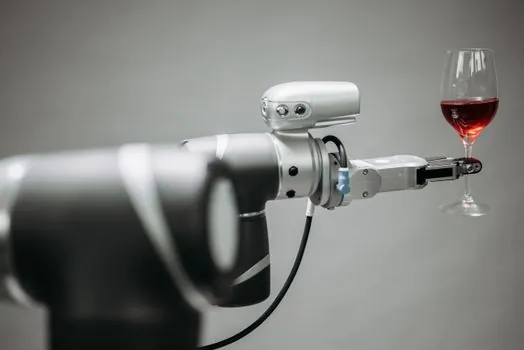
Watch the 2026 cobot PFL (power and force limiting) speed-cap and force-threshold reset covered in Cobot PFL speed limits: 250 mm/s TCP cap, force thresholds, and the 2025 standards reset, since any tightening of TCP speed limits directly compresses the cobot cycle-rate envelope cited above. The next IFR preliminary 2026 results and the 2026 palletizing-robot market sizing will show whether food and beverage stays above 45 percent of demand and whether U.S. installations keep the 2025 11 percent growth trajectory [S3].
For an AGV robot or AMR robot fleet feeding either cell type, the next decision node is end-of-arm tooling standardization: shared gripper frames across cobot and industrial cells cut changeover time and reduce spare-parts SKUs, which is where most 2026 integrator ROI claims are now anchored [S4].