
Specifying a steam separator on a chemical process skid is a mechanical-equation problem, not a vendor preference: maximum saturated steam flow, design pressure, allowable pressure drop, and steam quality at the skid boundary set every downstream line item [S1][S2]. Get the first three wrong and nothing else compensates; get the last one wrong and the entire downstream control loop hunts.
The dominant mechanical types in chemical skid duty are baffle (impingement), centrifugal (vortex), and combination units, with centrifugal designs typically specified for saturated mains above 50 mm nominal bore where velocities exceed gravity-separation limits [S1][S2]. Reference industrial data places the 10,000 fpm (~50 m/s) line velocity ceiling above which a properly sized horizontal pipe no longer behaves as a gravity separator, which is the trigger point for adding a dedicated device [S2].
Flow Rate, Pressure Class, and Pressure Drop
Maximum steam flow rate, minimum steam flow rate, and pressure drop across the separator are the three quantitative inputs a separator selection sheet must carry before any vendor is contacted [S2]. Undersizing reduces separation efficiency; oversizing costs money and adds an unnecessary pressure-loss element on a skid where every 0.1 bar matters to downstream PRV station sizing [S1][S2].
Standard skid pressure classes are PN16, PN25, and PN40 for European skids, mapping to ASME/ANSI 150#, 300#, and 600# flanged bodies in the North American supply chain [S1]. For a 600 PSIG (41.4 barg) saturated steam service, the Eliminator-series specification caps the operating envelope at 650°F (344°C) with a maximum operating pressure of 600 psig across sizes ½" to 2" [S3]. At 2½" and above, the same product line splits into ANSI 150 (150 psig / 565°F), ANSI 300 (300 psig / 650°F), and ANSI 600 (600 psig / 650°F) variants rather than carrying one body across all classes [S3].
Steam Quality Targets and Inlet/Outlet Definitions
Steam quality is defined as the mass fraction of vapor in a saturated liquid/vapor mixture: a value of 100 is dry saturated steam, 95 means 5% entrained liquid, and 0 is sub-cooled condensate [S2]. End users and process applications generally require steam quality at or close to 100%; entrained moisture can cut heat-transfer surface efficiency by 14% or more by thickening the condensate film on the heat-transfer area [S2].
Selection sheets must separately list inlet steam quality (what the upstream header is delivering) and desired outlet steam quality (what the downstream user needs), because the device only has to bridge that delta [S2]. A separator that takes 85% quality up to 99% is a different problem from one taking 98% to 99.5%, and the first case will not be solved by a baffle device regardless of body size [S2].
Orientation, Drain, and Steam Trap Station

Baffle-type separators are mandated to be installed in a horizontal pipe configuration with the drain directly below the line, the drain outlet below the condensate level, and an NPT bottom drain feeding a mechanical constant-flow steam trap [S3]. The Eliminator product specification also calls for a Y-strainer between the separator and the trap to keep particulates out of the trap seat [S3].
Trap sizing on the separator drain follows a clear, size-banded rule: separators up to DN32 take ½" or ¾" traps; up to DN50 take ¾" or 1"; and up to DN350 take 1½" traps [S6]. Trap type follows service pressure: float-and-thermostatic (F&T) units suit low-to-medium pressure, while inverted-bucket or thermodynamic traps are the correct match for medium-to-high pressure separator drains [S6].
Internal Construction, Materials, and 10-Micron Rating
Internal components on industrial separators are typically stainless steel, while pressure-containing bodies are carbon steel to ASME Section VIII Division 1, with welders qualified to ASME Section IX [S2][S3]. For the Eliminator line, the body and end caps are ASTM A106-B carbon steel, the coupling and end connections are ASTM A-105, the baffle is ASTM A 569, and the plug is ASTM A105, all matched to saturated-steam thermal expansion [S3].
Separation fineness is a published spec, not a vague claim: the Eliminator series is rated to extract nearly all moisture and solids above 10 microns, with no moving parts and a published capacity ceiling of 35,000 lb/hr of steam [S3]. For pharmaceutical or food skids where the downstream is a hygienic loop, the body material and internal finish — not just the micron rating — drive the next selection step; users in those cases should treat stainless internals as the floor, not the ceiling [S1].
Saturated-Mains Placement and Adjacent Equipment
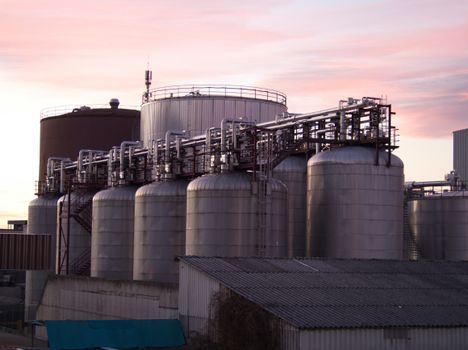
Separator placement on a skid is rule-driven, not stylistic: drip stations belong before temperature-control valves and pressure-reducing valves, with the separator positioned immediately upstream so the control valve never sees entrained water [S3]. A 14% heat-transfer efficiency loss and wiredrawing damage on the control valve seat are the two failure modes the device is being paid to remove [S2][S3].
Other published duty points on the same Eliminator spec sheet include steam mains, hot-air batteries, heat exchangers, sterilizers, radiator feeds, boiler leads, kiln inlets, and compressed-air supply to sensitive instruments, all of which share the requirement for dry saturated gas at the equipment boundary [S3]. For compressed-air instrument supply, the same 10-micron moisture-and-solids rating covers the air-side equivalent of a steam separator on a process skid [S3]. The same moisture-control logic that drives a steam separator on a saturated-steam skid also governs a cyclone separator selection on a gas-phase reactor feed line, so the placement rules transfer with a re-check of density and viscosity.
Comparison of Baffle, Centrifugal, and Combination Designs
Baffle (impingement) separators are the lowest-cost, lowest-efficiency option, suited to small-bore lines and modest quality lifts; centrifugal designs use vortex flow to push droplets to the wall and recover finer mist at higher flow; combination units stack both mechanisms in one body for the widest operating envelope [S2]. On a chemical skid, the comparison reduces to four decision criteria:
Baffle vs centrifugal vs combination on a chemical skid: (1) maximum flow — baffle is acceptable up to a few thousand lb/hr, centrifugal covers the 10,000–35,000 lb/hr band, combination handles cyclic loads and large mains; (2) steam-quality lift — baffle removes gross entrainment, centrifugal targets mist and fine droplets, combination achieves the highest outlet quality on a single body; (3) allowable pressure drop — baffle is the lowest ΔP, centrifugal is moderate, combination is the highest because the device is doing the most work; (4) orientation and footprint — baffle must be horizontal with the drain below, centrifugal can run in either orientation, combination is normally horizontal on a skid [S2][S3].
Who should NOT pick a baffle separator: any skid feeding a turbine, a precision heat exchanger with sub-degree temperature control, or a control valve where seat life is critical — baffle efficiency is lower than the other two types and these services need the higher quality lift only centrifugal or combination designs deliver [S2]. A skid that does not have a true moisture problem, in the sense of properly sized lines under 10,000 fpm with functioning drip-leg steam traps, also does not need a separator at all and adding one only steals pressure drop from the loop [S2].
Failure Modes, Maintenance, and Skid-Integration Limits
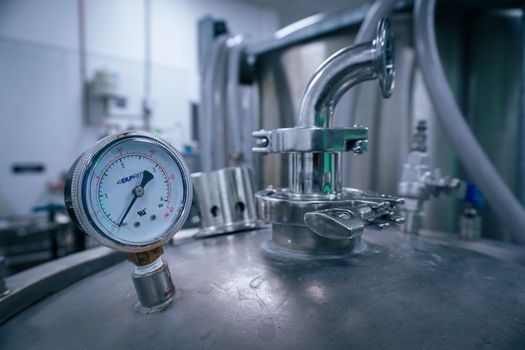
Moist steam in a saturated line is the root cause of water hammer, erosion of turbine internals, corrosion of valve seats, and erratic control-valve and flow-meter readings [S2]. A correctly selected separator addresses all four, but only if the upstream drip-leg stations are functional; a separator on top of a broken drip-leg trap is just a bigger collection sump with no discharge path [S2][S3].
Maintenance load on an Eliminator-class separator is effectively zero between annual trap-station inspections because the device has no moving parts and the body is rated for water-hammer loads [S3]. The trap and strainer on the drain are the only service items, which is why a Y-strainer between the separator outlet and the trap is a hard spec-line item on the Eliminator product sheet rather than an option [S3]. For skid builders sourcing the rest of the rotating and static equipment in the same package, it is worth treating the chemical anchor selection for the separator skid base and the chemical reagent compatibility of any cleaning solvent hitting the carbon-steel internals as part of the same selection matrix.
Track the next two signals before locking the separator purchase: the published saturated-steam flow at the actual operating pressure (not at the line PN rating), and the certified pressure-drop curve at the design flow from the OEM, not the generic catalog number [S2][S3]. If either number is missing on the vendor cut-sheet, the device is not yet ready to be welded into the skid.
For component-level specifications, see steam separator, skid steer loader, and chemical anchor.
Background reading: Magnetic-Drive vs Sealed Centrifugal Pump: Flow Stability Trade-Offs.