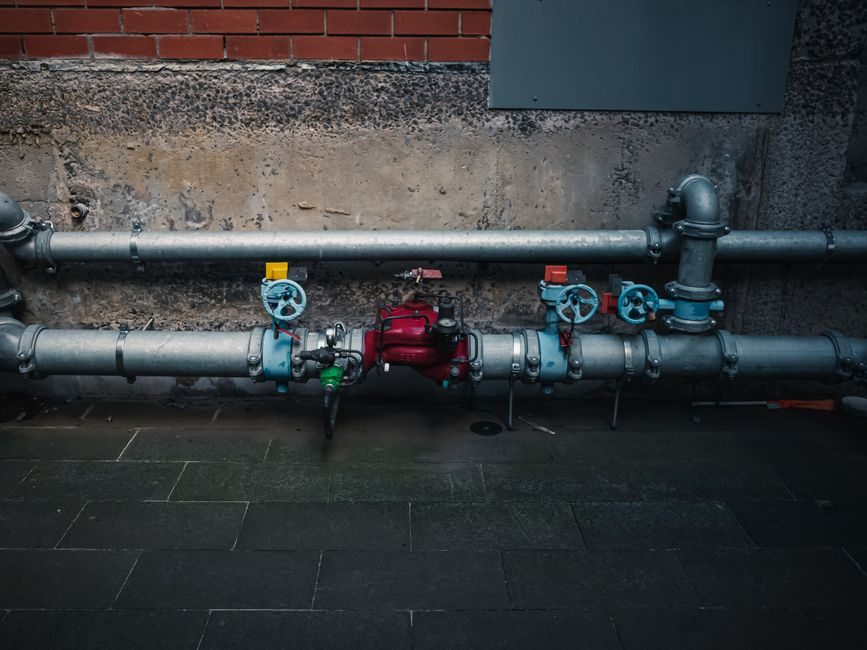
Steel pipe and steel strand sit on opposite shelves of a steel stockist and serve opposite jobs on a job site. Pipe is a hollow section rated for internal or external pressure — fluid, gas, slurry, structural casing — to standards such as API 5L, ASTM A53, ASTM A106 and ASTM A312 [S1][S3][S4]. Steel strand, in the prestressing sense, is a 7-wire cold-drawn cable (typically 6 wires helically laid around a central king wire) used to put concrete into compression, governed by ASTM A416 and the equivalent GB/T 5224 in China [S3].
Both families ship in long lengths and both ride on cut-to-length, custom-fabrication and credit-based supply chains that distributors and mills in the US and China ran through Q2 2026 [S1][S2][S4][S5]. The overlap stops at the reel: one is a pressure boundary, the other is a tension member. For a B2B spec cut, the deciding question is not "which is stronger" but "which load path am I closing" — pressure containment, or post-tensioned tensile reinforcement.
Definition and Scope: Pressure-Boundary Tube vs 7-Wire Tension Cable
Steel pipe is a tubular product manufactured by seamless (hot-pierced billet) or welded (ERW, LSAW, SSAW, spiral) processes, then cut, threaded, beveled or coated per the order [S6][S8]. Welded mills running ERW, galvanized and LSAW lines dominated Chinese export listings in June 2026, with stainless variants in 304/316 and duplex grades offered alongside carbon grades [S2][S7][S8]. The product page on the steel pipe encyclopedia entry groups these under one roof — pressure, structural, conveyance, casing.
Steel strand in the civil sense is a different geometry entirely: seven cold-drawn wires, nominal diameters 9.53 mm (3/8"), 12.70 mm (1/2"), 15.24 mm (0.6") and 17.8 mm (0.7"), twisted under tension to give a uniform lay and a guaranteed minimum breaking strength of 1720 MPa (250 ksi) for 1/2" Grade 270 strand under ASTM A416 [S3]. It is sold on reel, uncoiled at the deck, fed through ducts, stressed by a hydraulic jack, then anchored. The product page on the prestressing strand entry makes the function explicit — a tensile reinforcement element, not a pressure boundary.
Selection Criteria: Five Levers that Drive the Wrong-Cart Decision
Three levers decide whether a buyer should even be quoting both: load type, governing standard, and end-use environment. Pipe is selected on OD × wall × length, on pressure rating (Sch 40, Sch 80, Sch 160, XXS) and on material grade (A53 Gr.B, A106 Gr.B/C, API 5L X42–X70, 304/L, 316/L) [S1][S2][S4][S6][S8]. Strand is selected on diameter, relaxation class (low-relaxation vs stress-relieved), tensile grade (1720 MPa / 1860 MPa), and whether the application is pretensioned (precast) or post-tensioned (cast-in-place) [S3].
Two more levers sit behind those: corrosion protection and certification. Pipe gets anti-corrosion coating (FBE, 3LPE, hot-dip galvanizing) or internal linings; the steel-plastic composite pipe entry covers the bonded-PE variant for water and chemical service [S2][S3]. Strand gets plain, galvanized or epoxy-coated sheathing over the bundle; grease-filled sheaths plus HDPE duct is the standard post-tensioned package [S3]. Mixing these up at PO stage — for example, asking a pipe mill to "send me some 1/2-inch strand" — burns a week of lead time, because pipe mills do not run stranding lines and stranders do not run pilger mills.
Comparison Frame: Steel Pipe vs Steel Strand on Four Decision Criteria
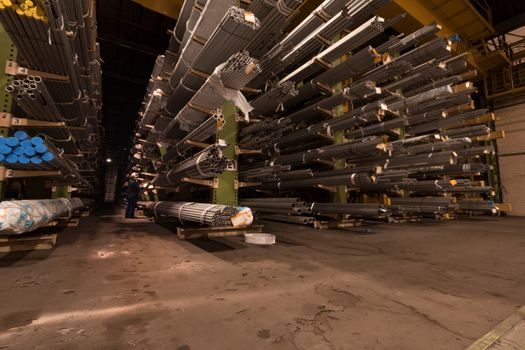
On four decision criteria that drive quote-stage mistakes, the two products diverge cleanly. (1) Load path: pipe carries hoop stress from internal pressure (and column load when used as a pile casing); strand carries axial tensile stress only. (2) Governing standard family: pipe cites ASTM/ASME/API/GB standards for tube; strand cites ASTM A416 / A421 / GB/T 5224 for cable. (3) Diameter range: pipe OD runs 1/2" to 48" and beyond; strand nominal diameters top out near 21.8 mm for the largest PC strand, and lay length is the user-cut length, not a mill stock length. (4) Delivery unit: pipe ships in random or cut-to-length pieces on bunks; strand ships on returnable wooden or steel reels with coil ID typically 1.0–1.1 m, and a 2–3 tonne reel is the standard invoiced unit [S1][S3][S5].
A direct criteria cut: for a fluid line at 6 MPa, spec pipe — A106 Gr.B Sch 40 ERW or seamless, hydrotested, FBE-coated if buried. For a post-tensioned bridge deck, spec 7-wire low-relaxation strand to ASTM A416 Grade 1860, 15.24 mm, with grease-filled HDPE-sheathed bundles inside duct. These are not interchangeable, and an engineer who tries to substitute a steel tube for a tensile element in a slab will see a structural failure, while substituting a strand bundle for a pressure line will see a burst at the first pressure-cycle test. The encyclopedia entries on seamless steel pipe and steel strand lay out the two spec families side by side for cross-check.
Who It Is FOR vs Who It Is NOT For
Steel pipe is the right pick for: oil and gas gathering and transmission (API 5L), process piping in refineries and chemical plants (ASTM A106, A335, A312), water and sewage mains (AWWA C200, ISO 2531 ductile-iron variants excluded), structural piling and casing, fire-sprinkler risers, and boiler tubes [S1][S2][S4][S6]. It is the wrong pick for any application where the load is purely axial tension with no pressure boundary requirement — there, strand or rebar will be cheaper and code-compliant.
Steel strand is the right pick for: pretensioned and post-tensioned concrete (bridge girders, hollow-core slabs, beams, nuclear containment domes), ground anchors and soil nails, rock bolts in tunneling, and stay cables for cable-stayed structures [S3]. It is the wrong pick for fluid service, fire main, or any pressure-rated line. A common misuse site-calls out: a contractor specifies "1/2-inch cable" expecting a flexible wire-rope product, but receives a 7-wire prestressing strand reel that must be uncoiled on a de-tensioning stand, not pulled off a spool. That mismatch traces to a missing ASTM A416 / A421 reference on the PO [S3]. For related rebar-processing context, the rebar cutter vs rebar straightener frame shows how adjacent reinforcement products are sourced and cycled on the same job.
Real Use Cases and Sourcing Notes (Q2 2026)
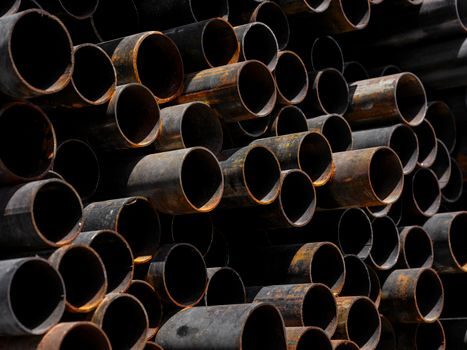
June 2026 distributor inventories in the US still ran cut-to-length and special-order service for ASTM/ASME pipe (A53, A106, A335, API 5L) with credit-account terms, while Chinese mill-export listings pushed ERW, galvanized, SSAW and stainless pipe (304/316) to global B2B buyers [S1][S2][S4][S6][S8]. On the strand side, civil-engineering suppliers such as HANDAN TOPMETAL ran dedicated micropile / soil-nail / anchor strand listings, with 7-wire PC strand in 9.53 / 12.70 / 15.24 mm to ASTM A416 and the GB/T 5224 equivalent, plus accessories (anchors, wedges, couplers, ducts) bundled in the same quote [S3].
Forest-City, NC and Forest-City-adjacent US distributors logged active structural-steel and culvert shipments through the same window, signalling that pressure-boundary pipe and culvert-grade structural pipe remained in steady Q2 demand alongside road and drainage projects [S5]. For a broader B2B steel-source frame, the Top Steel Companies 2026 map covers which mill groups own which pipe vs strand line. The pipe-only spec guide at Steel Pipe Buying Guide 2026 goes one level deeper on standard, grade, tolerance and coating levers for buyers who have already decided they are on the pipe shelf.
Limitations, Failure Modes and Common Pitfalls
Pipe failure modes are dominated by corrosion, weld defects, and over-pressure events — mitigated by NDT (UT/RT on the weld seam), hydrotest, and coating selection. Wall-thickness under-spec on Sch 40 pipe, or substitution of A53 for A106 in high-temperature service above 400 °C, are the two most common engineering-cost mistakes [S1][S4][S6]. The PE-encased steel-plastic composite pipe variant and the standard PE pipe alternative both exist for buried water service, but they do not replace high-pressure line pipe.
Strand failure modes are dominated by corrosion-induced wire breaks, relaxation losses exceeding design (10–12% over 40 years for low-relaxation strand), and anchorage-zone bursting behind the wedge. Epoxy-coated strand and grease-filled sheathed strand are the standard mitigation, and stress-relieved (low-relaxation) is now the default rather than the exception. A common pitfall on the buy side is treating strand as a commodity and skipping the relaxation-class callout, then receiving stress-relieved-only stock that is fine for most jobs but is rejected on a low-relaxation-only spec. The same lead-time loss hits the pipe side when a buyer quotes A106 generic and the mill has only A53 in stock — same nominal OD/wall, different chemistry and test regime, different pressure rating.
Trackable signal into late 2026: monitor whether Chinese mill-export listings add more strand-side capacity (currently dominated by civil-engineering specialists like HANDAN TOPMETAL [S3]) to balance their pipe-export depth, and whether US distributors in Forest-City / North Carolina and similar regional yards expand the structural-pipe and culvert mix relative to ASTM A53/A106 line pipe [S1][S5]. A second trackable signal is the publication of any new revision line on ASTM A416 or GB/T 5224, which would reset the relaxation-class and minimum-breaking-strength callouts for the 2026–2027 buying cycle.