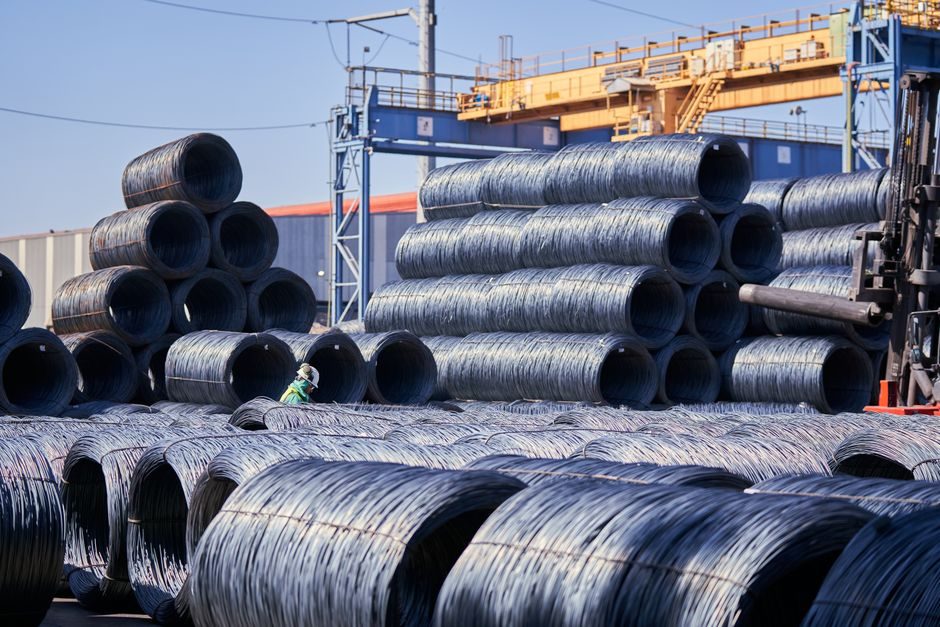
Deformed steel rebar in diameters from 6 mm to 40 mm is the dominant procurement line in 2026, with Chinese mill listings quoting HRB335, HRB400, HRB400E, and Q195/Q235 grades in standard 6 m and 12 m stock lengths and net bundle weights of 1-2.5 m.t. [S1][S8][S9].
Minimum order quantities on the public B2B catalogs start at 1 ton for premium rebar offers and scale to 5-25 tons for mill-direct contracts, with FOB-China quoted prices spanning US$315-488 per ton across surveyed Made-in-China and Okorder listings published between June and July 2026 [S2].
Grade, Diameter, and Standard Coverage
HRB400 to GB 1499.2 remains the baseline procurement grade for Chinese rebar exports, with HRB400E (the seismic-grade, "E" denoting improved through-thickness ductility) the upgraded variant offered on the same diameter range of 6-40 mm [S7][S10]. Theoretical mass per meter scales from 0.222 kg/m at 6 mm diameter to 9.87 kg/m at 40 mm, covering section areas from 28.3 mm² to 1257 mm² on the standard GB weight table [S10].
Cross-listed standards on the same supplier pages include AISI, ASTM, JIS, DIN, SAE, and EN, indicating that the surveyed Chinese mills produce against multiple national bar specifications rather than a single proprietary grade window [S1][S5][S8]. Hot-rolled ribbed surface with dry finishing is the consistent default; epoxy-coated and galvanized variants are offered as line extensions rather than mainline SKUs [S1][S9].
Manufacturing Capacity and Supply Capability
Listed single-supplier supply capability on Okorder reaches 19,865 m.t. per month for the surveyed HRB400/HRB335 hot-rolled ribbed bar SKUs, with payment terms split between TT (telegraphic transfer) and LC (letter of credit) on China-main-port FOB loading [S1]. The Made-in-China directory surfaces 2,000+ rebar manufacturers and 6,000+ rebar product SKUs, with concentration in Shandong and Guangdong provinces among the audited suppliers [S2].
Plant-area figures on the audited supplier pages range from 177 m² for trading-company re-sellers to 2,000+ m² for integrated manufacturer/trader hybrids such as Weixin Steel (Guangdong) Co., Ltd., which carries 628 SKUs across "rebar and round steel bar" alone [S2]. The 19,000+ m.t./month per-supplier capacity figure indicates the upper bound for mill-direct sourcing; for projects drawing more than 50,000 m.t., a multi-mill split is the norm rather than exception [S1][S2].
Price Bands, MOQ, and Lead Time
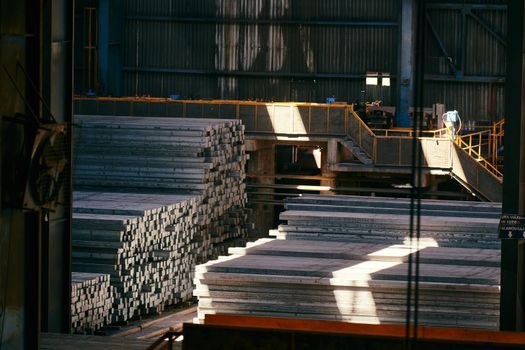
Surveyed FOB-China rebar price bands cluster between US$315 and US$488 per ton in July 2026 listings, with Weixin Steel quoting US$315-320/ton at 1-ton MOQ and Shandong Hongcheng quoting US$408-488/ton at 5-25-ton MOQ [S2]. The 50-170 USD/ton spread on nominally identical HRB400 product reflects (a) mill-versus-trader sourcing, (b) bundled certification (MTC EN 10204 3.1 versus generic MTC), and (c) regional port-of-loading differentials inside China [S2].
Response time on the Made-in-China audited supplier pages is consistently listed as ≤3 hours, with fast delivery promised within 15 workdays for the surveyed Shandong and Guangdong suppliers [S2]. For a procurement team comparing these offers, the practical spec window is 6-40 mm diameter, 6 m/9 m/12 m standard lengths, HRB400/HRB400E grade, and a US$315-488/ton FOB envelope — see also our rebar encyclopedia entry for the full grade-vs-application map.
Certifications and Mill Audits
Chinese mill listings consistently carry ISO 9001, CE, and SGS third-party certification markers, with the surveyed Okorder and Made-in-China pages all referencing at least one of these three schemes on the rebar line [S1][S8][S9]. The CE mark on Chinese rebar is typically the EN 10080 Annex C route for "weldable ribbed reinforcing steel," not the EN 10025 structural-steel CE route, and buyers specifying EU projects should request the EN 10080 certificate explicitly rather than relying on the generic CE logo [S1][S8].
For buyers needing machining-and-assembly of bar stock, separate categories apply: the surveyed suppliers in rebar coupler and rebar threading machine lines cover the mechanical-splice end of the value chain rather than raw bar production. Selecting a rebar mill without selecting the matching splice/accessory line is one of the more common specification gaps in 2026 project tenders.
Sourcing-Channel Comparison: Mill Direct vs B2B Catalog vs Trading Company

Three sourcing channels dominate 2026 rebar procurement from China, each with a distinct cost-versus-risk profile: (1) mill-direct through a manufacturer/factory, (2) B2B catalog (Made-in-China, Okorder) where 1-ton MOQ rebar SKUs from trading companies are common, and (3) integrated manufacturer-trader hybrids [S2][S4]. The Made-in-China company-search filter exposed 1 manufacturer in the "US$10-50 million revenue, 5-50 people" window for the surveyed rebar keyword, indicating the mill-direct supply base at this scale is narrow [S4].
For rebar processing equipment sourcing — bending, cutting, straightening — the supplier map differs from the mill map: dedicated rebar bender and rebar cutter makers run on separate factory footprints with their own price points, and a rebar mill's catalog rarely overlaps with the equipment-maker catalog. A practical RFQ package should split into (a) bar-stock supply, (b) bar-processing equipment, and (c) splice/accessory supply, rather than awarding a single vendor all three lots [S1][S2][S5].
Regional Concentration and Logistics
Surveyed rebar manufacturer and trader listings concentrate in Shandong (Jinan, Handan vicinity), Guangdong (Foshan/Guangzhou), and Shaanxi (Xi'an) provinces, with 15-day fast-delivery commitments from the Shandong and Guangdong clusters [S2]. Handan in Hebei — adjacent to the Jinan cluster — is the historic heavy-rebar heartland of Chinese production, though the surveyed July 2026 Okorder and Made-in-China snapshots do not name a Handan mill explicitly among the top SKUs [S1][S2].
For cross-border procurement, the loading ports remain the China-main-port cluster (Tianjin, Qingdao, Shanghai) under FOB Incoterms, with 1.5-2 m.t. net bundle weight and 6 m/12 m stock length as the default order unit [S1][S9]. Buyers on tight construction schedules should confirm mill-versus-port inventory before locking LC terms, since the 15-day fast-delivery SLA in [S2] applies to in-stock SKUs and not to made-to-order diameters outside the 6-40 mm standard range.
Failure Modes and Specification Pitfalls
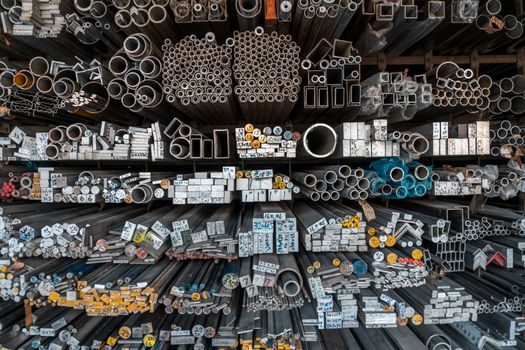
Pull-out failure of plain round bar is the canonical reason for using deformed (ribbed) rebar in reinforced-concrete design, per the surveyed supplier-side technical notes: ribbed bars develop mechanical interlock with the concrete matrix that smooth round bar cannot, and the lack of this interlock is a documented precursor to larger-scale structural collapse [S7][S8][S9]. Specifying a smooth round bar where deformed bar is required — a recurring error on cross-standard project transfers — is the single most expensive rebar mistake at the design stage.
A second recurring pitfall is grade mis-mapping between national standards: HRB400 (GB 1499.2) is not a 1:1 equivalent to ASTM A615 Grade 40, and HRB400E's seismic ductility requirement has no direct ASTM counterpart without explicit supplementary specification [S1][S7]. Buyers moving between Chinese and US project specifications should request the mill test certificate (MTC) per EN 10204 3.1 and verify both yield strength (≥400 MPa for HRB400) and elongation class on a per-heat basis [S1][S10].
Related Industrial Procurement Context
Rebar mill sourcing sits inside a wider Chinese steel-product procurement ecosystem that includes galvanized sheet, structural sections, and stainless coil. For procurement teams running parallel sourcing for galvanized sheet suppliers 2026 the same mill clusters and FOB terms typically apply, and the same Shandong/Guangdong supplier density is observable across both product lines [S2][S3].
For the concrete-side specification rather than the steel-side, the concrete fiber selection reference covers the steel-fiber versus synthetic-fiber decision that often pairs with rebar design on industrial slab pours. The rebar-versus-fiber substitution is partial, not full, and a slab spec'd to either/or rather than both-plus typically under-performs the combined reinforcement design.
Trackable signals for the next 90-180 days: (a) HRB400E mandatory-spec movements in seismic-zone provincial building codes, (b) shifts in the US$315-488/ton FOB band on the Made-in-China and Okorder catalogs, and (c) any new EN 10080 audit disclosures on the audited-supplier pages that would tighten or loosen the CE-mark compliance window for Chinese rebar into the EU.