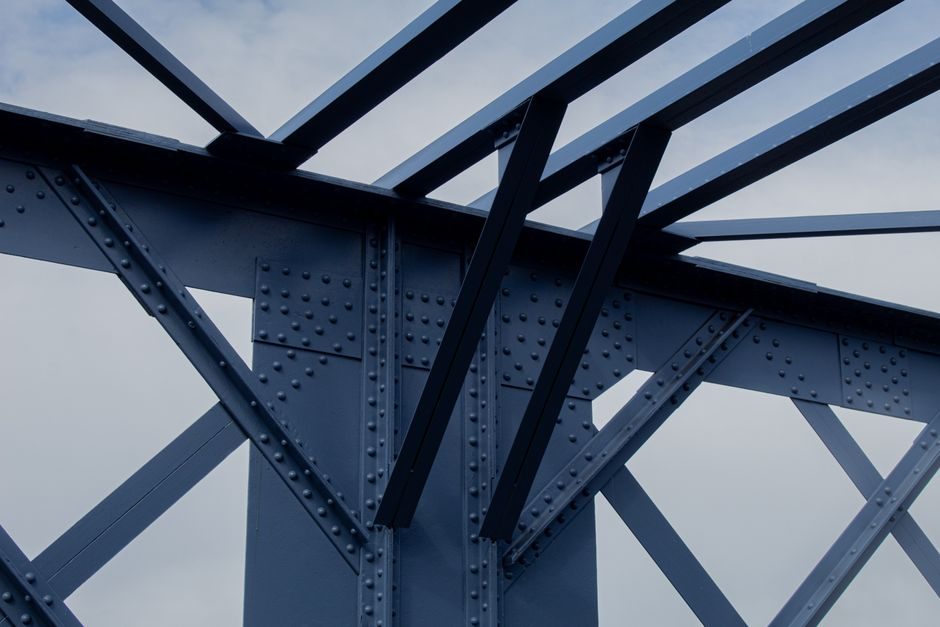
Hot-rolled structural steel sections deliver yield strengths of 235–460 MPa depending on grade (S235/S275/S355/S460 per EN 10025) and a strength-to-weight ratio that concrete cannot match, which is why they dominate multi-storey frames, long-span trusses and industrial portals [S2].
Specifying engineers select steel section type — I-beam, H-column, channel, angle, tee, RHS or SHS — by load path, connection geometry and buckling length, not by catalog price alone; each profile carries a different moment-of-inertia, radius of gyration and welding-access envelope that the engineer has to balance against fabrication cost [S2].
Strength-to-Weight and Fabrication Speed
A standard S355JR UB 533×210×92 kg/m section resists a design moment roughly 3–4× higher than a similarly sized reinforced-concrete beam at one-third the self-weight, which slims foundations and crane picks on site [S2].
Prefabrication off-site cuts site labour hours: a bolted end-plate connection on an H-column can be torqued in minutes, whereas a cast-in-place concrete joint needs formwork, pour time and a 7–28 day cure before the next trade can load it. The 2023 review of thick-section laser welding notes that modern joining lets plate-built box sections compete with hot-rolled heavy sections on throughput once section depth exceeds ~400 mm [S2].
Fire, Corrosion and Ductility Trade-offs
Structural carbon steel loses strength predictably with temperature: at 550 °C the yield strength drops to roughly 50% of its room-temperature value, which is why passive fire protection (intumescent coating, board, spray) is typically added to reach 60–120 minute R-ratings on occupied buildings [S2].
Unprotected mild steel corrodes at 0.1–0.5 mm/yr in rural atmospheres and 1 mm/yr or higher in marine splash zones; galvanizing adds 50–100 µm of zinc that pushes first-maintenance out 20–50 years, but adds line-item cost. The flip side: steel's ductile yield behaviour gives visible deflection warning before collapse, a fail-safe advantage over brittle materials [S2].
Section-by-Section Comparison for Specifiers
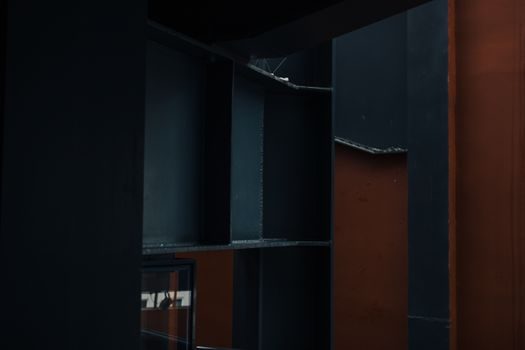
Universal Beams (UB / I-section) give the highest moment of inertia about the major axis per kg, making them the default for simply-supported floor beams. Universal Columns (UC / H-section) have near-equal Ix and Iy, so they resist bi-axial bending on perimeter columns better than UB at the same mass per metre. Parallel Flange Channels (PFC) and rolled angles (L) shine in lattice trusses, gantry stiffeners and bracing members where the load is axial; their low torsional constant (J) rules them out for members loaded in pure torsion. [S1]
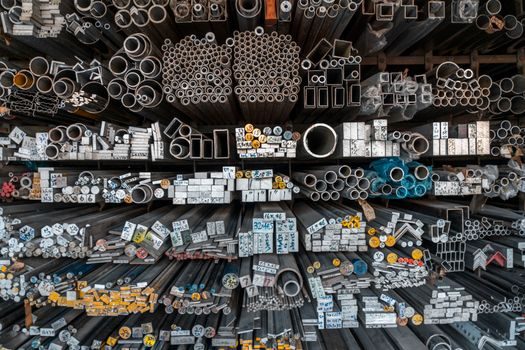
RHS and SHS deliver an aesthetic, closed cross-section with equal Ix = Iy and a clean torsional constant roughly 100× higher than an open channel of the same depth, which is why architects use them for exposed canopies. Tee-sections cut from UB stock are economical for built-up plate girders but lack a bottom flange for moment resistance, so they read as chord members, not main beams. For a spec-driven walkthrough of similar trade-offs on plant equipment, see the engineer's cut on bulldozer advantages and disadvantages.
Material Family Choice: Carbon vs Stainless vs Alloy
Standard structural sections are almost always hot-rolled carbon-manganese steel (S235/S275/S355) or micro-alloyed thermomechanical grades (S355M/ML, S460M/ML) where the rolling delivers fine grain and tighter Charpy values without extra heat treatment. A full taxonomy of carbon, alloy, silicon and stainless families sits in the carbon steel and alloy steel reference pages, while stainless steel sections (typically 1.4404 / 316L) get specified only where corrosion loss or hygiene rules out carbon — at roughly 4–6× the per-kg cost. [S2]
Engineers chasing a tighter material spec on lighter structures also cross-reference silicon steel for electrical laminations (not a structural product, but the same family distinction matters when a spec sheet asks for "low-carbon electrical steel"). For the broad catalog of rolled shapes — angles, channels, beams, hollows — the consolidated steel section reference page is the working starting point, and a deeper read on steel fiber reinforcement covers the concrete-composite half of the same family.
Connection Detailing and Welding Risk
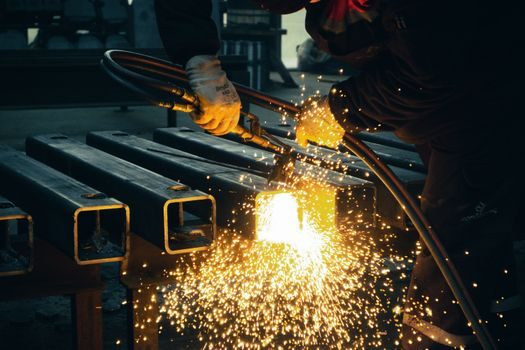
Welded moment connections in thick plates (>25 mm) face the well-documented risk of lamellar tearing, hydrogen-assisted cracking and uneven filler distribution documented in 2023 thick-section laser-welding research; preheating to 100–175 °C, buttering layers and a qualified WPS per EN ISO 15614-1 are the standard mitigation [S2].
Bolted end-plate and fin-plate connections move that risk off the critical path: shop-welded, site-bolted assemblies let erectors work in weather, swap torque for visual inspection, and keep the structural welding to the controlled factory floor. Designers price the bolted option against welded when erection time, inspection cost and field weld-certification overhead are on the table.
Where Steel Section Is the Wrong Choice
For low-rise, low-span farm or storage structures in remote sites, hot-rolled steel is often over-specified: timber or cold-formed steel framing is cheaper per m² even with reduced spans. For highly corrosive chemical or coastal service, stainless or FRP grating out-lasts carbon over the 30–50 year design life despite higher first cost. For very high-temperature service (above ~550 °C) the strength decay drives designers to either fire-engineer the section or switch to a non-ferrous alloy. [S3]
Trackable Signals for Spec Updates
Watch the EN 10025 revision trail for any shift in the S460M/ML impact-toughness floor at -50 °C, and follow Eurocode 3 Part 1-14 amendments on hot-rolled stainless design, both of which would let engineers spec leaner or more durable sections without re-deriving project calcs. [S1]