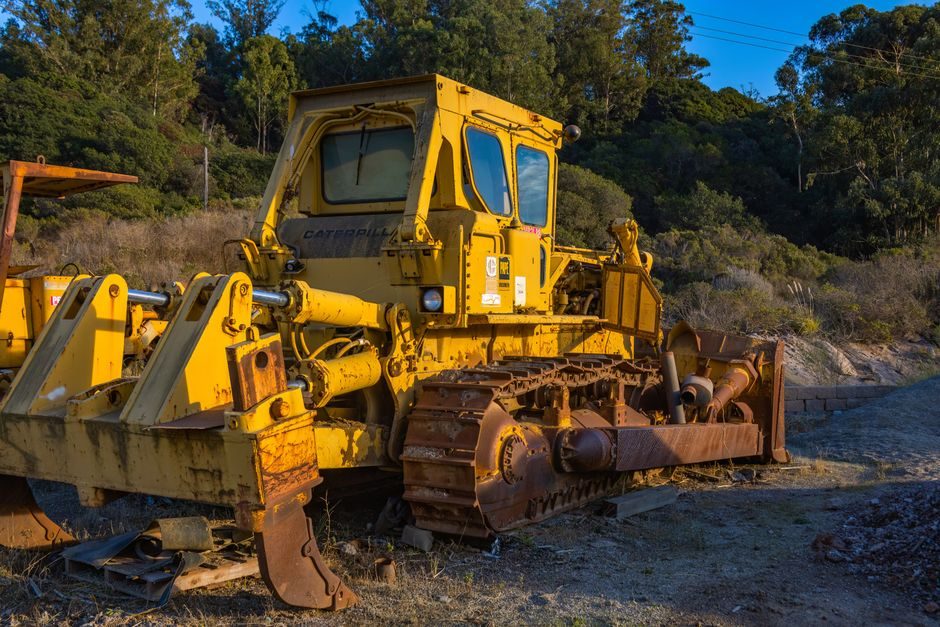
Tracked bulldozers from the 14 t D5/D6 class up to the 100+ t D11 class deliver 100–450 kW at the flywheel and blade-tip forces scaled to machine mass, which is why they dominate land clearing, mine overburden stripping and push-loading scraper fleets on soft or broken ground.
The trade-off is fixed: a bulldozer's value comes from a steel-on-soil interface that is great for traction and rip-and-push work, and terrible for finished-grade mobility, long-distance travel and pavement — the same mass that pushes a 6 m³ rock load is what wrecks an unprepared haul road.
Where the bulldozer blade wins and where it loses
A tracked bulldozer running a semi-U or full-U blade on a 240–360 kW class chassis moves 6–11 m³ per pass in stacked material, with ripper penetration controlled by 1–3 shanks working at adjustable angles to break compacted layers before the push [S2]. The bulldozer class is graded on drawbar pull, not top speed: production-class units walk at 0–12 km/h forward and reverse and roll out at 6–12 km/h on flat ground, with site-to-site transport almost always done on a lowboy because tracks, idlers and final drives are not designed for sustained 40 km/h roading.
For soft, wet or shot-rock conditions the steel track plus blade down-pressure gives a bulldozer a working window an articulated dump truck or motor grader cannot match — but on finished subgrade, asphalt or tight urban sites the same hardware scores the surface, chips curb and chews final-drive oil. A 30 t class machine turning inside a 4 m lane radius is a 30-minute job that a 3 t PLC-controlled compact track loader can do in eight.
Comparing the three blade / chassis combinations
Selection on a bulldozer spec sheet runs on three numbers: flywheel power, operating weight, and blade capacity. Against four decision gates, the standard tracked configuration, the LGP (low ground pressure) variant and the wheeled dozer line up as follows: [S1]
Operating weight: standard tracked 14–38 t; LGP 18–45 t with wider track shoes (610–910 mm vs 460–560 mm); wheeled dozer 12–25 t but with four rubber tyres and no steel track. Ground pressure: standard tracked 55–110 kPa; LGP 28–55 kPa — that is the reason LGP is the only configuration that will work on muskeg, tailings beach or saturated clay without bogging. Top travel speed: tracked 6–12 km/h; wheeled 20–40 km/h, which is the reason wheeled units are specified for road-build corridors and yard dozing where the machine has to reposition itself kilometres at a time. Blade capacity: 4–11 m³ on tracked units, typically 2–3 m³ on wheeled dozers because the lighter chassis cannot push a full U-blade through stacked rock without wheel slip.
OEM guidance for new European chemical-plant and refinery site prep work now layers bulldozer machine-control (factory-fitted GNSS on the blade and ripper) over a pressure transmitter-driven hydraulic load sense, so a 25 t class machine can hold a ±20 mm grade tolerance on a prepared sub-base — a spec the same machine would not have hit ten years ago with a manual ripper lever [S1].
Engine, drivetrain and the operating-cost lines that hurt
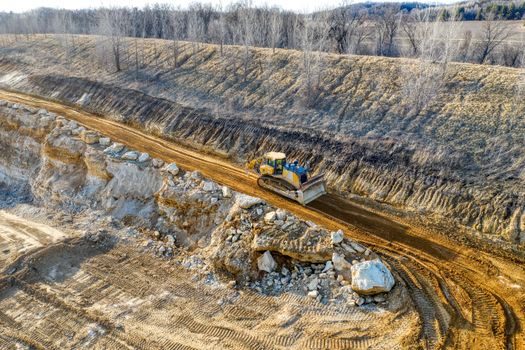
A modern emissions-compliant bulldozer carries a Tier 4 Final / Stage V diesel in the 100–450 kW band, hydrostatic drive on smaller units and torque-converter + powershift on machines above ~150 kW, with diesel exhaust fluid (DEF) consumption running 2–6% of fuel use on the larger engines [S2]. Fuel burn at full drawbar load sits at 25–80 L/h depending on class, and undercarriage life on a 30 t machine in abrasive rock is 2,500–5,000 hours before a full track-group rebuild — the single largest wear line in the TCO, and the reason mine-site planners budget $0.40–$0.80 per moved BCM (bank cubic metre) just for undercarriage.
Push-loading a scraper fleet shifts that arithmetic: a 240 kW push dozer working with two 25 m³ scrapers cycles at 35–55 seconds per load in good material, which is the production line that justifies a tracked dozer's capital cost on a mine or motorway earthworks job, and the same line that makes it a money-loser on a 5,000 m³ car-park cut where the flow meter-calibrated water truck is the constraint, not the push machine.
Limitations, failure modes and the job sites to avoid
Three failure modes drive most of the pain on a bulldozer: track stretch on a machine that has been roading long distances at speed, final-drive planetary failure when the machine is repeatedly shock-loaded on rip-and-push cycles, and blade C-frame cracking at the weld where down-pressure transitions to lift. Each maps to a specific operating rule: a tracked dozer is a sub-1 km radius machine, ripping should be done in second-gear low-range, and the operator should never use the blade as a pry bar to pop a buried boulder — the C-frame and trunnion absorb about 40% of machine weight, and a hard shock load is what kills them. [S2]
Job sites to avoid with a standard tracked configuration: finished asphalt or concrete, narrow urban corridors under 6 m, slopes above 30° on side-long work, and any environment with buried utilities mapped below 0.5 m because the ripper does not have a depth-only mode that overrides the operator input. For the last case the correct machine is a hydrostatic mini-dozer with a 1.0–1.6 m blade width, not a 30 t class unit with a 3.9 m semi-U, and the same logic applies in industrial valve yards, refinery pipe racks and rail-trenching work where the ground between bays is the load, not the obstacle.
Standards, sourcing and the 2026 spec sheet
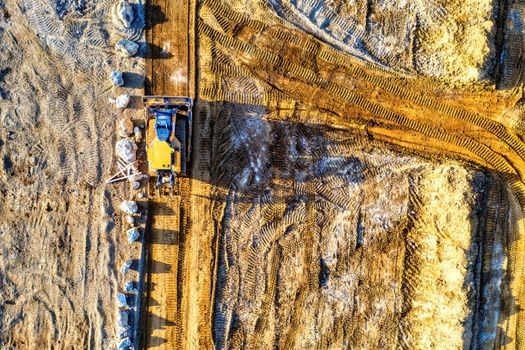
OEM specification sheets now publish ROPS/FOPS certification to ISO 12117-1:2022 (the standard governing falling-object protective structures on tracked construction equipment), SAE J1346 flywheel-power ratings, and sound-power levels to ISO 6395 [S2]. Aftermarket ripper shanks, cutting edges and end bits typically come in 200–400 HB boron steel for the centre blade and 400–500 HB for the end bits that see the abrasive wear, with the inside of the bowl in 450 HB for high-impact rock service — those grade callouts are what buyers should pin into the spec, because they are the line items that decide blade life between overhaul.
For 2026 fleet planning, the signal worth tracking is the roll-out of factory-fitted machine control (3D GNSS on blade and ripper, IMU on the cab) as a no-cost option on 150 kW and up, and the parallel build-out of LGP variants for grid-scale solar and wind-farm civil work where ground-pressure limits are written into the EPC contract — the Wheel Loader Installation Guide covers the receiving gates that also apply to dozer delivery, and the Die Casting Machine Advantages and Disadvantages piece runs the same pros-and-cons format for a different fixed-asset class.