
Renovation work almost never starts on a clean sheet, and that is exactly why steel strand selection goes sideways more often than it should. A 1×7 guy strand, one core wire wrapped by six outer wires, behaves like a rigid bar; a 6×19 or 6×37 wire rope, multiple strands helically laid over a central core, behaves like a flexible spring [S1]. Specifying the wrong one is a load-path mistake the building will remember for the next 30 years.
For renovation budgets, the practical decision tree is short: static tension member, or member that runs over sheaves, through rigging, or around a drum? The first case wants steel strand in a 1×7 construction. The second case wants multi-strand wire rope. Diameter, coating class, and grade are then selected against the actual working load, not the catalogue headline number.
Construction Defines Duty: 1×7 vs 6×19 vs 6×37
A 1×7 strand is the canonical guy-strand architecture: one straight king wire, six outer wires, no moving parts inside the section. It is intentionally rigid and low-stretch, which is exactly what a renovated tower guy, a roof tie-back, or a bridge-cable stay needs when consistent tension over decades matters more than bendability [S1].
Wire rope constructions 6×19 and 6×37 trade that rigidity for fatigue life over sheaves. The first number is the strand count, the second is the wire count per strand; more, finer wires give more flexibility and more contact-area over a drum, at the cost of higher stretch and lower abrasion tolerance per wire. 7×7 and 7×19 sit between these two, with 7×19 commonly cut for aircraft-cable and rigging service where small-diameter flexibility matters [S2]. For renovation work that involves any new saddle, sheave, or redirect, the strand count decision effectively decides the cable.
Galvanizing Class, Coating Weight, and Corrosion Exposure
For renovation sites, the zinc coating usually does more for service life than the grade of wire underneath. Hot-dip galvanizing lays a thicker, more sacrificial zinc layer than electro-galvanizing, and the extra thickness matters in any outdoor, humid, or mildly corrosive environment; the coating protects the steel cathodically even where the surface is scratched [S2].
Class A, B, and C coating weights on prestressing strand and guy strand follow ASTM A475 conventions, with Class C carrying the heaviest zinc mass for the most aggressive exposure. A coastal façade retention, a chemical-plant walkway upgrade, or a rooftop fall-arrest anchor all justify Class A at minimum. Indoor structural retrofits in dry service can usually accept electro-galvanized 7×7 to control cost, provided the cable is not in a corrosive atmosphere or in contact with dissimilar metals that drive galvanic attack.
Breaking Strength, Working Load, and the 2.5×–3× Rule
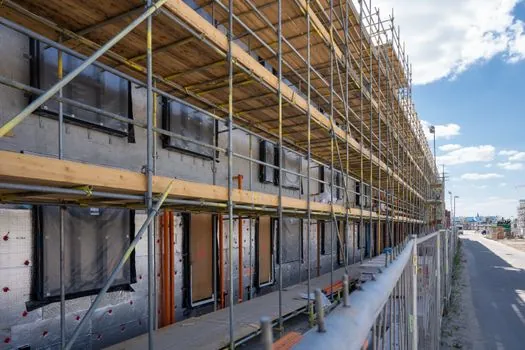
Galvanized steel cable is commonly produced from roughly 1/16 inch up to over 2 inches in diameter, with breaking strengths tailored to specific working loads [S2]. The catalogue minimum breaking strength (MBS) is the failure load of a new, defect-free cable in a laboratory pull, and it is not the working load. Field practice on guy strand and static tension members is to limit working load to roughly one-third of MBS, which embeds a 3:1 safety factor; for life-safety rigging, dynamic lifting, or personnel-carrying systems the safety factor climbs toward 5:1, and many specifiers retire 2.5:1 designs outright in favour of 3:1 even on routine lifts.
For renovation, the first arithmetic step is therefore: required working load × safety factor = required MBS. From there, the engineer picks the smallest standard diameter whose rated MBS meets or exceeds that number, then checks that the selected cable's weight per metre is acceptable for the existing anchor, since adding 0.3 kg/m by stepping up a diameter can overload a corroded anchorage that nobody planned to replace. Renovation almost always exposes legacy anchor under-capacity, and the cable selection has to be paired with an anchor check, not treated in isolation.
Termination Hardware Is Not a Free Choice
Construction dictates the hardware, and the wrong hardware quietly turns a good cable into a field-failure waiting to happen. 1×7 guy strand terminates in formed-eye anchors, dead-end grips, or big-grip dead-ends sized to the strand diameter; multi-strand wire rope terminates in swaged sockets, mechanical splice fittings, or wire-rope thimbles with cable clips [S1].
For renovation, the practical rule is to match the termination to the cable class. Mixing a wire-rope clip on a 1×7 guy strand under-tensions the outer wires and slips under cyclic load; using a guy-strand dead-end on a 6×19 rope crushes the inner strands and breaks wires at the mouth of the fitting. When a renovation has to interface with legacy hardware already cast into the structure, that constraint frequently drives the cable choice backwards, the engineer picks the cable that fits the existing anchor, rather than picking a preferred cable and forcing new anchors into an old structure.
Renovation-Specific Pitfalls: Creep, Corrosion, and Hidden Anchor Rot
Three failure modes dominate renovation strand work. First, sustained static load on a multi-strand wire rope where guy strand was originally installed: the rope creeps, the installation goes slack, and the engineer chases tension for years. Second, mixed metals at the anchorage: a new galvanized cable on a black-steel anchor in a wet environment eats the anchor long before it eats the cable, so the inspection has to include the anchor metallurgy, not just the strand. Third, hidden corrosion at the contact zone: a guy passing through a masonry wall or a steel sleeve traps moisture and runs the zinc layer out in months. [S1]
Spec-first practice on renovation is to pull a short sample from any existing strand being replaced, measure the remaining wire diameter against nominal, and compare zinc coating thickness against ASTM A475 Class A minimum. Where the existing strand is being retained and re-tensioned, the same checks apply before any new load is added. A renovated structure with new cladding, new roof-top equipment, or new fall-arrest loading can easily push an old guy strand past the load it was sized for, and the strand does not get a vote.
Material Family Context: Strand vs Alloy Wire vs Stainless
Carbon steel strand with a zinc coating is the default for almost every renovation budget because it delivers high tensile strength at the lowest cost per metre, and the galvanizing carries the corrosion duty in moderate environments [S2]. Stainless steel strand enters the picture only when the service environment defeats zinc, salt-water immersion, chemical splash, or food/pharmaceutical wash-down, and even then stainless is usually a 1×7 or 7×7 construction to keep creep low. Alloy steel and silicon-steel wire products are not typical guy or wire-rope materials; they belong in spring, electrical-lamination, and high-fatigue mechanical duty, and substituting them into a structural strand is a category error. Picking the right family is therefore step one: carbon-steel galvanized for general renovation, stainless for corrosion-aggressive service, and the alloy and silicon-steel families off the table for this duty.
Selection Criteria Compared: Three Cable Options on Five Variables
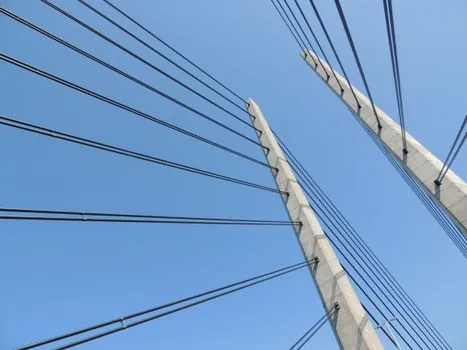
For a renovation specifier, three options cover most of the decision space: 1×7 galvanized guy strand, 6×19 or 6×37 galvanized wire rope, and 7×7 or 7×19 stainless wire rope. Lining them up against the variables that actually drive the purchase: [S1]
1×7 galvanized guy strand: lowest cost per metre, lowest stretch, highest rigidity, simplest terminations (formed-eye, big-grip), poor fatigue if bent over a sheave, zinc-driven corrosion life. Best fit for static guy, mast stay, roof tie-back.
6×19 / 6×37 galvanized wire rope: moderate cost, moderate stretch, designed for sheaves and drums, swaged-socket terminations, good general-purpose flexibility. Best fit for rigging, crane reeving, suspended-platform retrofit on a façade.
7×7 / 7×19 stainless wire rope: highest material cost, lowest corrosion concern, moderate flexibility, requires stainless hardware to avoid galvanic mismatch. Best fit for coastal façade retention, food-plant overhead, or chemical-area retrofit where zinc fails.
Two decision criteria usually eliminate two of the three quickly. If the cable runs over a sheave, 1×7 drops out. If the cable sits in a dry indoor static-tension role, stainless drops out on cost. What remains is the right answer, paired with the correct termination and the correct safety factor on working load.
Trackable signals for the next planning cycle: ASTM A475 coating-weight compliance certificates on every reel, mill test reports that report actual MBS rather than nominal, and a documented anchor-capacity check for every existing connection that is being reloaded. A renovation that captures all three is one a maintenance team can sign off without scheduling a re-tension visit in 18 months.
This topic is covered further in Safety Light Curtain Selection for Welding Operations: 2026 Spec Guide.