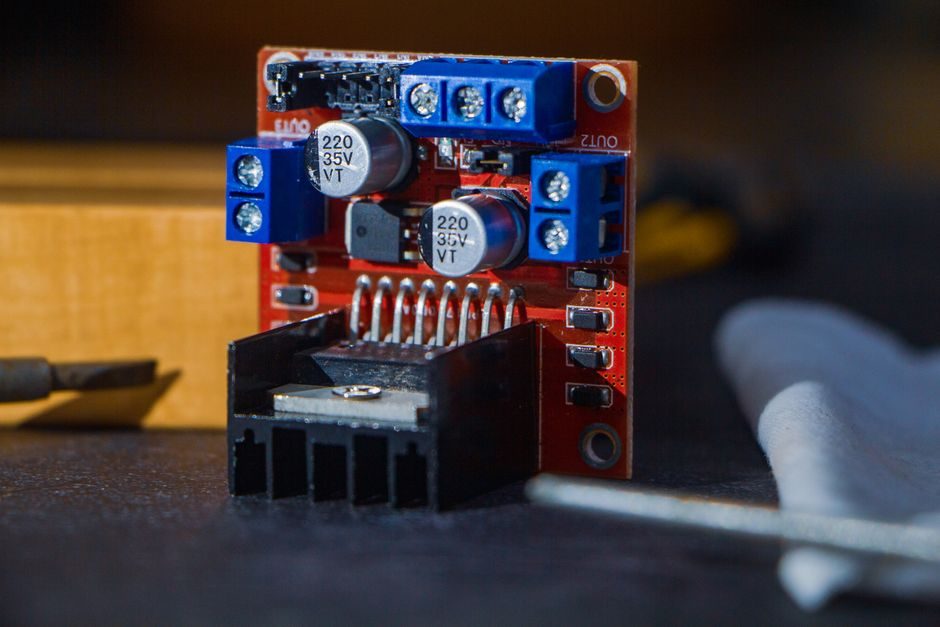
A stepper motor and a stepper drive are not the same component: the motor is a permanent-magnet or hybrid electromagnetic actuator that advances in fixed angular increments, while the drive is the power electronics unit that synthesises the stator excitation waveforms, sets phase current, and accepts step/direction or pulse-train commands from the controller [S2][S3].
Specifying them together is what matters. A 2-phase NEMA 23 or NEMA 34 frame motor paired with a microstepping drive accepting 24-80 V DC bus and 1.5-7.0 A phase current is the dominant mid-power 2026 build pattern for CNC, 3D-printer, dispensing, and glue-spray machinery, per current OEM product lines [S5][S6].
Stepper Motor: Rotor, Stator Windings and Step Geometry
The MathWorks Simscape Stepper Motor block models a permanent-magnet rotor with two wound stator windings, and the documentation explicitly notes that motors with a centre tap on each winding should be modelled as Unipolar Stepper blocks instead [S2]. A small step size — typically 1.8° mechanical for a 200-step full-frame motor, or 0.9° for a 400-step frame — is produced by a toothed rotor with alternating north and south poles [S2].
Permanent-magnet stepper motors accept three operating modes documented in the same block: full-stepping, half-stepping, and microstepping [S2]. Full-step moves the rotor one full mechanical step per command, half-step alternates phase energisation to halve the increment, and microstepping subdivides each full step into 1/8, 1/16, 1/32, or 1/256 increments using sinusoidal current shaping in the drive [S3]. Microstepping does not increase absolute positional accuracy proportionally to subdivision count — mechanical detent torque, load friction, and resonance band still bound the practical resolution.
Stepper Drive: Power Stage, Current Control and Command Interface
The drive is a switching amplifier with three functional blocks: an AC-DC or DC-DC power section that establishes the bus voltage, an H-bridge output stage per phase that commutates the stator windings, and a logic/sequencer that converts controller commands into phase-current references [S3]. Bipolar microstep drives are the dominant 2026 form factor, including direct-from-mains units that accept 110-230 VAC and rectify internally to a high-voltage DC bus [S1].
Common command interfaces in the 2026 supply market are step/direction (step+DIR pins), CW/CCW pulse mode, and serial protocols such as RS-485 Modbus or CANopen on higher-end units [S3][S4]. Input voltage for low-voltage DC drives commonly lands at 12-48 V DC for NEMA 17 applications, while NEMA 34 and NEMA 42 builds are routinely specified with an 80 V DC bus and per-phase current settings in the 3-7 A range, as illustrated by the Geckodrive GR214V at 80 V input [S6] and the Leadshine 3DM883 three-phase drive listed in the same drive category [S6].
Selection Criteria: Torque, Speed, Microstep Resolution, Bus Voltage
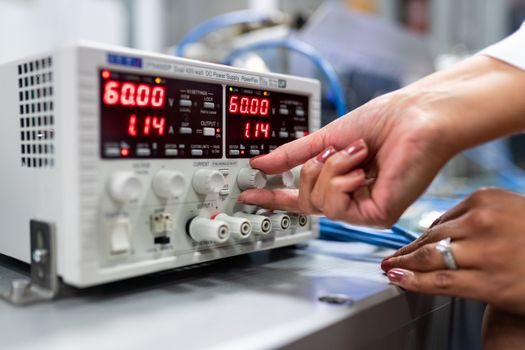
Four engineering criteria drive the 2026 selection. Holding torque is the static torque the motor delivers with rated phase current energised and is the first number to fix from the load-inertia calculation. Inductance per phase sets the maximum usable step rate at a given bus voltage, because the L/R time constant limits current rise time into each winding. Microstep resolution is selected on the drive, not the motor — the same NEMA 23 frame can be driven at full-step, 1/8, 1/16, or 1/32 microstep depending on the drive's current-shaping capability [S3][S4]. Bus voltage on the drive should be at least 10-20× the motor's rated phase voltage to maintain current regulation at high step rates.
Command interface is the second filter. A controller that outputs only step/direction pairs pairs cleanly with a step-direction drive; a CANopen master will demand a drive with a CANopen slave stack, which typically costs 2-3× a comparable step/direction unit. The MATLAB Stepper Motor Driver block models the step-direction case with two pulse trains, A and B, and an ENA enable threshold, which is the canonical signal set engineers see on the controller side [S4].
Comparison Table: Common 2026 Stepper Drive Build Profiles
Three drive tiers dominate the 2026 mid-power market. Entry-level DC-bus drives for NEMA 17 (e.g. 12-36 V DC, 0.5-2.0 A phase, 1/32 microstep, step/direction only) suit 3D printers and small-format CNC. Mid-tier units such as the Leadshine DM860H cover NEMA 34 with 24-80 V DC, 2.0-7.2 A phase, 1/16 to 1/256 microstep, and optical-isolation signal inputs [S5]. High-voltage direct-from-AC units like the R.T.A. X-PLUS B4.1 accept 110-230 VAC mains input and target low-noise, low-vibration precision machinery [S1].
The trade-off is explicit: higher bus voltage gives better high-speed torque (because current rise time into the winding inductance falls), but it also increases the drive's EMI footprint and demands more aggressive decay-mode management. For low-noise applications, drives with sinusoidal microstep current shaping and configurable mid-band resonance damping — such as the X-PLUS B4.1 — are specified instead of basic constant-current chopper units [S1]. The same motor can sit on any of these drives, but the system torque-speed curve shifts substantially with bus voltage and current setting.
Use Cases, Limits and Common Failure Modes
Stepper systems fit applications with a defined position set, low-to-medium speed, and open-loop control. CNC Z-axes, syringe dispensing, glue-spray valves, label cutters, and 3D-printer extruders are the canonical 2026 use cases, matching the supplier product lines published in the past quarter [S5]. Open-loop positioning is acceptable because missed steps show up immediately as a position error in a fixed-cycle machine, and the operator re-homes.
The two hard limits are resonance band and thermal derating. Every stepper has a mid-speed resonance where torque drops sharply; a well-tuned drive with microstep smoothing and acceleration ramping pushes this band out of the operating envelope. Continuous current is a thermal limit, not a peak-current limit, and the drive's RMS current setting must be matched to the motor's continuous-rated phase current, not the peak. Running a 4 A motor from a drive set to 7 A peak will overheat the winding within minutes, with no fault indication on entry-level chopper drives [S3].
Standards, Sourcing and 2026 Market Signals
No single IEC or ISO standard governs the stepper motor/drive pair as a unit; instead, the relevant certifications are the motor's insulation class (Class B 130 °C or Class F 155 °C are the most common frame ratings), the drive's CE/EMC conformity under EN 61800-3 for adjustable-speed electrical power drive systems, and any application-specific standards such as UL 508A for industrial control panels. Buyer-facing verification in 2026 leans on the supplier's published phase-resistance, phase-inductance, and rotor-inertia data, not on a single governing standard number. [S1]
Two 2026 sourcing signals stand out. First, Chinese OEM supply at the NEMA 23/34 tier is dense and price-competitive — Shenzhen Zonhone Huarui alone lists the CF3065D, DM860H, and a potentiometer-speed-control switch drive in a single supplier page [S5]. Second, the high-end tier is consolidating around direct-from-AC microstep drives with sinusoidal current shaping, where the 110-230 VAC mains input removes the external DC supply and simplifies cabinet wiring [S1]. For buyers cross-specifying a complete motion axis in 2026, the stepper motor and stepper drive should be sized together against torque, bus voltage, and command interface before any brand is selected. Related motion categories such as servo drive become the alternative when closed-loop feedback and dynamic following error are required. Trackable signals over the next two quarters: continued NEMA 23/34 price compression at the China OEM tier, and a wider roll-out of CANopen/EtherCAT-capable stepper drives into the entry-level price band.
For related coverage, see V-Ribbed Belt vs Timing Pulley: Spec Cut for Power Transmission Buyers.